





















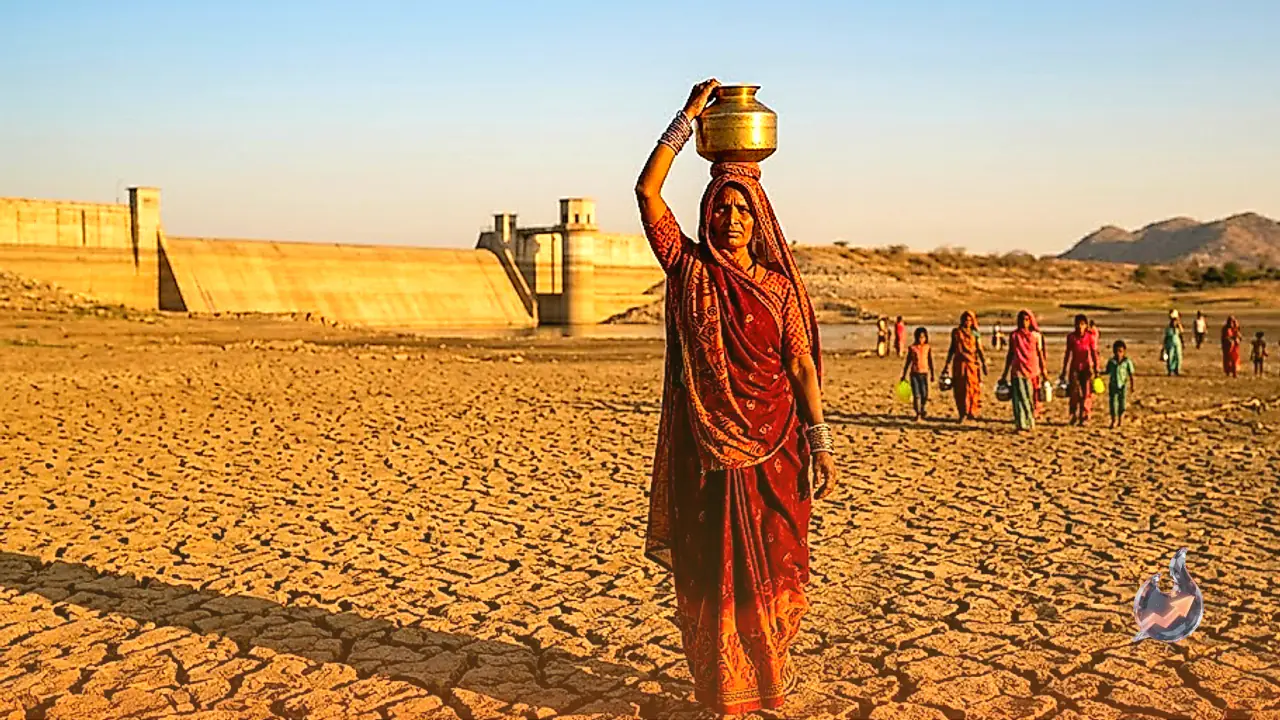

Weeks after the monsoon officially arrived in the arid state of Rajasthan, the region is staring at a deepening water crisis as its primary reservoirs continue to dry up. For a state historically vulnerable to drought, these water bodies serve as the absolute lifeline for both sprawling urban populations and extensive agricultural belts. While rainfall activity saw a slight uptick on July 21 and 22, the increased showers have entirely failed to translate into meaningful inflows. The situation on the ground has become extremely critical, with hundreds of large and small dams completely parched and overall water levels plummeting drastically compared to the previous year.
Massive Drop in Water Levels and Depletion Rate
The volume of water lost from the state’s reservoirs over the past year has not been replenished even fractionally during the current rainy season, creating a massive deficit that threatens to disrupt daily life. According to official data, as of July 21, the 693 dams across Rajasthan hold merely 45.32 percent of their total storage capacity. This marks a steep and alarming decline from exactly a year ago, when these same water bodies were filled to 68.49 percent of their capacity on July 21. Statistics reveal that the combined holding capacity of all these reservoirs stands at 13,029.09 million cubic meters. However, the present water availability has shrunk to a worrying 5,904.30 million cubic meters. Adding to the widespread concern, instead of registering an increase during the monsoon, the state actually recorded a further depletion of 3.12 million cubic meters in its water storage within the 24 hours leading up to 8 AM on July 21. This rapid drop during the peak recharge season underscores the severity of the crisis.
Severe Regional Disparities in Water Storage
A geographic breakdown of water availability across the state reveals stark inequalities, with certain regions facing imminent drought conditions. The Kota zone currently maintains the most comfortable buffer, with its reservoirs holding 56.20 percent of their capacity. This is followed by the Jaipur zone at 47.11 percent, the Banswara zone at 45.36 percent, and the Udaipur zone at 36.51 percent. Conversely, the situation in other regions is rapidly deteriorating into a full-blown emergency. Dams in the Bharatpur zone have dwindled to just 25.45 percent capacity. Meanwhile, the western Jodhpur zone remains the worst hit across the entire state, with its water storage collapsing to a mere 17.50 percent. For communities and farmers in these severely depleted zones, the lack of stored water poses an immediate threat to agricultural livelihoods and daily domestic needs, leaving millions anxiously hoping for heavy rain.
Major Reservoirs and the Capital's Lifeline
When evaluating the 23 major dams that form the vital backbone of the state's water infrastructure, the average storage currently sits at 56.78 percent. A few rare exceptions exist, such as the Morel dam, which has achieved 100 percent capacity, and the Kota Barrage, which is nearly full at 97.42 percent. The Rana Pratap Sagar dam is also holding steady at 66.14 percent capacity. However, there is growing anxiety surrounding the Bisalpur dam, a critical lifeline that quenches the thirst of the capital city Jaipur and numerous surrounding urban centers. The Bisalpur reservoir currently holds 66.14 percent of its capacity. Unlike the previous monsoon season, which saw massive inflows causing the dam to overflow three separate times, the current season has brought absolutely no significant fresh water into its catchment area. Meanwhile, Jaipur’s historic Ramgarh dam remains entirely bone-dry, continuing a long-standing pattern of desolation. Nearby secondary reservoirs are faring no better, with Chhaparwara holding a meager 15.31 percent and Kalakh Sagar practically exhausted at 1.70 percent capacity.
Hundreds of Dams Completely Empty
The most alarming takeaway from the state's hydrological report is the sheer number of reservoirs that have completely failed to capture any runoff. Out of the 693 monitored dams across Rajasthan, a staggering 283 are entirely empty, without a single drop of water remaining. Another 403 dams are only partially filled, leaving a paltry seven reservoirs that have reached their full storage limits. Even more concerning is the fact that these seven full reservoirs owe their status not to the current monsoon showers, but strictly to leftover water conserved from the previous year's abundant rainfall. Despite the monsoon technically being in an active phase across the country, this massive localized shortfall highlights an urgent and desperate need for heavy, sustained downpours in the immediate future. If the weather systems do not intensify rapidly to generate substantial runoff, Rajasthan could face an unprecedented escalation in its ongoing water crisis, threatening both drinking water supplies and the crucial upcoming agricultural sowing season.