






















Archival documents and administrative records from the princely state era serve as valuable windows into the governance structures, linguistic traditions, and fiscal systems of their time. In Bikaner, Rajasthan, an exceptional document dating back more than a century has captured widespread interest among historians and heritage enthusiasts. Dating to the year 1907, this rare financial instrument is approximately 119 years old and directly connected to the sovereign monetary operations of the erstwhile Bikaner State. What sets this artifact apart from ordinary historical records is its extraordinary physical dimension, making it a prominent highlight among archival discoveries.
The preserved paper belongs to the private collection of heritage collector Bharat Bhushan Gupta. Kept carefully over decades, the document represents the high administrative procedures of Bikaner's princely court. Its grand size, period handwriting, and distinctive royal insignias make it an intriguing object of study for researchers documenting pre-independence fiscal practices.
Bilingual Inscriptions and Departmental Designations
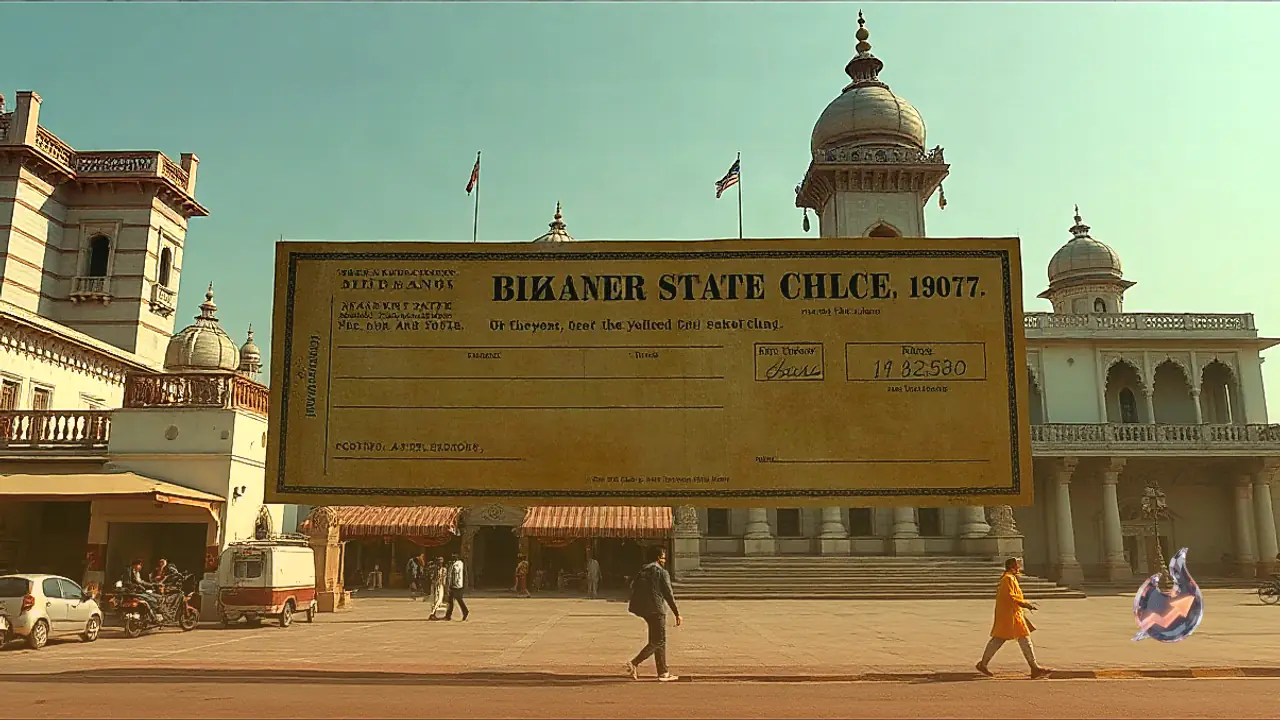
A close inspection of the cheque reveals a fascinating blend of languages and official protocols typical of the period. At the top of the paper, the territory's identity is printed in English as “Bikaner State”, flanked in Hindi by the title “Shri Bikaner Darbar”. Reflecting the traditional auspicious conventions of royal documentation, the phrase “Shri Ramji” is prominently visible across the upper section. This confluence illustrates how traditional cultural invocations coexisted alongside formal bureaucratic procedures.
The lower section of the document carries authoritative institutional credentials confirming its official stature. Marked explicitly with “BY ORDER”, the document bears formal titles including “SECRETARY, FINANCIAL DEPARTMENT, MAHKHMA KHAS” alongside “ACCOUNTANT GENERAL”. The presence of Mahkhma Khas, the supreme executive authority of the princely state, alongside the financial department establishes that this instrument was not an individual private transaction. Instead, it was an executive treasury draft utilized for governmental disbursements within Bikaner State's administrative machinery.
Extraordinary 16x12-Inch Dimensions and Historical Context
The most visually striking feature of this archival paper remains its physical proportions. Collector Bharat Bhushan Gupta noted that the cheque measures approximately 16×12 inches. Routine financial instruments during that era were generally far more compact, making these dimensions quite anomalous. Because of this monumental scale, Bharat Bhushan Gupta considers it to be the largest recorded cheque associated with the Bikaner State known to date.
Nevertheless, establishing a formal historical benchmark would require rigorous comparative analysis with surviving archival files, records of contemporary banking institutions, and other princely treasuries from the early twentieth century. Even without an official comparative audit, its sheer presence stands as a remarkable physical witness to specialized bureaucratic drafting traditions.
Handwritten Entries and Preservation of Administrative Seals
Beyond its dimensions, the document reflects the precise clerical calligraphic traditions of the early 1900s. Crucial particulars such as the issue date and transactional monetary figures were meticulously entered by hand. Official endorsements, signatures of state functionaries, and stamped seal impressions confirming administrative clearance are distinctly intact across the surface.
Although time has naturally aged the parchment, the penmanship, royal stamps, and formal text remain clearly legible after more than a century. In contrast to modern bank cheques that measure only a few inches for automated clearing, this expansive 1907 artifact preserves the physical scale and craftsmanship of imperial administration. It provides a unique lens into Bikaner State's financial machinery, bookkeeping practices, and regal bureaucratic heritage.