





















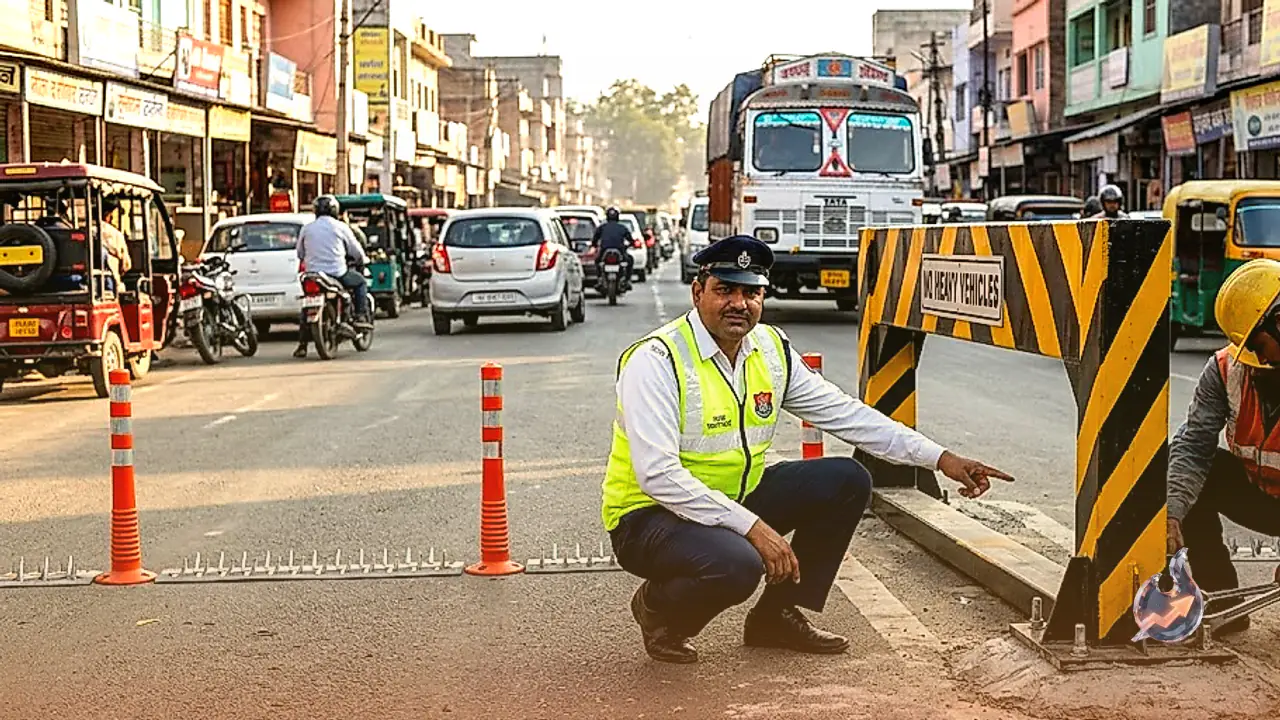

Traffic authorities in Sikar, Rajasthan, have formulated an extensive operational plan aimed at permanently resolving chronic gridlock and regulating heavy vehicle movements across the city. Scheduled for full implementation starting September, this initiatives integrates specialized infrastructure upgrades designed to streamline daily commuting. The master plan focuses on installing height barriers, embedded road spikes, and lane delineators across major traffic corridors. Traffic in-charge Manoj Bhatiwad confirmed that the overarching objective of this deployment is to restrict large commercial vehicles from invading central city streets while maintaining smooth vehicular movement along primary arteries.
Heavy Vehicle Ban and Modern Infrastructure Engineering
The unrestricted movement of heavy freight carriers through Sikar's narrow urban lanes has long been a primary catalyst for severe traffic bottlenecks. To address this structural vulnerability, traffic police and civic administrators are upgrading physical road infrastructure. Under the new guidelines, commercial vehicles exceeding designated height thresholds will be systematically blocked at perimeter access points. By combining strict physical enforcement with automated lane management tools, authorities aim to transform the city's transport dynamics through a time-bound municipal schedule.
One-Way Corridors and Spike Barriers to Curb Wrong-Side Driving
To relieve pressure on Sikar's most congested commercial zones, traffic police are converting key arterial routes into strict one-way corridors. The thoroughfare connecting Surajpole Gate toward Ajmer Stand is being designated as a single-direction passage. Similarly, the route leading from Ghantaghar back toward Surajpole Gate will operate exclusively as a one-way street. To enforce compliance along these stretches, heavy-duty directional road spikes are being installed into the asphalt. Any vehicle attempting to travel against the permitted direction will face immediate tire damage, effectively eliminating illegal entry and reducing risk of collisions. Authorities noted that if this mechanism proves effective, similar spike-enforced one-way systems will be extended to other congested stretches.
Delineators and Dedicated Lane Management at Depot Tiraha
Establishing strict lane discipline forms another cornerstone of the revised traffic plan. Along the busy corridor stretching from Depot Tiraha to the Mandi area, physical delineators will be anchored to segregate vehicular traffic into distinct lanes. This physical division is intended to curb erratic lane changing, reckless overtaking, and chaotic clustering near commercial hubs. Police officials emphasize that clear lane demarcation will provide drivers with structured pathways, mitigating sudden slowdowns. Successful performance metrics along the Depot Tiraha-Mandi segment will prompt the rollout of delineators along other high-volume urban corridors.
Height Barriers at Perimeter Gates to Restrict Commercial Vehicles
To physically bar oversized commercial trucks from entering congested inner-city roads, overhead height barriers are being erected at strategic city entry points. The initial installation project focuses on the passage connecting Dujod Gate to Chandpole Gate. Installing height riders along this corridor will automatically prevent heavy trucks exceeding vertical height limits from encroaching upon narrow street networks. Following the completion of this initial phase, height barriers will be deployed across all remaining entrance gates surrounding the municipality. Traffic police have mandated a strict deadline of September for full operational readiness.
Retrospective Analysis: Success of Past Bus Stop Relocations
The upcoming September initiatives build upon a series of successful traffic interventions previously executed by police and municipal authorities. Previously, passenger buses bound for Nagaur, Kuchaman, Didwana, and Losal routinely halted directly on the main road near Bajrang Kanta, causing massive gridlock. To rectify this bottleneck, Nagar Parishad cleared roughly 150 feet of vacant land adjacent to its office to construct a temporary bus terminal. Moving bus boarding off the main thoroughfare immediately alleviated congestion around Bajrang Kanta.
Similarly, buses arriving from the Rani Sati direction previously stopped directly at Ambedkar Circle, bringing the T-junction to a standstill. In response, authorities shifted the bus stop near the Santoshi Mata Temple and established a dedicated lane for auto-tempos. Further down, at Piprali Circle, buses heading to Jhunjhunu were relocated approximately 150 meters away near the Electricity Department office, while Jaipur-bound bus stops were moved 100 meters past the circle. Removing bus halts directly from the circle restored smooth vehicular passage.
Addressing Court Road Congestion and Ongoing Tender Execution
Targeted measures have also yielded improvements around the municipal court district. Parking by auto-rickshaws near Anand Restaurant previously created severe blockages directly facing Court Road. Traffic authorities resolved the issue by creating a dedicated auto-rickshaw and mini-bus terminal near Canara Bank, clearing the main road for through traffic. Moving forward with the September plan, Nagar Parishad has already issued formal procurement tenders and work execution orders for installing the new road spikes and delineators. Traffic in-charge Manoj Bhatiwad reiterated that contractor teams have been instructed to finalize installations promptly to ensure seamless execution.