



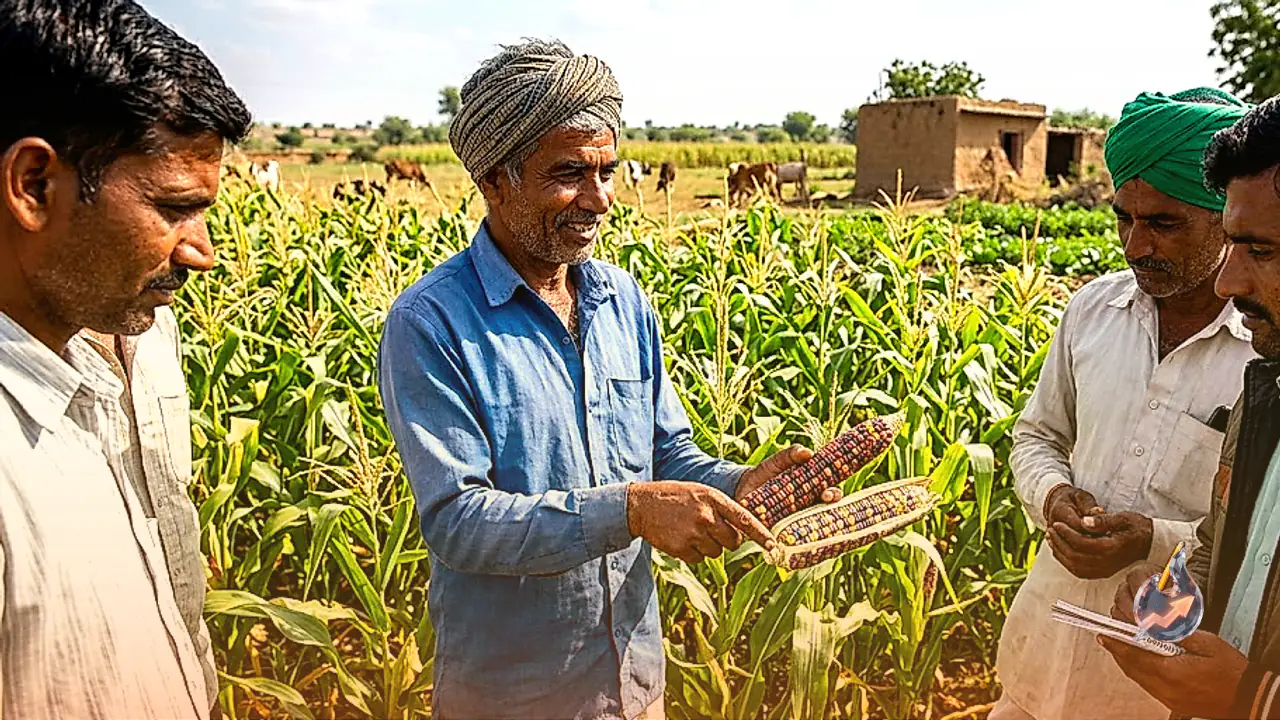

















In the fields of Sikar, where farmers usually grow corn in plain yellow or white, one plot now bursts with five different colours of corn cobs. The man behind this unusual sight is Sanjay Yadav, a farmer who studied only up to the 8th grade but turned his land into a working laboratory, building a farming model so effective that growers from other states now travel to see it firsthand. Relying on natural farming methods, organic manure, indigenous seeds and homemade pesticides, he has shown that grit and constant experimentation can matter more than formal schooling.
How the experimentation began
After completing training in natural farming and mushroom cultivation, Sanjay turned his farm into a testing ground. It took nearly two years of continuous trial with different seeds and techniques before he successfully grew corn in five distinct colours. What began as an experiment soon turned into a full success once the results started showing, and the unusual look and quality of the corn quickly caught attention, drawing demand even from hotels and restaurants. Given the rising demand, Sanjay has now applied for a patent for his five-coloured corn variety so that his years of work are formally credited to him.
Cutting chemicals pushed savings from 30% to 70%
Sanjay recalls that he once relied on chemical fertilisers and pesticides across one hectare of land, a method that only managed to save around 30 percent on cultivation costs. He gradually phased out chemical inputs entirely and switched to fertilisers and pesticides made from indigenous resources. The shift sharply cut his farming costs, pushing his overall savings to nearly 70 percent. His farm today stands as a model that delivers higher output at a much lower cost, drawing visits from farmers across state lines.
He explained the model to PM Modi
In October 2025, Sanjay was called to Delhi for the inauguration of the Dhan-Dhaanya Yojana. There, he got the chance to meet Prime Minister Narendra Modi and walked him through the details of his natural farming model. Sanjay says his farm produces its own organic inputs, jeevamrit, ghanjeevamrit, vermicompost and saral compost, made using indigenous seeds along with cow urine and dung from desi cows. Using these has sharply cut down what he used to spend buying fertilisers and pesticides from outside, directly boosting his savings.
Homemade solutions replace market pesticides
For pest control, Sanjay avoids expensive market pesticides altogether. Instead, he prepares organic solutions such as agni astra, brahmastra, dasparni extract and panchagavya at home. He believes that making better use of resources already available on the farm not only lowers costs but also keeps the soil healthier over the long run, which in turn shows up in the quality of what he grows.
One farm, growing vegetables, spices and turmeric
At his farm in the Durgapura Piprali area, Sanjay grows chilli, tomato, okra, bottle gourd, bitter gourd, brinjal, cauliflower, broccoli and radish depending on the season. Under mixed cropping, he also produces turmeric and black turmeric, while mustard and fennel make up his spice crops. Sanjay produces his own seeds on the farm and supplies them to other farmers as well, giving nearby growers access to good quality indigenous seed.
Vegetables, ghee and mushrooms bring in lakhs each year
Every Sunday and Wednesday, Sanjay sells vegetables from his farm directly to customers in Sikar city, earning roughly three to four lakh rupees a year from this alone. He also keeps five desi cows, turning their milk into ghee for an additional three to four lakh rupees annually. On top of that, growing button, oyster and milky mushrooms brings in more than five lakh rupees a year. Between vegetables, dairy and mushrooms together, Sanjay has built a farming income model that does not depend on a single source.
Training ground for 150 farmers and counting
Sanjay's farm has grown beyond a production unit into a training centre for other farmers. He has already trained around 150 farmers in the techniques of natural farming. Beyond Rajasthan, farmers from other states are now visiting his farm to study and learn from his model, hoping to replicate the same low-cost, high-return approach on their own land.