























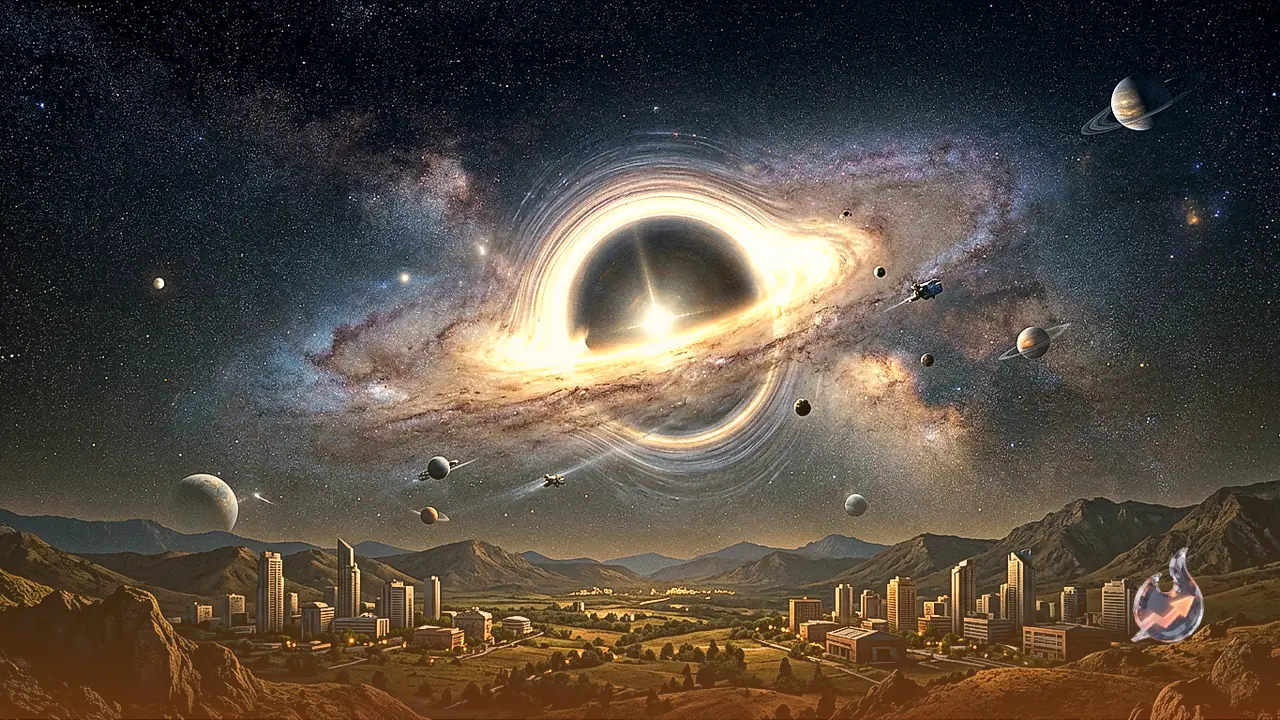

Deep within the galactic core, astronomers have identified a star breaking all known cosmic speed records. Named S301, this celestial body reaches an astonishing top speed of 25,000 kilometers per second as it orbits Sagittarius A*, the supermassive black hole dominating the center of the Milky Way. Completing a full orbit in just 8.7 years, S301 attains approximately 8 percent of the speed of light at its absolute peak velocity. To put that into perspective, our Sun orbits the galactic center at roughly 230 kilometers per second, meaning S301 moves more than one hundred times faster than our own star.
Gravitational slingshot and extreme elliptical orbit
The key to S301's extreme velocity lies in its orbital geometry and how close it ventures toward Sagittarius A*. Data from the European Southern Observatory (ESO) shows that at periastron, its point of closest approach, the gap between the star and the supermassive black hole shrinks to a distance roughly equivalent to that separating Saturn and the Sun in our solar system. The massive gravitational draw of Sagittarius A* violently accelerates S301 as it falls toward the black hole, yet the star avoids plunging past the event horizon, following instead an exceptionally elongated orbit.
This eccentric trajectory explains why the star's speed varies so drastically throughout its path. As it approaches the black hole, gravity whips S301 around at maximum velocity, whereas at the farthest reaches of its orbit, its speed drops significantly. Astrophysicists compare this dynamic to comets in our own solar system, such as Halley's Comet, which accelerate rapidly when rounding the Sun and slow down as they move out toward deep space. S301 currently holds the record for both the highest orbital velocity in the Milky Way and the closest distance to Sagittarius A*.
The violent history of a torn binary system
Astronomers emphasize that S301 could not have originated in the location where it is currently observed. Stellar nurseries cannot form so close to a supermassive black hole because the intense gravitational tidal forces would shred gas clouds before star formation could occur. Researchers at the European Southern Observatory (ESO) explain that S301 was almost certainly once part of a binary star system that drifted too close to Sagittarius A*.
As the binary pair encountered the black hole's gravitational field, intense tidal forces tore the two stars apart. S301 was captured into a tight, high-speed orbit around Sagittarius A*, while its stellar companion received an enormous kinetic ejection. That companion star was thrown outward at hypervelocity, attaining enough speed to likely exit the Milky Way galaxy altogether.
Measuring the spin of Sagittarius A* through spacetime warping
Astrophysicists rely on two primary properties to define a black hole: mass and rotational spin. While the mass of Sagittarius A* has been calculated accurately, determining its exact rate and direction of spin has proven elusive. Existing data suggests the supermassive black hole is rotating, but scientists have lacked the tools to measure it precisely. S301 is expected to change that within the next 10 years.
According to Albert Einstein's theory of general relativity, a rotating massive body drags the fabric of spacetime along with it, a physical effect known as frame-dragging. This phenomenon should introduce minute orbital precessions into S301's trajectory over time. By measuring these tiny deviations over the coming years, astronomers will be able to determine both the spin velocity and orientation of Sagittarius A*.
From 2017 archival data to the upcoming 2031 periastron
S301 was first spotted in 2023 using the GRAVITY instrument on the ESO's Very Large Telescope Interferometer (VLTI), located in Chile. Following the initial discovery, researchers cross-referenced current tracking data with archival astronomical observations going back to 2017. Combining these observations allowed astronomers to reconstruct S301's full orbit with high precision, confirming that it made its previous closest approach to Sagittarius A* in early 2023. The star is now traveling along the outer loop of its 8.7-year orbit and will reach periastron again in 2031.
Why S301 surpasses previous stellar benchmark S2
For several decades, astronomers have monitored stars orbiting close to Sagittarius A*, most notably S2, to calculate the black hole's mass and test key predictions of general relativity. However, because S301 passes far closer to Sagittarius A* than S2, it provides a unique advantage. Scientists anticipate that observing S301 will allow them to measure the spin of Sagittarius A* within a single decade, whereas doing so using stars like S2 would require several additional decades of continuous tracking.