






















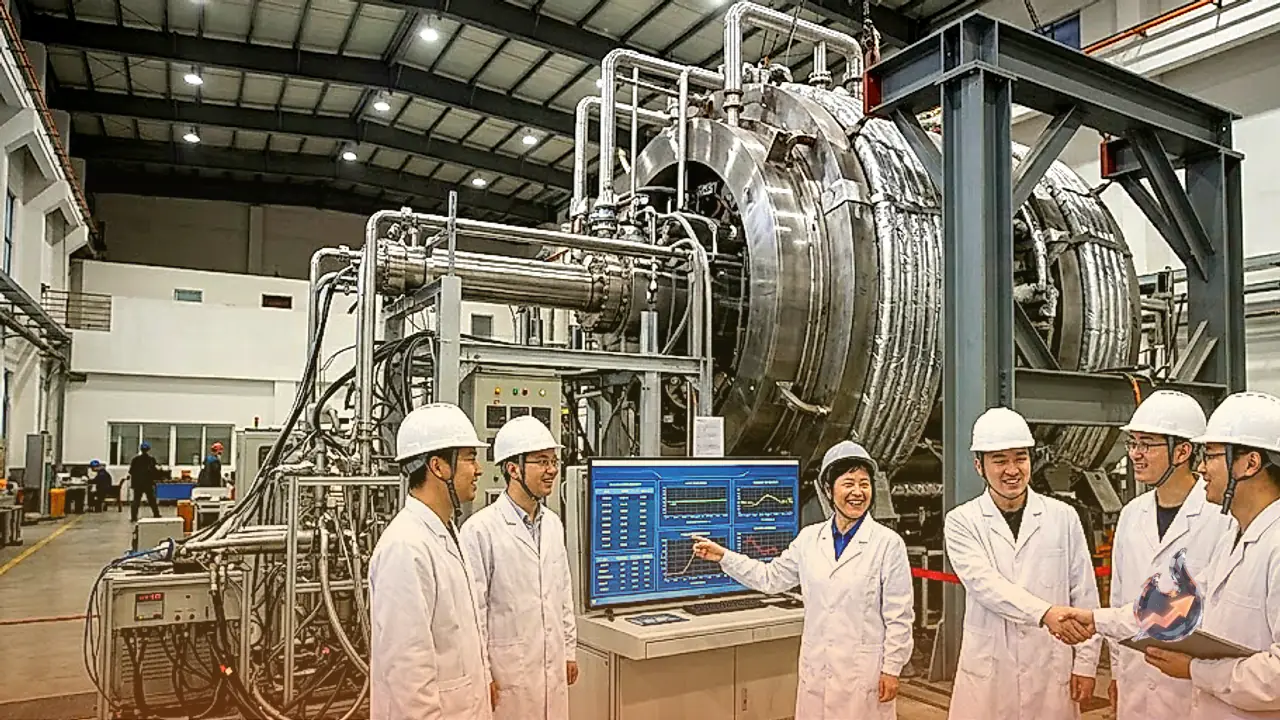

Addressing expanding global energy requirements and environmental pollution, scientists at the Institute of Plasma Physics under the Chinese Academy of Sciences have achieved a significant technical milestone. The research team has successfully concluded operational testing of a massive 582-ton superconducting fusion magnet. This sophisticated apparatus serves as the central core of China's artificial sun nuclear fusion reactor initiative. The strategic objective of this project is to generate unlimited, zero-emission clean electricity by the year 2030, marking a major advancement in global fusion energy research.
This ongoing development represents a critical effort toward securing sustainable future energy supplies. Traditional energy sources including coal, petroleum, and natural gas face depletion risks while emitting substantial greenhouse gases. In contrast, nuclear fusion mimics the fundamental power generation processes of the natural sun, offering a potential path to virtually limitless clean power. The newly tested magnet plays a pivotal role in ensuring that fusion reactions remain controlled and stable inside the experimental reactor structure.
Physical Dimensions and Engineering Specifications
The newly completed superconducting magnet features impressive structural and operational metrics. Built in a distinct D-shaped geometric configuration, the magnet measures 21 meters in length and 12 meters in width. Its total structural mass stands at 582 tons, equivalent to the weight of numerous heavy-duty commercial transport trucks. Compared to existing international facilities, this magnet exceeds the specifications of components currently deployed in major fusion projects.
In terms of scale, the magnet is 1.3 times larger in overall volume than the superconducting magnets manufactured for the International Thermonuclear Experimental Reactor (ITER). Furthermore, its energy storage capability is rated at 3 times that of ITER magnet systems. The magnet is designed to facilitate the fusion of hydrogen atoms, creating sustained temperatures exceeding 100 million degrees Celsius. For context, the core of the natural Sun reaches approximately 15 million degrees Celsius, meaning this artificial sun system will generate internal temperatures several times hotter than the center of the Sun.
Thermal Physics and Magnetic Plasma Confinement
During a nuclear fusion reaction, extreme thermal energy converts gas into a high-energy state known as plasma. At temperatures reaching 100 million degrees Celsius, no known physical material on Earth, including advanced alloys, steel, or reinforced concrete, can withstand direct contact without melting or vaporizing instantly. If hot plasma touches the interior walls of the containment vessel, structural damage would occur immediately.
To prevent physical degradation of the reactor core, the 582-ton magnet generates an exceptionally strong magnetic field inside the reactor chamber. This magnetic barrier confines and levitates the 100 million degree Celsius plasma in mid-air, keeping it suspended at a safe distance from the vessel walls. Consequently, the magnetic containment allows the fusion reaction to proceed continuously without compromising the structural integrity of the surrounding facility.
Domestic Technological Sovereignty and Innovation
The development of the superconducting magnet was executed entirely through domestic research and manufacturing capabilities in China, without relying on imported components or foreign technical assistance. The Central Solenoid Coil, often described as the primary heart of the fusion reactor, was tested alongside the main magnet and was likewise produced completely in-house. This achievement follows six years of dedicated development work by Chinese research personnel.
Throughout the six-year engineering program, scientific teams registered 47 new technological patents and established 25 new industrial standards for fusion component manufacturing. This accomplishment eliminates dependency on hardware or intellectual property from American or European suppliers in this specialized high-tech sector, highlighting China's expanding domestic capacity in fusion technology.
Cryogenic Operations and Zero Electrical Resistance
Maintaining the magnet's functional capabilities requires extreme environmental conditions. The entire magnetic apparatus is designed to operate continuously for up to 60 years at ultra-cold cryogenic temperatures of minus 269 degrees Celsius (-269°C) without experiencing mechanical or electrical degradation. At these extreme cryogenic levels, the internal materials enter a state of superconductivity.
Within this superconducting regime, electrical resistance is reduced virtually to zero. This allows the system to conduct electric currents exceeding 100,000 amperes without incurring resistive power loss or thermal overload. This efficiency enables the generation of high-density magnetic fields while keeping operational electrical overhead to a minimum.
Prior Track Record and the Three-Stage Roadmap
This magnet test forms part of a broader strategic framework for fusion energy deployment. Previously, China's Experimental Advanced Superconducting Tokamak (EAST) facility established a world record by sustaining plasma confinement at 100 million degrees Celsius for 1,066 seconds. Building upon that foundation, a three-step developmental roadmap has been outlined for commercial implementation.
Under this roadmap, the first objective involves completing the assembly of the Burning Plasma Experimental Tokamak by the end of 2027. The second milestone aims to produce commercial electricity from the artificial sun reactor for the first time by 2030. The final phase entails building the full-scale China Fusion Engineering Demonstration Reactor to deliver continuous, clean power to the electrical grid indefinitely.
Technical Challenges and Potential Energy Sector Impact
Despite the successful magnet test, several engineering challenges remain before fusion power can be integrated into public energy grids. Future stages will require assembling all reactor subsystems together, conducting extended durability testing, and demonstrating net energy gain (Q > 1), wherein the reactor outputs significantly more energy than is required to sustain its operation.
Nevertheless, the successful demonstration of the 582-ton superconducting magnet signals progress toward viable fusion energy. If successfully commercialized, fusion power could diminish long-term global reliance on fossil fuels such as Middle Eastern crude oil, coal, and natural gas, fundamentally altering global energy dynamics and establishing China as a central figure in clean energy technology.