






















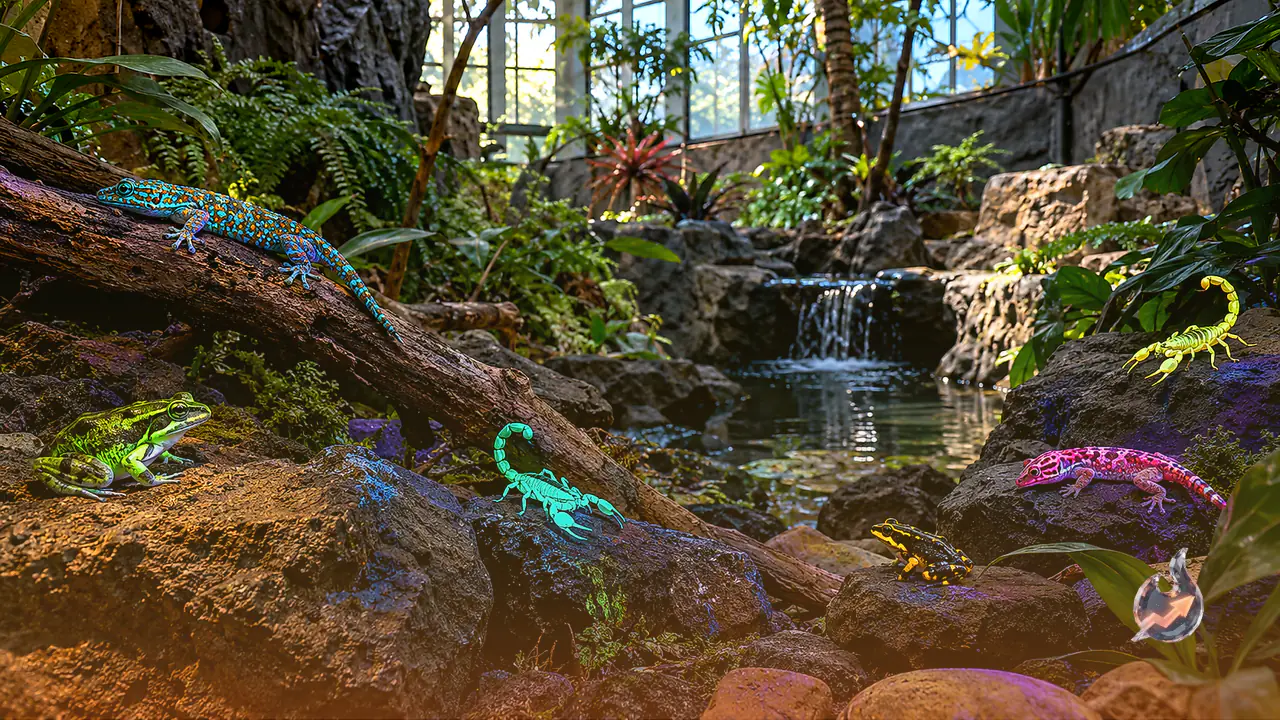

Nature harbors countless adaptations that remain completely invisible to the unaided human eye under everyday lighting conditions. Many creatures that look dull, brown, or ordinary during daylight take on a completely different appearance when exposed to ultraviolet radiation. When UV light hits their bodies, they emit vivid and striking glows in shades of blue, green, purple, and neon pink. In biological sciences, this process is known as biofluorescence. Unlike chemical light production from internal metabolic reactions, biofluorescence occurs when biological tissues absorb high-energy, short-wavelength ultraviolet light and instantly re-emit it at longer wavelengths that human eyes and specialized cameras can perceive.
The Dual Marvel Of The Platypus
The platypus ranks among the most remarkable mammals on Earth, well known for laying eggs instead of giving birth to live young while spending much of its existence in aquatic environments. In regular sunlight, the fur of a platypus appears as a plain, uniform shade of dark brown. When scientists shone UV light across its coat, the animal's body began emitting an enchanting glow in shades of blue and green. This biofluorescent trait sets the creature apart from most standard terrestrial mammals and indicates that biological light absorption may be far more widespread across ancient mammalian lineages than previously understood.
Wombats Radiate In Blue And Violet
Native to the forests and grasslands of Australia, wombats are stout, gentle herbivores with a notoriously calm demeanour. While foraging in daylight, their coarse hair looks dusty and unremarkable. Under direct UV radiation in darkness, however, their fur begins to glow with distinct shades of blue and purple. Researchers investigating this phenomenon found that specific organic compounds embedded within the mammal's hair follicles interact with incoming ultraviolet rays, transforming a seemingly plain burrowing creature into a glowing nocturnal subject.
The Mesmerising Exoskeleton Of Scorpions
Scorpions are universally recognized for their venomous sting and predatory prowess, but their hard outer shell is equally fascinating from a biophysical standpoint. When ultraviolet light strikes a scorpion in total darkness, the outcome is visually stunning. The entire exterior skeleton lights up like a magical fluorescent beacon, glowing brightly in vivid shades of neon blue and green. Specific chemical substances embedded directly within the scorpion's cuticle absorb the invisible UV wavelengths and transform them into this unmistakable luminescence, making them exceptionally easy to spot during nighttime field studies.
Flying Squirrels In Hot Pink And Maroon
Leaping between towering tree branches in dense forest canopies, flying squirrels look entirely standard during daylight hours. Nighttime exposure to targeted UV illumination unveils an entirely different visual reality. The underside of their bodies, particularly their belly fur, suddenly lights up in brilliant tones of hot pink and maroon. Observers and wildlife researchers were stunned by this revelation, as such bright, saturated pink tones are extraordinarily rare across mammalian species, raising important evolutionary questions about camouflage and nocturnal social signals.
The Subtle Glow Of Bottlenose Dolphins
Dolphins navigating open ocean waters have long been studied for their cognitive abilities and agility. Scientific research has also documented a fascinating light phenomenon involving bottlenose dolphins. When their skin and specific external structures encounter UV wavelengths, they emit a soft, discernible glow. Witnessing this subtle illumination beneath the water demonstrates that biofluorescent characteristics extend beyond small insects and nocturnal land animals into highly developed marine mammals navigating dim aquatic depths.
Chameleon Skeletons Create Fluorescent Patterns
Chameleons have an established worldwide reputation for their capacity to adjust skin pigments to match their surroundings. When it comes to the intersection of light and darkness, certain species reveal an even deeper biological trick. Under UV illumination, their bones and overlying dermal layers produce striking patterns in vivid shades of blue and green. Bony crests and skeletal nodules located just beneath the surface filter through translucent skin layers, creating glowing geometrical designs that appear almost like intentional luminescent artwork.
California Horn Sharks And Neon Signatures
Cruising across the ocean floor, the California horn shark displays a captivating visual response to ultraviolet stimulation. When UV rays reach the rough skin of this shark species, the natural markings across its body light up like intense neon fixtures. In the dim expanse of the marine habitat, this bright illumination creates a pronounced visual profile, allowing the shark to stand out distinctly against its murky surroundings while interacting with its marine environment.
Springtails Shine Like Microscopic Stars
Inhabiting soil layers, leaf litter, and decomposing forest foliage, tiny insects known as springtails round out the list of glowing organisms. Despite their minuscule physical dimensions, their response to targeted laser and UV light is striking. When exposed to ultraviolet beams, their bodies shine like sparkling stars against the dark earth. That such diminutive creatures living hidden within dirt and decaying vegetation possess such brilliant biofluorescence continues to amaze researchers, demonstrating that nature's optical complexity touches even the smallest organisms on our planet.