






















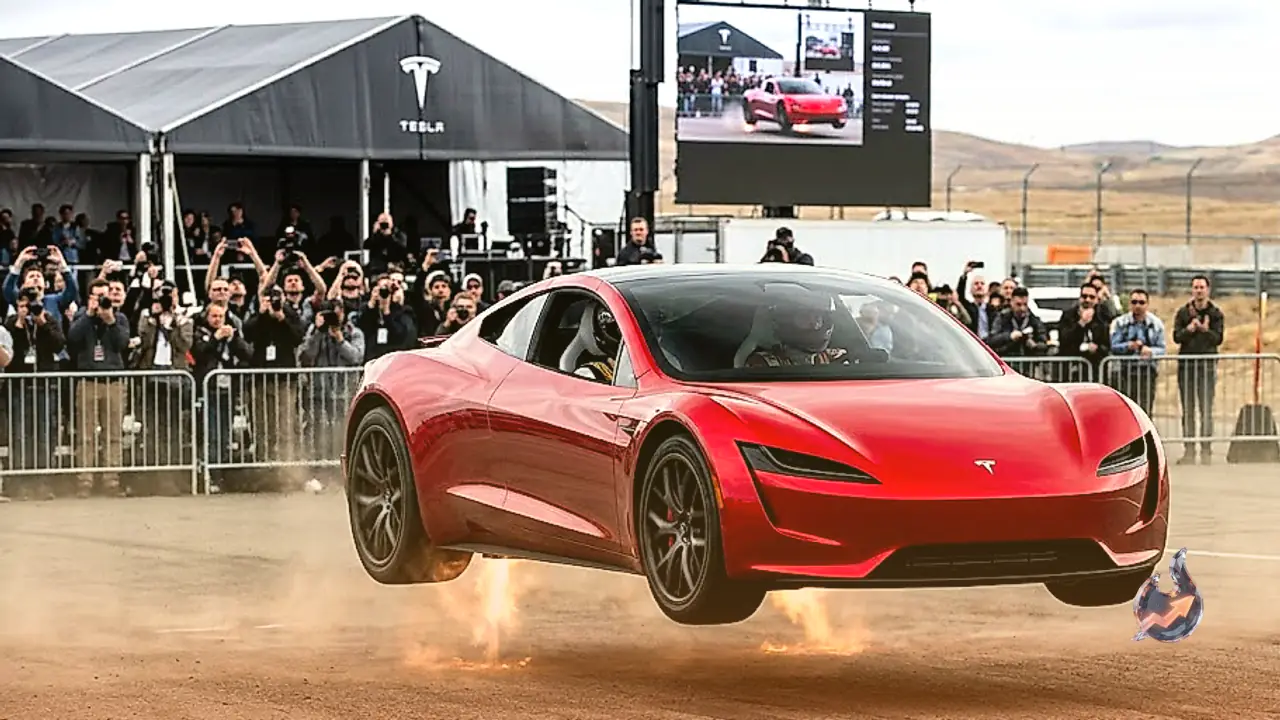

Elon Musk recently showcased Tesla's long-delayed Roadster 2, packed with extraordinary features. The vehicle can fly for short bursts, scale vertical walls, and leap over entire lineups of Tesla vehicles, pushing the boundaries of automotive engineering.
These capabilities prompt two distinct inquiries. First, should humans be allowed to pilot vehicles up vertical surfaces and into the air? Given existing difficulties in navigating standard two-dimensional roadways, the answer appears to be an obvious negative. However, that regulatory dilemma belongs to lawyers and the Federal Aviation Administration. The second inquiry focuses on how the Roadster 2 prototype accomplishes these stunts, which can be answered directly through physics.
The analysis begins with how the vehicle managed to ascend a circular ramp and remain anchored to it upside down in Spider-Man fashion. While such maneuvers should be avoided by ordinary drivers, this specific engineering feature can actually enhance traction on conventional roads. The underlying mechanism relies entirely on friction.
When two surfaces interact, such as rubber tires meeting asphalt, a force often prevents them from sliding relative to each other. This physical interaction is known as static friction. A straightforward model governs this force, where the magnitude depends directly on how intensely the surfaces are pressed together, represented by the normal force, combined with the material properties of the surfaces involved.
The force pressing the surfaces together is termed the normal force because it acts perpendicularly to both surfaces. The coefficient of static friction describes the interacting materials, where the practical maximum sits at 1, while rubber on asphalt measures around 0.6. This static friction acts as a force of constraint, applying precisely the amount of force needed to prevent sliding up to a specific maximum threshold.
When a conventional automobile attempts an incline, three primary forces act upon it: friction, the normal force, and gravity. As the angle of the incline increases, the perpendicular component of the gravitational force decreases, causing a corresponding drop in the normal force and maximum frictional force. If this friction falls below the gravitational pull dragging the vehicle down the slope, slippage occurs. With a friction coefficient of 0.6, the maximum stable angle reaches roughly 31 degrees, falling far short of a vertical wall. Even an optimized coefficient of 0.9 limits the maximum incline to 42 degrees.
Overcoming this limitation to scale a vertical wall requires artificially increasing the normal force and, consequently, the frictional force. On a vertical surface, this friction force must exactly equal the gravitational pull to prevent the car from falling. This is where the Roadster 2 employs its first major mechanism, utilizing internal fans to exhaust air from beneath the chassis. Combined with specialized side flaps, this process reduces air pressure underneath the vehicle, mimicking the mechanics of a vacuum cleaner.
Estimating the required pressure beneath the Roadster 2 to maintain wall adhesion involves basic physics. The vehicle targets a weight of 1,700 kilograms, with a contact area of roughly 2 square meters. Utilizing the pressure equation where force equals pressure multiplied by area, and factoring in standard atmospheric pressure of 105 newtons per square meter, the calculated undercarriage pressure drops to about 86 percent of atmospheric pressure. This calculation proves entirely plausible, though imperfect seals require the fans to run continuously.
While an upside-down vehicle serves as an impressive marketing tool, the underlying suction technology offers massive utility during standard right-side-up driving. Frictional force dictates acceleration capabilities; increased friction translates directly to superior vehicle performance. Pushing the vehicle downward enables faster acceleration, shorter braking distances, and sharper cornering capabilities, a principle performance automakers have leveraged for decades, albeit to a lesser extreme.
The Roadster 2 also claims an acceleration rate from 0 to 60 mph in under one second. For traditional automobiles, this feat remains physically impossible. Because standard cars rely entirely on tire-road friction to accelerate, they remain bound by the friction coefficient. Utilizing a generous coefficient of 0.6, the theoretical physical limit caps acceleration from 0 to 60 mph at 4.56 seconds. Upgraded tires and aerodynamic downforce provide marginal gains at higher speeds, but they cannot achieve a one-second threshold.
To bypass these limitations, the Roadster 2 incorporates compressed air thrusters positioned at the rear, operating on identical principles to rocket propulsion. A simple domestic experiment involving an inflated toy car propelled by escaping air demonstrates this dynamic. As stretched rubber forces air out through an attached tube, accelerating that air mass requires force. According to Newton's third law, the action of the balloon walls pushing the air generates an equal and opposite reaction force, propelling the toy forward. The Roadster 2 replaces the deflating balloon with high-pressure compressed air tanks.
This same compressed-air propulsion mechanism enables the vehicle to lift off the ground, fulfilling the flying car claim. However, this description stretches definitions, as the onboard air tanks can only sustain thrust for a few seconds before pressure drops. Depleted pressure results in lower exhaust velocity and reduced thrust, offering only brief moments of airborne capability rather than prolonged flight.
A secondary hurdle involves acceleration limits. Because the thrusters operate briefly, they must exert massive force to generate rapid velocity changes required to leap over obstacles like transport trucks. High force inevitably produces extreme acceleration, which poses significant physiological risks to human occupants. Video analysis tracking the vehicle's position frame by frame during a jump over a Tesla Semi truck reveals the mechanics. Given the truck's known height of roughly 4 meters, researchers can map vertical position against elapsed time.
At the start of the maneuver, vertical velocity begins at zero before upward acceleration kicks in. Assuming constant acceleration, the position-time data forms a parabolic curve. Fitting a quadratic function to this trajectory yields an estimated vertical acceleration of approximately 98 meters per second squared, translating to roughly 10 g's of force for human occupants. While humans can endure such extreme force levels for very short durations, the experience remains intensely uncomfortable and hazardous, likely explaining why a robotic driver operated the prototype during the public demonstration.