























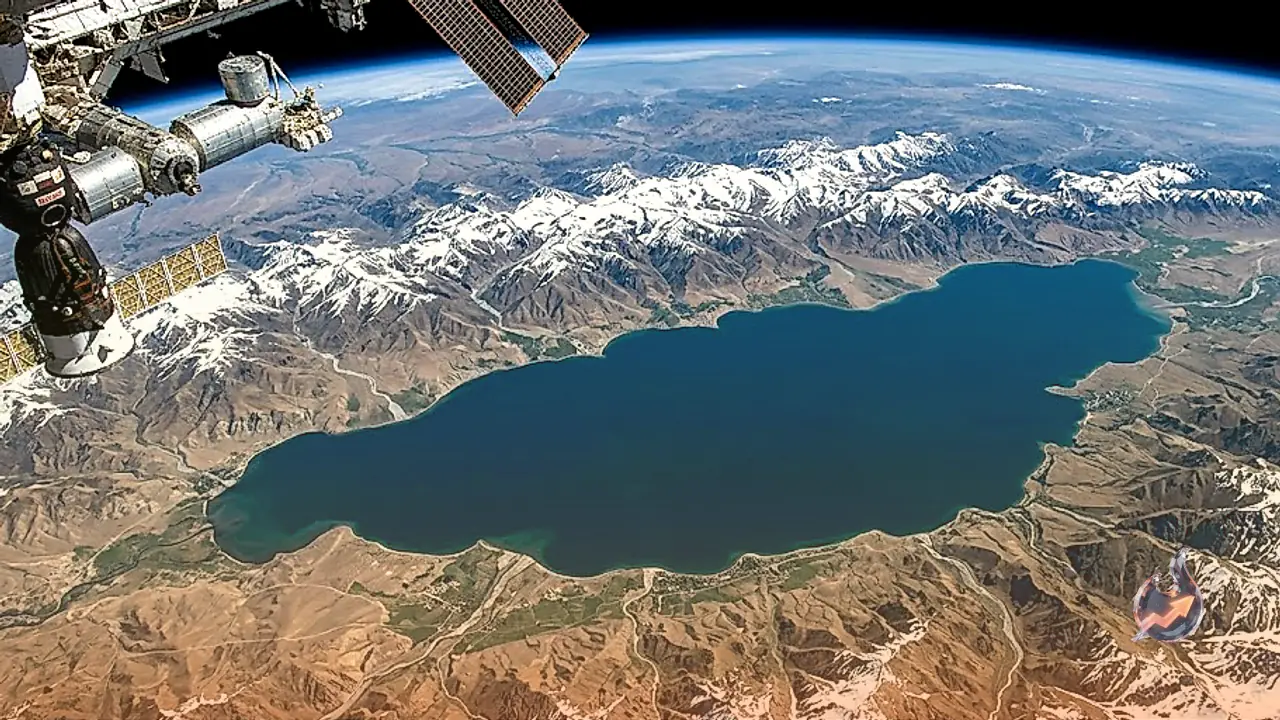

A striking image captured from the International Space Station as it orbited over Kyrgyzstan has offered an extraordinary view of Lake Issyk-Kul, one of the most remarkable natural formations on Earth. Taken by cameras aboard the orbital laboratory, the picture highlights the sprawling blue waters of the lake framed by the snow-clad peaks of the Tian Shan mountain range. Positioned high above sea level in a region known for harsh freezing temperatures, the lake displays a rare combination of hydrological characteristics that continues to fascinate scientists worldwide.
A Majestic Alpine Lake in the Tian Shan Mountains
Geographically, Lake Issyk-Kul holds the distinction of being the largest lake in Kyrgyzstan and the second-largest alpine lake globally. It rests at an elevation of approximately 1,607 meters above sea level, stretching across an estimated length of 182 kilometers and a width of about 60 kilometers. Encircled by the high-altitude topography of the Tian Shan range, the massive body of water resembles a radiant blue gem when viewed from space, showcasing the breathtaking scale of Earth's high-altitude water systems.
118 Inflowing Rivers with Zero Outflow
The defining hydrological mystery of Lake Issyk-Kul lies in its water budget and drainage system. More than 118 rivers and mountain streams, driven largely by glacial meltwater and seasonal snowpack, flow continuously into the lake basin. Despite this massive inflow, not a single river flows out of it. Issyk-Kul is a classic endorheic basin, meaning it operates as a closed drainage system. Water entering the basin has no outlet to external seas or oceans, leaving atmospheric evaporation as the primary process through which water exits the lake.
Why the Waters Resist Freezing in Sub-Zero Winters
During the winter months, ambient air temperatures around the surrounding peaks regularly drop well below freezing, blanketing the terrain in snow. Remarkably, the surface of Lake Issyk-Kul rarely freezes over completely, earning it the local moniker of Warm Lake. Researchers attribute this thermal resilience to three key physical properties: its substantial depth, the enormous volume of water it holds, and its slight salinity. Together, these elements enable the lake to retain absorbed heat over long periods, preventing the surface water from solidifying into ice.
A Critical Indicator for Climate Science
Beyond its scenic grandeur, Lake Issyk-Kul serves as an essential natural laboratory for environmental and climate scientists. Because it functions as a closed basin without river drainage, variations in its water level provide direct data regarding glacier retreat, precipitation trends, evaporation rates, and broader thermal shifts across Central Asia. Space-based imagery and satellite tracking of the lake offer invaluable insight into how rising global temperatures are reshaping delicate mountain ecosystems.