






















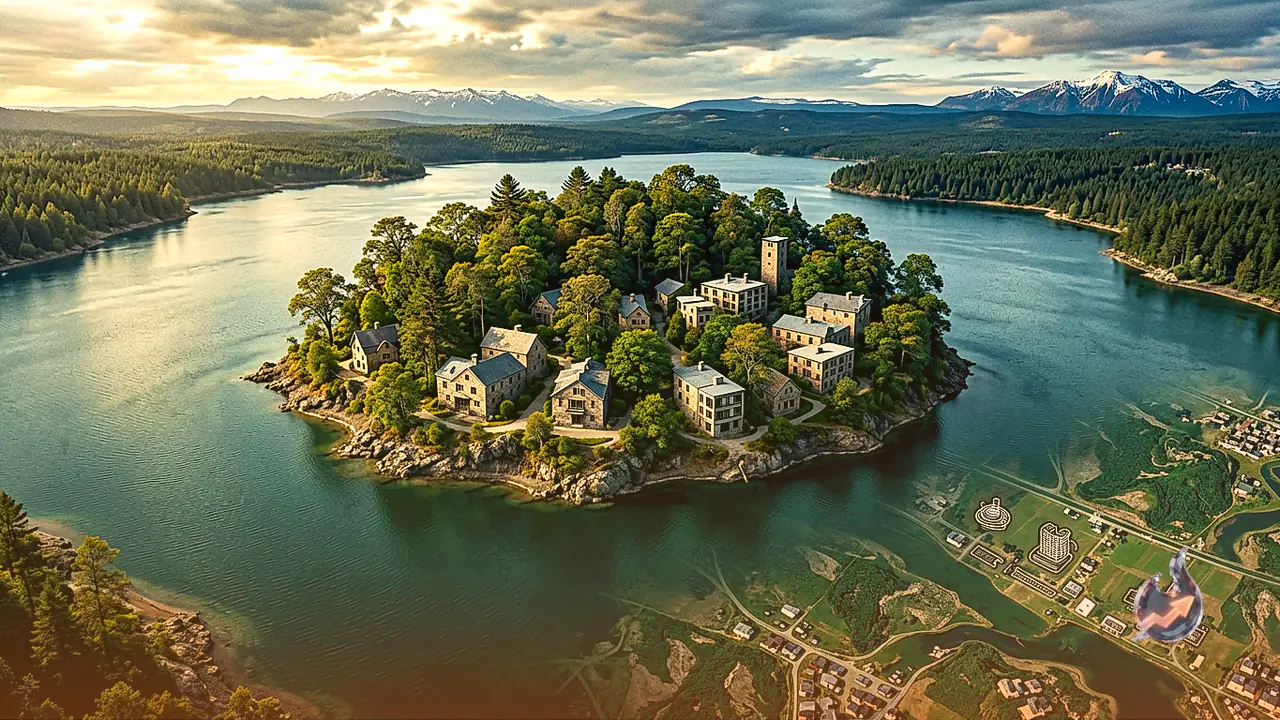

A remarkable and puzzling phenomenon recently unfolded in British Columbia, Canada, where a massive tract of land covered in trees was spotted floating across the waters of the Williston Reservoir. The strange spectacle captured the attention of local residents and experts alike, resembling an entire woodland adrift upon the lake surface. However, the most baffling part of the entire occurrence is that this floating island vanished from satellite imagery just weeks after it first appeared.
Discovery by a Local Boater
Photographs of this bizarre sight were initially captured by a local boater, sparking widespread curiosity among residents in the surrounding area once the images came to light. The matter quickly spread across social media, accumulating views from thousands of users online. Initially, officials struggled to believe that the massive landmass depicted in the photographs was genuinely floating on water, even considering the possibility that the image might have been generated using artificial intelligence.
Satellite Confirmation and Massive Scale
Any lingering doubts were ultimately cleared by satellite imagery when BC Hydro confirmed the presence of the floating landmass in photos captured on July 20 and July 21. The structure measured approximately 70 meters wide and 140 meters long, encompassing roughly 9,800 square meters or about the size of two NFL football fields. It was located in the main body of the reservoir, west of Finlay Bay and roughly 60 miles away from the W.A.C. Bennett Dam.
The Sudden Disappearance
The story took a mysterious turn when newer satellite images from August 5 revealed that the giant floating forest was completely gone. There was no remaining trace or clear clue indicating where the massive structure might have gone, leaving authorities with a blank surface where the sprawling mass once floated.
Origins and Unresolved Theories
While officials have a plausible explanation for how the island formed, its disappearance remains a puzzle. Authorities suggest that logs and organic debris accumulating along the shorelines over many years gradually decayed, allowing plant and tree roots to weave together and form a sprawling floating mat over time. As water levels rose, this mass likely broke away from the shoreline and drifted into open water. Regarding its disappearance, officials note that it has not necessarily sunk; it may have drifted into a quieter or hidden pocket outside the viewing angle of available satellite imagery, though breaking apart or submerging remain possibilities as BC Hydro continues to monitor the situation.