
















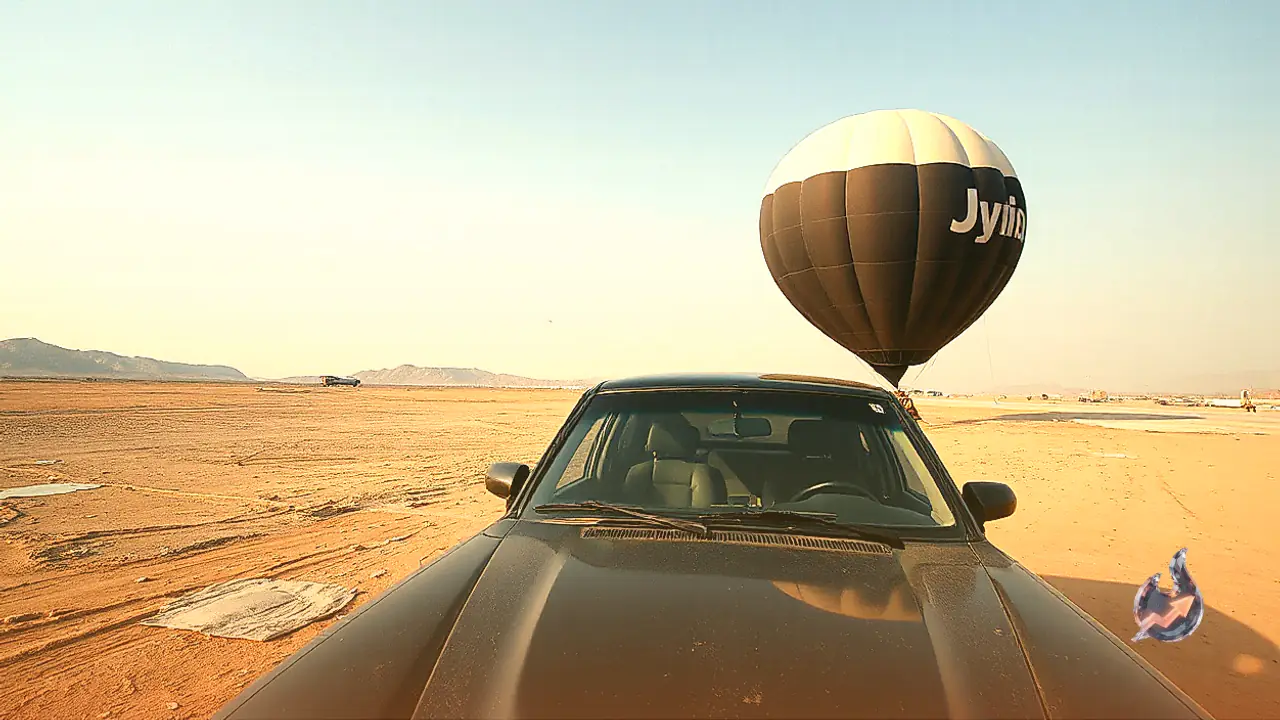

Surface protection films on modern automobiles are designed to resist daily highway hazards, including dust, stone chips, sun fading, and minor abrasions. A recent aerospace experiment conducted in Tamil Nadu pushed these protective capabilities far beyond conventional automotive bounds, exposing vehicle bodywork to the extreme upper reaches of the atmosphere. Chennai-based aerospace startup Aero Launch India successfully lifted the bonnet of a compact car 21 kilometres above the ground using a specialised high-altitude balloon. The primary objective of the mission was to evaluate the resilience of Aegis XG series paint protection film manufactured by automotive detailing brand CarzSpa under conditions far harsher than ordinary terrestrial driving. The trial exposed the material to temperatures plunging to minus 50 degrees Celsius, severe low atmospheric pressure, and intense ultraviolet radiation.
Testing Surface Film in Near-Space Environmental Extremes
Paint protection film, commonly referred to as PPF, serves as an elastomeric shield designed to safeguard automotive paint from physical damage and chemical degradation. To commemorate two decades of CarzSpa's presence in the automotive detailing industry, the team initiated mission HAB0226. While material resilience is typically tested inside climate-controlled laboratory environmental chambers, this project took the evaluation directly into real stratospheric conditions. The launch took place on November 1 from the campus of Krishnasamy College of Arts and Science, located in Cuddalore, Tamil Nadu.
Ascending through the troposphere, the payload established its peak altitude 21 kilometres above sea level within the stratosphere. Atmospheric sensors recorded temperatures dropping to approximately minus 50 degrees Celsius. At this altitude, the drop in atmospheric density combines with reduced screening from the ozone layer, exposing surfaces to significantly elevated ultraviolet radiation compared to ground conditions. Following an airborne flight lasting approximately two hours, the payload touched down, and post-flight physical inspections showed no visible degradation, cracking, or loss of adhesion on the coated surface.
Contrasting Atmospheric Balloon Flights with Falcon Heavy Rocket Missions
Propelling automobile hardware toward the sky inevitably draws parallels to the landmark 2018 SpaceX mission, during which Elon Musk launched a personal Tesla Roadster aboard the maiden flight of the Falcon Heavy rocket. However, the Indian project operated on an entirely different scientific and mechanical methodology. The SpaceX launch utilised an orbital-class, multi-stage heavy-lift rocket designed to escape Earth's gravity and place a payload onto a heliocentric trajectory. In contrast, the Tamil Nadu experiment utilised an environmentally inert high-altitude helium balloon system without rocket propulsion.
Rather than aiming for outer space exploration, the Chennai team leveraged the severe natural conditions of the upper atmosphere as a reusable, cost-efficient testing ground for commercial materials. The flight involved zero rocket propellants or orbital insertions, focusing entirely on near-space atmospheric engineering and clean material testing.
Custom Payload Architecture and High-Definition Imaging Integration
Transporting a broad, metallic vehicle bonnet into high winds and sub-zero conditions required a carefully balanced structural frame. Aero Launch India avoided simply suspending the component from lines and instead developed a dedicated aerospace payload cradle. The team incorporated lightweight expanded polystyrene to shield sensitive components from thermal shock, while carbon fibre pipes provided rigid structural support capable of withstanding shifting aerodynamic loads.
To document every stage of the ascent, engineers fitted a 5.7K resolution 360-degree camera system to the frame. The camera documented the bonnet rising through dense cloud decks, emerging into the pitch-black near-space horizon, and maintaining structural integrity across two continuous hours. This spherical footage provided visual confirmation of aerodynamic stability and material behaviour during every stage of the climb.
Retrieval Operations 30 Kilometres Downrange and Post-Flight Analysis
Upon concluding its mission at peak altitude, the payload separated and initiated a descent under a recovery parachute system. Driven by prevailing upper-level wind currents, the package touched down in Melkangayan Kuppam, situated approximately 30 kilometres away from the initial launch site at Cuddalore. Using live onboard GPS trackers, recovery personnel from Aero Launch India reached the touchdown coordinates swiftly and recovered the bonnet and instruments intact.
CarzSpa confirmed that post-mission technical examinations showed the Aegis XG series coating suffered no apparent surface damage, discoloration, or peeling. Representatives noted that marking the company's 20th anniversary prompted the desire to validate their flagship product through an unconventional and verifiable stress test. The brand noted that roughly 25 lakh car owners across India have utilised its detailing services over the past two decades.
Atmospheric Data Logging via Dedicated Ultraviolet Sensors
Beyond evaluating an automotive surface product, the flight incorporated a dedicated scientific research payload. Surat-based aerospace startup STAR, an acronym for Space Technology and Aeronautical Rocketry, provided an onboard ultraviolet data logger that was mounted alongside the vehicle bonnet. This instrumentation continuously logged the intensity and spectrum of ultraviolet radiation across varying altitude bands during the climb.
The recorded sensor data produced a comprehensive profile of atmospheric radiation exposure, supplying practical empirical data regarding radiation fluctuations across flight levels. This dual-purpose configuration highlighted how commercial product trials and academic atmospheric research can be combined within a single suborbital mission profile.
Scalable Flight Architecture Capable of Reaching 35 Kilometres
Aero Launch India was founded in 2021 by Hemprasath and Sri Ranganathan, focusing on the engineering and operation of high-altitude balloon platforms. The firm designs systems capable of lifting varied scientific and industrial packages to altitudes of up to 35 kilometres depending on customer requirements.
The founders explained that their initial operational scope centred primarily on providing straightforward launch platforms. Following roughly five years of intensive research and development, the startup has expanded its scope to engineer customised mission payloads, capture high-resolution multi-angle footage, gather scientific sensor readings, and manage reliable hardware retrieval. Mission HAB0226 illustrates how private Indian aerospace ventures are expanding their market offerings beyond standard orbital satellite launches, making high-altitude test environments accessible for real-world product verification.