






















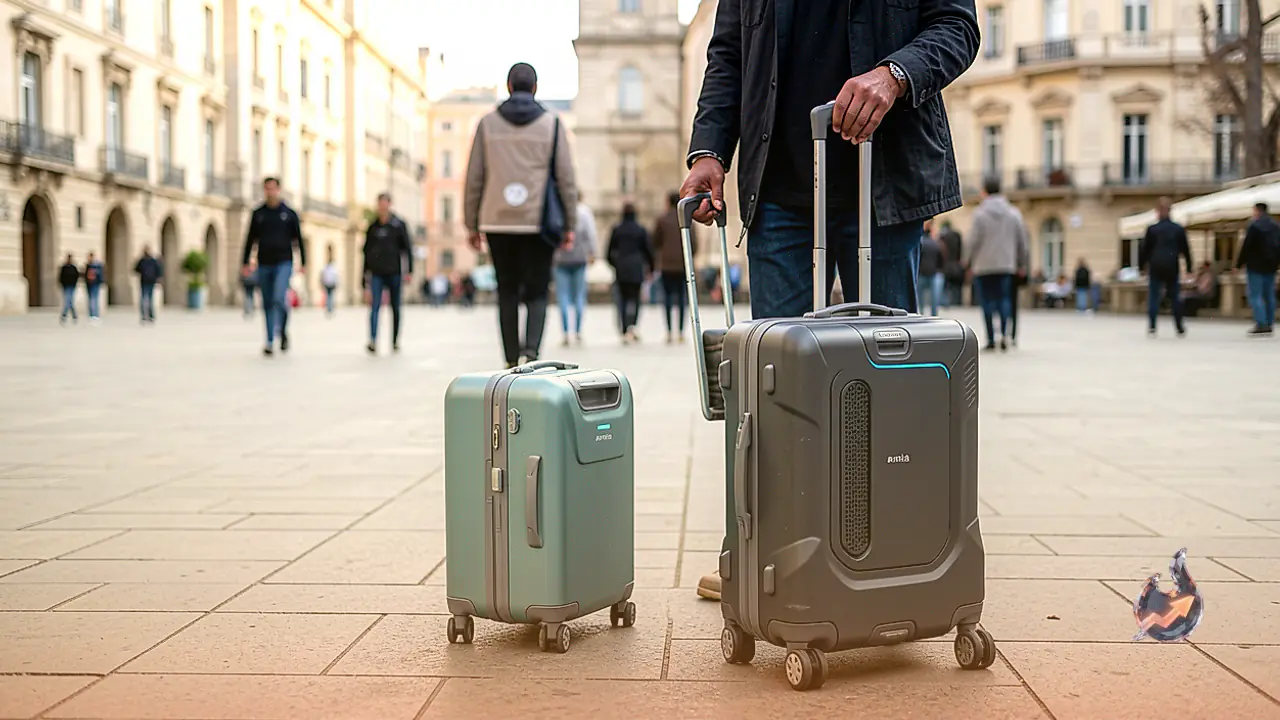

Luggage design is undergoing a major technological transformation, evolving from manual rolling bags into motorized personal mobility units. Bridging the gap between travel accessories and personal transit, a newly developed smart suitcase functions directly as a sit-on scooter. Engineered primarily to eliminate fatigue inside massive airport terminals, this motorized baggage allows passengers to sit on it and ride smoothly to their boarding gates.
Arista Vault and Technological Innovation
The rideable smart suitcase has been developed by Arista Vault, an Indian consumer tech hardware firm founded in 2017-18. Founded by Purvi Roy along with co-founder Atul Gupta, the venture focuses on introducing high-utility consumer products integrated with modern electronic systems. Their product roadmap emphasizes integrating automated assistive tech into everyday travel and security lifestyle accessories.
Design, Riding Mechanics, and Performance
The core mechanism of this motorized suitcase relies on ultrasonic sound systems combined with electronic drive controls. To ride the unit, travelers can pull out the integrated foot steps located near the base of the luggage and rest their feet comfortably. Propulsion is directed via a handheld remote control that manages forward and reverse movement with simple inputs. Riders can also steer the unit and bring it to a halt using their feet for balance and directional guidance.
In terms of mobility specifications, the suitcase travels at speeds between 7 and 10 kilometers per hour. The structural frame is rated to handle a passenger load capacity of up to 120 kilograms without straining the internal motor assembly. While functioning as regular luggage storage, the unit is tailored specifically for navigating smooth airport flooring across extensive concourses.
Battery Engineering and Autonomous Navigation
Powering the propulsion system is a removable battery unit that reaches a full charge in 2 hours. The detachable format ensures the battery pack can be easily unclipped for standard wall socket charging and aligns with baggage handling guidelines during transit.
The engineering incorporates multiple autonomous capabilities, led by an advanced Follow Me mode. When activated, the bag tracks the handheld remote sensor and rolls directly behind the traveler on its own without requiring physical contact or dragging. To maintain stability across uneven surfaces, the luggage includes self-balancing mechanisms alongside specialized hill climbing capabilities to manage moderate terminal ramps.
Retail Pricing and Commercial Distribution
The smart luggage is currently priced in the retail range of 50,000 to 60,000 rupees. The company leadership, comprising founder Purvi Roy and co-founder Atul Gupta, has stated that future manufacturing scale will enable them to lower this consumer price point. Prospective buyers can acquire the product directly through the company's official portal at aristavault.com, as well as on third-party marketplace channels including Amazon and Flipkart.
Scaling From 70 Lakh Outlay to 100 Crore Turnover
Detailing the financial journey of the hardware line, the co-founder explained that developing the complete smart luggage series required an initial investment of roughly 70 lakh rupees. That product foundation now powers an annual revenue turnover of 10 crore rupees. Looking ahead, the enterprise has mapped an aggressive expansion plan to scale its turnover past 100 crore rupees within the next 2 years.
The startup's commercial progress is further bolstered by institutional and government backing. The Government recently completed an investment in Arista Vault, alongside infrastructural support from the Ministry of Electronics and Information Technology, which allocated access to dedicated testing laboratories and engineering facilities. The company also secured private capital on the television pitch platform Shark Tank India, drawing an equity investment from Anupam Mittal, the founder of shaadi.com.