



















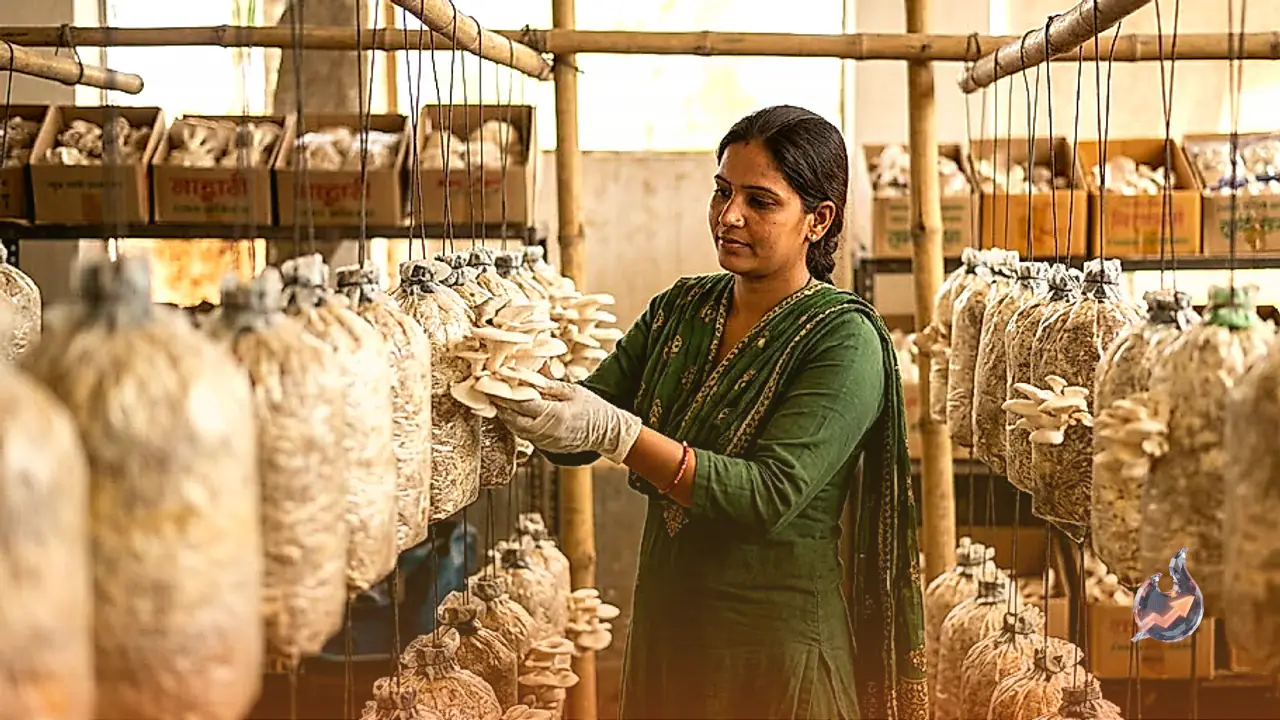

Pooja Saini, a resident of Saharanpur district in Uttar Pradesh, has set a remarkable benchmark in domestic agribusiness through sheer determination and hard work. Despite having completed her formal education only up to the 10th grade, she has proven that financial success does not depend on high academic degrees, but rather on proper guidance, perseverance, and dedication. What began as a joint venture with her husband shortly after their marriage to manage household expenses has today transformed into a highly profitable enterprise. Operating directly from her home, she cultivates mushrooms on a massive scale and earns a net annual profit of 15 to 20 lakh rupees. Her extraordinary achievement has not only brought local acclaim but also serves as a strong inspiration for countless homemakers seeking financial independence.
Training and Initial Steps at Krishi Vigyan Kendra
Pooja Saini began her entrepreneurial journey in 2018. Just three months after her marriage, she discussed income generation ideas with her husband to improve their family's economic standing. Together, they decided to explore mushroom farming within their residential premises. To acquire proper technical knowledge, they approached the Krishi Vigyan Kendra in Saharanpur, where they completed formal training in mushroom cultivation techniques. Armed with basic technical skills, they initiated their trial production using just two cultivation bags. At that point, they had never envisioned that this modest experiment would evolve into a multi-lakh business. Over the years, consistent effort and high product quality led to rising market demand, allowing them to expand their operation to between 5,000 and 6,000 cultivation bags today.
Cultivation Methodology, Varieties, and Cost Structure
Explaining the technical aspect of mushroom farming, Pooja Saini shared that straw (wheat chaff) serves as the primary raw material for preparing the cultivation bags. After proper chemical or steam treatment of the straw, mushroom spores are spawned into the mixture. Preparing a single cultivation bag incurs an expenditure ranging from 60 rupees to 120 rupees. Under optimal room temperature and humidity conditions, each bag yields approximately 3 to 5 kilograms of fresh mushrooms. Pooja Saini does not limit her farm to traditional varieties; instead, she grows multiple diverse mushroom species to maximize market profitability. Her portfolio includes Button mushroom, Oyster mushroom, Milky mushroom, Dhingri mushroom, Portobello mushroom, and the highly valued medicinal Keeda Jadi (Cordyceps) mushroom.
Harvesting Cycles, Commercial Distribution, and Market Demand
The operational lifecycle of mushroom farming offers rapid turnarounds. Once the bags are prepared and placed in controlled dark rooms, mushroom pins start sprouting within 15 to 20 days. Harvesting from a single batch continues systematically over a span of three to four months. Pooja Saini sells her premium produce at a market rate of 200 rupees per kilogram. Owing to the superior quality of her harvest, supply goes far beyond local markets. She regularly dispatches mushroom shipments to major urban centers including Delhi and Dehradun. The commercial demand for fresh mushrooms in these cities remains consistently high, to the extent that her current output frequently falls short of meeting total buyer demand.
Saharanpur's Standing as Uttar Pradesh's Mushroom Hub
Saharanpur district holds the prestigious first rank in mushroom production across the state of Uttar Pradesh. The geographic region benefits from favorable atmospheric temperatures and climate conditions that are ideally suited for growing several delicate mushroom strains. Utilizing this environmental advantage, numerous local youths and women are adopting indoor mushroom farming as a primary revenue stream. Homemakers like Pooja Saini have demonstrated that substantial annual earnings, surpassing many conventional white-collar jobs, can be generated without heavy capital infrastructure. Her initiative plays a vital role in strengthening the regional rural economy while redefining self-reliance for women.