























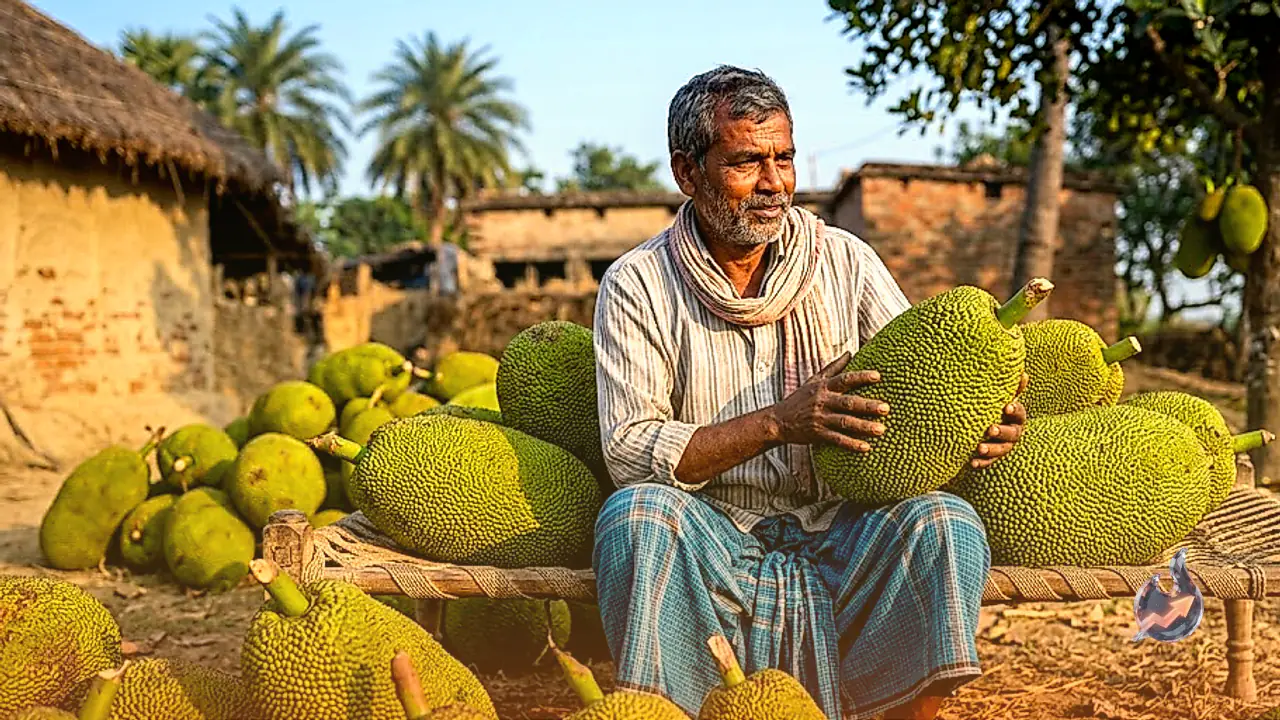

A farmer in Bihar's Jehanabad has quietly built a low-cost, high-return sideline out of jackfruit, timing his harvest so it hits the market only in winter, when the fruit fetches up to ₹150 a kilo. Anjani Sinha, who grows a mix of fruits on one and a half acres in the Punpun block of Patna district, planted 60 jackfruit trees on his land. Of those, 55 are still standing today and continue to bear fruit.
A different path from paddy and wheat
Growing paddy and wheat demands heavy labour and expense year after year, yet the returns often stay limited. That is why many farmers in Bihar are now shifting toward crops that need less time in the field and deliver a better return on effort. Sinha followed the same logic when he decided to plant jackfruit. He says the crop is rarely grown in his region, even though it is highly profitable once established. Unlike paddy and wheat, which need repeated doses of fertiliser, constant watering and frequent weeding, a jackfruit orchard needs close attention only in the initial years after planting. After that, both the labour and the running cost drop sharply, which is exactly the kind of trade-off Sinha was looking for.
Vietnamese Early Super variety, prized for its taste
All 55 surviving jackfruit trees on Sinha's farm are about one and a half years old, and have already produced one round of fruit. They belong to the Vietnamese Early Super variety, a strain known for its excellent taste. Most of this jackfruit ends up being cooked as a vegetable rather than eaten ripe. Jackfruit trees of this kind typically bear fruit twice a year, once during the summer months and again in winter, giving growers a choice of when to bring their produce to market.
Why he skips the summer crop
Sinha deliberately lets the summer crop go rather than harvesting it. His reasoning is simple: jackfruit does not fetch a good price when it floods the market in summer, while in winter a single kilo can sell for as much as ₹150. That price gap is why he takes only one harvest a year, timed to land in winter. The overall yield may be smaller as a result, since one full cropping cycle is skipped, but the sharply higher price more than makes up for it and leaves him with better income.
Five years into farming, guava and banana too
Sinha has been engaged in agriculture for the past 5 years. Besides jackfruit, he grows other fruits and vegetables depending on the season, including guava and banana, spreading his output across different crops rather than relying on one alone. He says the varieties he has planted are considered good quality strains that carry real potential to give farmers a solid income.
Early days, but better returns expected ahead
According to Sinha, the whole idea behind starting this style of cultivation was to move away from traditional farming and earn better income in a shorter span of time. Since the orchard is still in its early stage, the profit from it is not yet clearly visible on the books, but he expects better earnings to show up as the trees mature in the coming years.