




















Whether navigating the devastating aftermath of flash floods, structural collapse caused by earthquakes, or deep subterranean cave traps, search and rescue operations consistently present formidable challenges to emergency response teams. Dense debris, razor-thin crevices, and unstable structures often prevent human rescuers from making direct physical contact with survivors, while conventional large-scale robots remain too bulky to maneuver through micro-pathways. To overcome these critical bottlenecks, scientists at the University of Queensland in Australia have engineered a novel biohybrid robotics platform. By retrofitting living insects into cybernetic medical responders, dubbed 'Paraborgs', the researchers have demonstrated that tiny cyborgs can travel through complex rubble fields to identify survivors and administer immediate, life-saving pharmaceuticals. Across 25 rigorous laboratory trials, this cutting-edge technology achieved a 72 percent success rate, marking a transformative leap forward for disaster response and biomedical engineering.
Two-Tiered Operations of Observer and Medic Insects
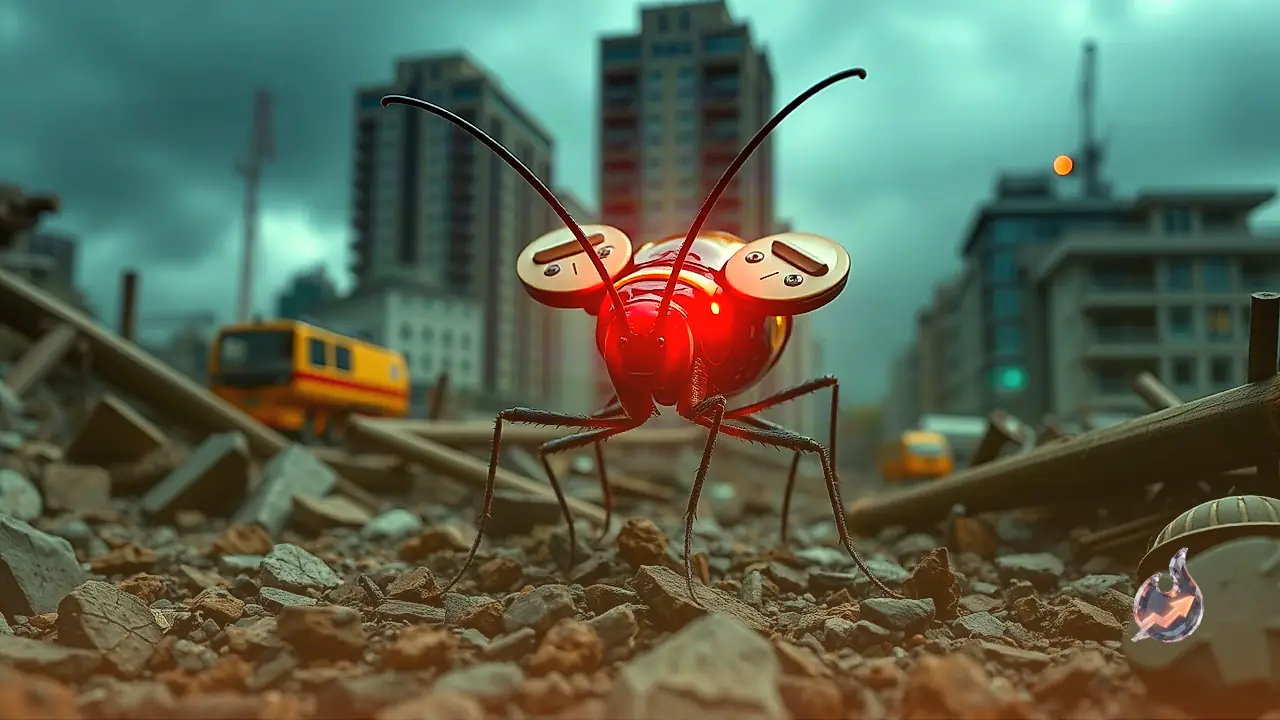
The Paraborg operational architecture relies on a specialized paired deployment of at least two cockroaches, with each organism assigned distinct tactical roles. The first component is the 'observer cockroach', which carries a miniaturized Wi-Fi camera mounted on its back. This camera feeds real-time high-definition video back to control room computers, allowing human operators to pinpoint the precise location of trapped individuals while simultaneously tracking the progress of the secondary roach.
The second organism serves as the 'medic cockroach', equipped with a micro auto-injector module fastened onto its dorsal surface. Once the target location is identified, operators remotely trigger a spring-loaded activation mechanism powered by chemical reaction pressure, driving the needle forward to inject vital medication directly into the victim. This dual-cockroach coordination ensures both continuous visual monitoring and rapid therapeutic intervention in environments inaccessible to conventional machinery.
Why the North Queensland Giant Burrowing Roach Was Selected
For this biohybrid platform, researchers specifically selected the North Queensland Giant Burrowing Cockroach species. Exhibiting impressive physical proportions, these insects reach lengths of up to 8.7 centimeters and widths of 4.5 centimeters, weighing up to 40 grams. Furthermore, members of this species boast a natural lifespan extending up to 10 years.
These robust physical parameters make the species uniquely qualified to carry heavy electronic payloads—including cameras, control boards, micro-electrodes, and auto-injectors—without sacrificing mobility or stability. Smaller insect species lack the load-bearing capacity required for such equipment, whereas the giant burrowing roach maintains traction and balance across uneven rubble, providing a durable platform that can be maintained over long operational life cycles.
Precision Navigation Control via Antenna Electrodes
Steering living organisms along designated search corridors represented a major engineering hurdle. To solve this, scientists installed micro-electrodes into the roaches' anatomy. Electrodes attached directly to the antennae deliver directional cues, steering the insect left or right, while secondary sensors positioned at the rear of the abdomen regulate movement speed.
By sending controlled electrical pulses, researchers actively guide the roaches toward specific coordinates. Co-author Thang Vo-Doan emphasized that this research effectively transforms a living insect into a functional, bio-integrated rescue platform. Crucially, while navigation relies on electrical stimulation, human operators retain total command over all critical medical actions, ensuring that drug delivery decisions remain strictly in human hands.
Evaluating Performance Across 25 Experimental Trials
According to lead author Hai Nhan Le from the University of Queensland, achieving precise positional alignment during deployment was the primary hurdle during testing. Navigating the cyborg insect to the target coordinate and ensuring proper physical contact required meticulous control. To evaluate system efficacy, the team conducted 25 distinct trials where the cyborgs were tasked with negotiating three sequential checkpoints before attempting to inject a silicone target model.
The quantitative results of these experimental trials broke down as follows
- Direct Contact Injections (12 Successful Trials): Achieving direct head contact between the insect and target resulted in 12 precise, flawless injections.
- Medium-Distance Success (6 Successful Trials): Injections initiated from distances between 5 and 15 centimeters yielded 6 additional successful drug deliveries.
- Sudden Directional Deviations (2 Failed Trials): Sharp, unexpected turns by the roaches caused 2 trials to abort due to loss of alignment.
- High Recoil Force (5 Failed Trials): Attempts executed from distances of 15 to 25 centimeters failed 5 times due to excessive pressure causing the injector module to recoil backward upon firing.
Despite these physical constraints, the overall 72 percent success rate confirms the practical viability of biohybrid rescue systems under real-world disaster conditions.
Cost Savings and Energy Efficiency of Biohybrid Robotics
Designing fully synthetic micro-robots capable of traversing chaotic debris requires immense financial investment and suffers from severe battery life limitations. In contrast, biohybrid robots offer a drastically cheaper alternative by leveraging the natural biomechanics, leg propulsion, and structural resilience of living organisms. Their energy demands are exceptionally low; the insect powers its own locomotion through normal biological functions, leaving internal batteries to supply power solely to lightweight onboard electronics.
Commenting on the broader medical implications, Than Nho Do, Director of the Medical Robotics Lab at the University of New South Wales, noted that the platform represents a major breakthrough from a biomedical perspective. In scenarios where immediate physical evacuation to a hospital is delayed, these cyborgs can deliver emergency treatments for acute trauma, severe allergic reactions, or venomous snakebites directly at the scene, extending the critical survival window for victims waiting for heavy extraction machinery.
Advancements Beyond Previous Japanese and Australian Trials
This milestone builds upon several years of progressive research in cybernetic insect control. In 2022, researchers in Japan successfully demonstrated remote navigation of Madagascar Hissing Cockroaches. Building on that foundation last year, the same Australian research team successfully guided Darkling Beetles using standard video game controllers.
The latest breakthrough by the University of Queensland team advances the field from basic locomotion control to functional medical execution by incorporating active payload delivery systems, transforming passive surveillance bugs into active emergency medics.
The Future of Search and Rescue Operations over the Next Decade
The development team stresses that this biohybrid technology is designed to augment, rather than replace, human emergency responders. In future disaster scenarios where structural instability renders human entry impossible, response teams could deploy swarms of specialized cyborg insects—some carrying high-resolution cameras and environmental sensors, others carrying emergency medical treatments.
While encountering a large cockroach under normal circumstances might evoke fear, for a survivor trapped beneath collapsed concrete, a biohybrid roach could mean the difference between life and death. Scientists anticipate that fully functional Paraborg rescue teams could be actively deployed in field operations within the next 5 to 10 years.