






















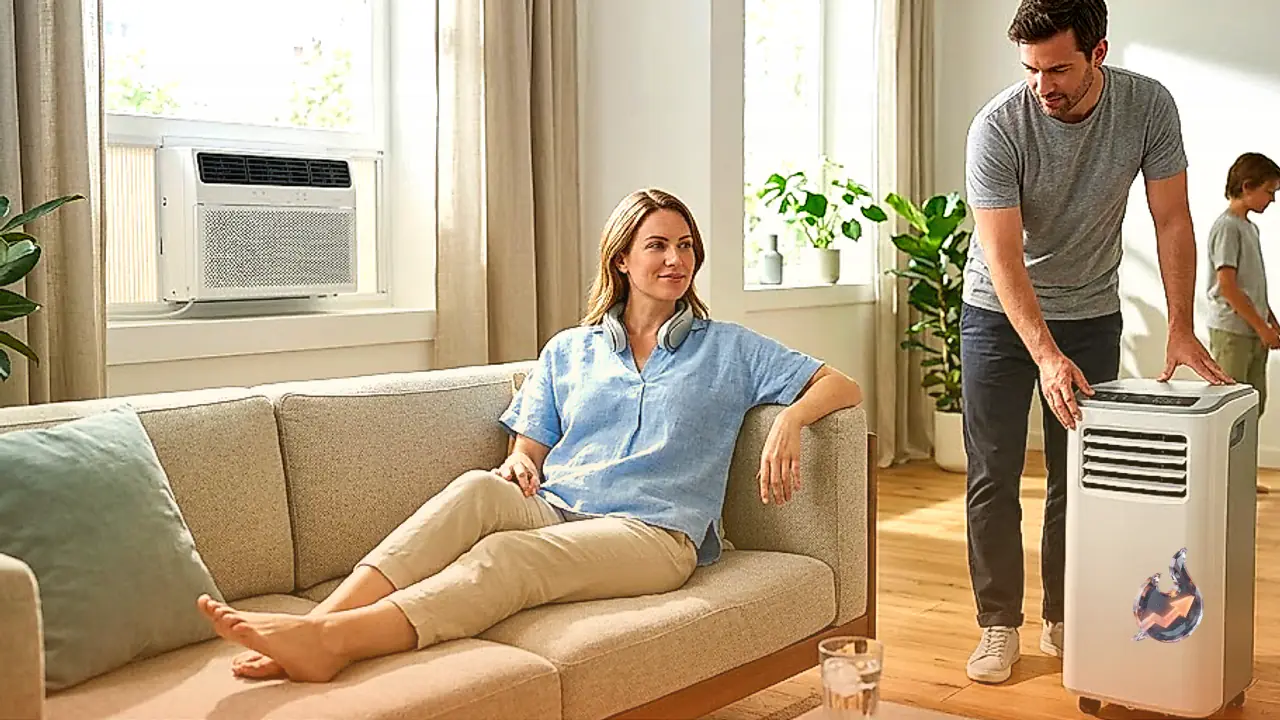

Most window AC units prevent you from using your window, but the U-shaped design from Midea solves this issue entirely. By using a support bracket, the bulk of the unit’s weight is shifted outside the wall, which allows the window to slide down into the notch between the unit’s front and rear halves. This configuration ensures a much tighter seal, resulting in quieter performance and significantly less wasted cooling energy.
Top Recommendation: Midea
This is currently the top choice for 2026, operating at a remarkably quiet 42 decibels on high, largely because most of its mechanical hardware is positioned outside the window. It offers seamless integration with Google Assistant and Amazon Alexa, and includes both app and remote control support, with the app even sending alerts for filter changes. It comes in 8,000, 10,000, and 12,000 BTU versions; for context, 8,000 BTU is generally sufficient for a master bedroom or standard living room.
It is worth noting that Midea also offers a window-mounted heat pump called the PWHP. Unlike basic AC units with a simple heating add-on, this is a fully reversible heat pump. It operates by moving heat rather than generating it, allowing it to provide warmth even when outside temperatures are well below freezing. Its 9,000 BTU output is impressive and far more economical to run than many other heating devices, though as this remains cutting-edge consumer technology, units are quite expensive and currently difficult to source.
The Portable Option: Zafro
For those needing mobility, the Zafro is a freestanding, dual-hose portable unit that does not require permanent mounting. It uses an adjustable panel that slides into a window opening, allowing you to move it from room to room as needed. Control options include onboard buttons, a remote, and a Wi-Fi-enabled app. It features modes for humidity reduction, fan-only operation, and a high-power mode designed to reach 16 degrees Celsius (61 degrees Fahrenheit) quickly.
By utilizing two hoses instead of one, the Zafro avoids the negative-pressure effect common in cheaper portable units, which often draws warm air back into the room through gaps. While its portability is a significant advantage, sealing the window perfectly can be a bit tricky, and it is noticeably louder than the Midea, operating at 60 decibels on its highest setting.
Stylish and Smart: Windmill
The Windmill brand focuses on aesthetics and installation simplicity, marketing its units as beautiful, quiet, and easy to set up. It arrives pre-assembled, cutting installation time to roughly 15 minutes. The WhisperTech model operates at 50 decibels on its high setting. It features a convenient magnetic front panel for easy access to the main and activated carbon filters, supports Google Home integration, and includes an auto-dimming LED display for smart-home enthusiasts.
Wearable Cooling: Sony Reon Pocket
When you are away from home, traditional units are impractical, which is where the wearable Sony Reon Pocket comes in. It sits against the back of your neck using a rubberized band and utilizes a stainless-steel plate to heat or cool, supported by a small fan. The fourth-generation model has fixed the design flaws of its predecessors, such as a loose neckband and poor venting. The new Reon Pocket Tag 2 sensor feeds outdoor data to the app for automatic adjustments. The battery lasts about 10 to 15 hours in Smart Cool mode, and it charges to 90 percent in just over two hours.