



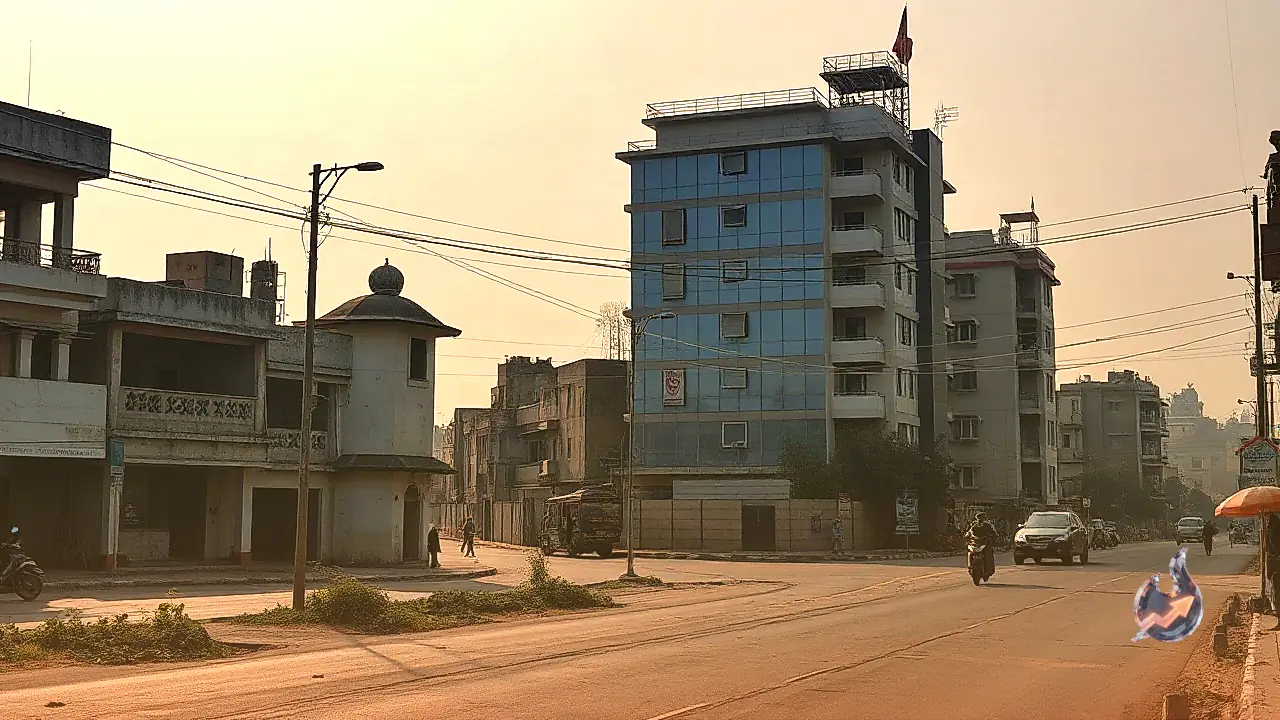
















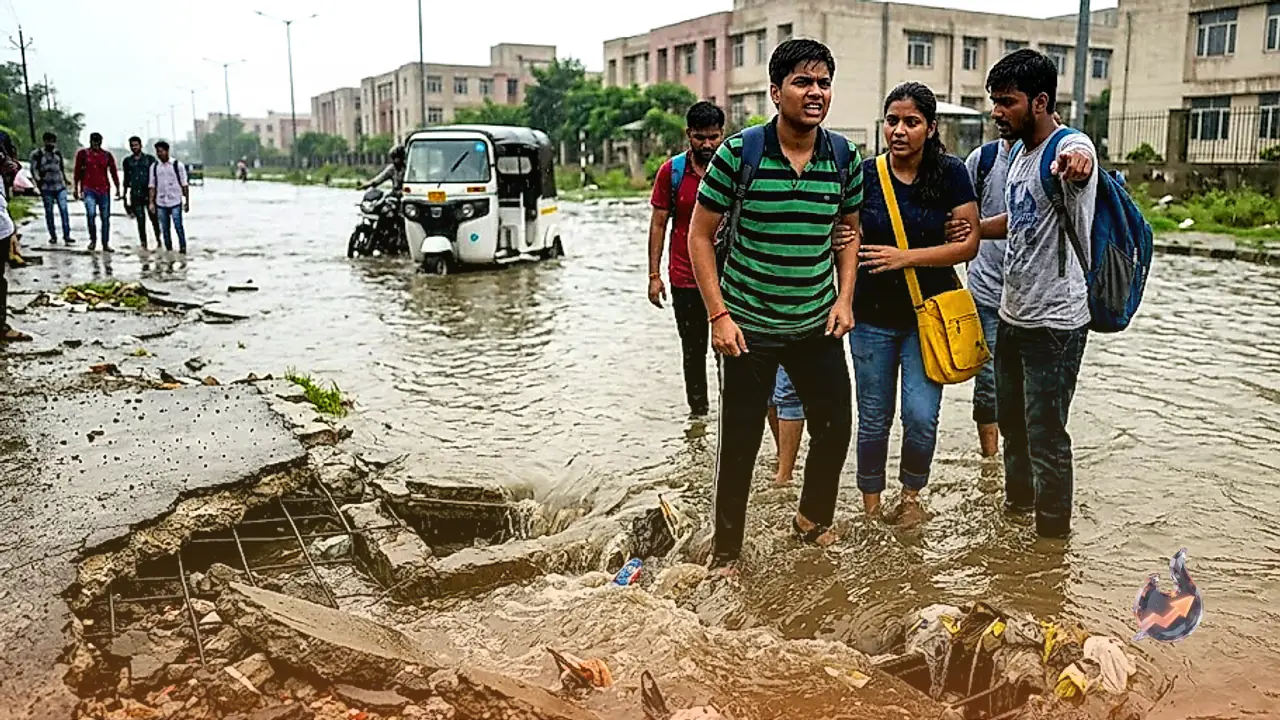

The claims of Greater Noida being a premier, high-tech smart city in Uttar Pradesh have washed away with the very first spells of monsoon rain. In Knowledge Park-3, widely regarded as the region's primary educational hub, the administrative assurances of robust road infrastructure and efficient drainage systems have fallen flat. Specifically, the D-block road situated directly in front of Gate No. 3 of the IIMT College has transformed into a dangerous muddy swamp. Following the downpour, deep potholes across the stretch have filled with dirty water, presenting massive hurdles for local businesses, residents, and the thousands of students who traverse this route daily. The prevailing conditions have sparked severe anxiety among locals, who fear that a major mishap is waiting to happen if immediate action is not taken.
Daily Struggles of Residents and Shopkeepers
Local residents and business owners are deeply frustrated by the sheer neglect of the area. Aryan Chaudhary, a local resident, explained that the road has deteriorated to such an extent that even walking to nearby shops has become an uphill task. This particular road witnesses heavy daily movement of commercial goods, including paint, footwear, and other essential supplies. However, the deep craters and thick layers of mud make vehicle navigation nearly impossible. According to Chaudhary, commuters routinely lose their balance and fall into these submerged potholes. Whether it is working professionals, college students, or local buyers going to the market, almost everyone ends up with their clothes ruined by splashes of filthy water and mud. Despite several minor and major accidents occurring on this stretch in the past, a permanent solution remains elusive.
The Stark Contrast Between Smart City Claims and Ground Reality
Another local resident, Suryansh Pratap Singh, criticized the complete breakdown of civic amenities, stating that while Greater Noida is marketed as a highly advanced city, the ground reality of Knowledge Park tells a completely different story. He pointed out that while large-scale construction activities, including builder studios, luxury apartments, and residential flats, are rapidly expanding around this road, basic infrastructure is utterly non-existent. The persistent waterlogging and dangerous potholes amidst grand claims of urbanization highlight the extreme apathy and negligence of the local municipal authorities.
Hidden Dangers Beneath the Waterlogged Streets
Veer Bahadur Singh, who also resides in Knowledge Park-3, raised serious alarms over the safety of commuters. He observed that even a brief spell of rain turns the entire road into a virtual lake. Because the deep potholes are entirely covered by dirty water, it becomes impossible for commuters to distinguish where the flat road ends and a dangerous crater begins. This creates a perpetual safety hazard, particularly for two-wheeler riders and pedestrians, who are forced to navigate the waterlogged streets with no visual cues, leaving their safety entirely to chance.
Students Bear the Brunt of Administrative Apathy
The worst victims of this administrative failure are the young students. Abhishek, a student, shared how the monsoon severely disrupts their educational routine. Students step out of their hostels wearing clean, ironed clothes, only to have them ruined by splashing mud and dirty drain water long before they can reach their college classrooms. Negotiating this waterlogged stretch during the rainy season feels like a daily battle. Many students frequently slip and fall in the mud, which not only damages their study materials and laptops but also inflicts physical injuries.
Future of Over Fifty Thousand Students at Risk
Speaking on the grim situation, Professor R.B. Singh remarked that the civic infrastructure of Knowledge Park collapsed on just the second day of the monsoon season. He emphasized that the Knowledge Park area is a massive educational hub, housing more than 50,000 students who have come from different states across India. The locality features numerous sprawling student hostels and PG accommodations both inside and outside the college campuses. Despite such a massive student population, the state of the roads, drainage, and basic hygiene is deeply concerning. Professor Singh noted that even moderate rain leads to a flood-like scenario, submerging the entire vicinity. While authorities consistently make tall claims about development and world-class facilities, the actual situation is deplorable. He warned that if the road is not repaired and the drainage system is not overhauled immediately, a major tragedy is inevitable.
Ignored Warnings and Lack of Accountability
Locals point out that Knowledge Park is the heart of Greater Noida's academic environment, seeing daily footfall from thousands of students, professors, and administrative staff. Leaving such a vital zone in ruins directly compromises public safety. Previously, the issue was formally brought to the attention of Greater Noida Authority's GM Project, A.K. Singh. Despite this direct communication, no corrective measures were taken, and the administrative body turned a blind eye to the looming crisis. Consequently, with the arrival of the monsoon, the region is once again battling severe waterlogging and hazardous roads. The community has urged the Greater Noida Authority to immediately fill the hazardous craters, establish a functional drainage network, and implement a long-term engineering solution to provide relief to the students and residents.