


















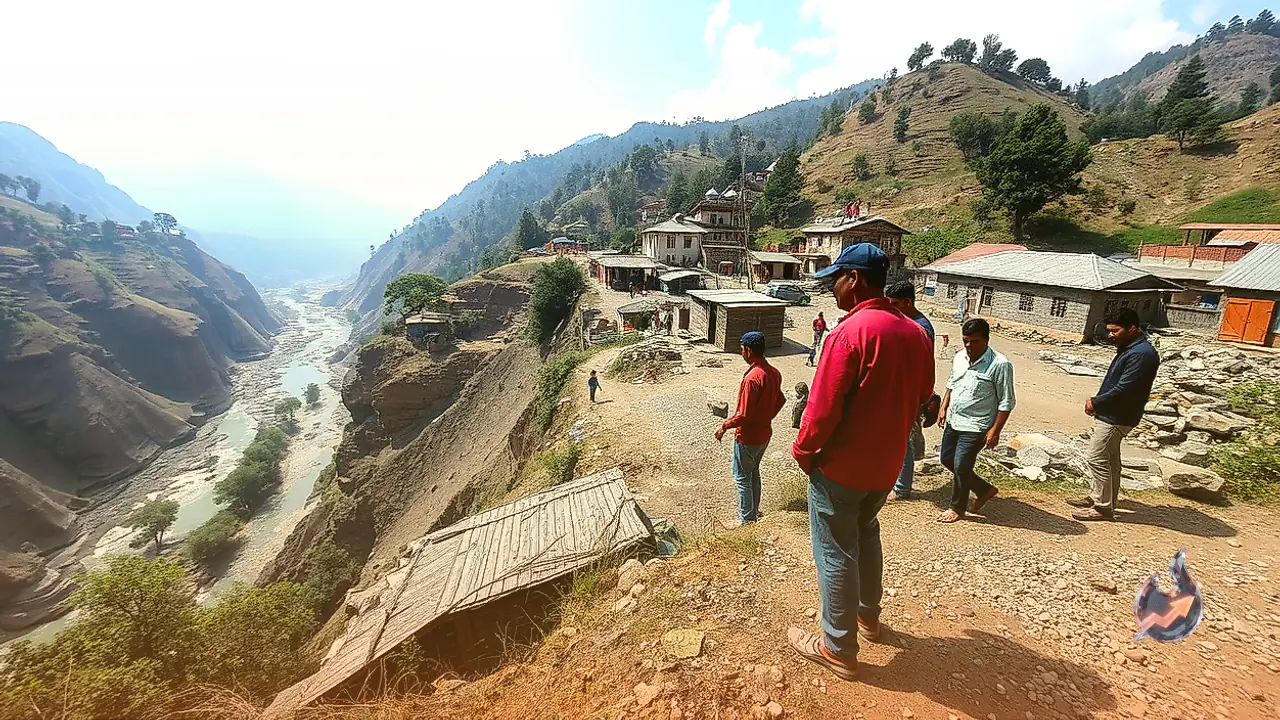

The remote border village of Garbyang in the Pithoragarh district of Uttarakhand is currently facing a severe threat to its survival due to progressive land subsidence and riverbank erosion. Situated on a plateau to the right of the Kali River at an altitude of approximately 10,500 feet near the borders with China and Nepal, the village was once renowned for its breathtaking alpine valleys. In earlier decades, its natural beauty earned it titles such as India's Europe and Mini Europe. Today, however, the very river flowing beneath the settlement has become a critical hazard, gradually eating away at the foundation of the plateau and causing the landmass to slide downward.
From a Prosperous Trading Hub to a Deserted Outpost
Prior to the 1962 war between India and China, Garbyang was an economic powerhouse that served as a central junction for international trans-Himalayan commerce. The cross-border trade route with Tibet provided enormous prosperity and established the area's global reputation. During the period of British rule, this affluence combined with scenic topography led to it being officially referred to as Mini Europe. However, the conflict in 1962 abruptly closed the trading lines and stripped the village of its economic foundation. Although bilateral trade between India and China was restored in 1992, the former vitality and economic stability never returned to the settlement. Out of 400 families originally belonging to Garbyang who are now dispersed across the country and the world, only 146 families currently reside permanently in the village.
History of Displacement and Chronic Infrastructure Deficits
The ground instability driven by continuous river cutting has displaced residents for generations. Because of progressive subsidence, more than half of the village's households were formally shifted and resettled in Sitarganj within the Udham Singh Nagar district back in 1976. Despite this long history of peril, the residents who chose to remain have spent decades cut off from core civic infrastructure. Situated directly on an international boundary, Garbyang still lacks grid electricity, reliable drinking water systems, medical facilities, and modern telecommunication networks. While strategic road connectivity up to the Lipulekh Pass reached the region in 2020, solving basic road transit, other vital services remain completely disrupted. For telecommunications, locals remain dependent on mobile signals spilling over from Nepal, often forced to travel six kilometres to Chhialekh simply to make a phone call.
Local Grievances and Administrative Commitments
Local resident Krishna Garbyal pointed out that while the highway link has provided much-needed connectivity, the absence of functional healthcare, electricity, tap water, and network towers makes living conditions untenable, sustaining a high rate of outbound migration. Another villager, Bhupendra, highlighted that the swelling current of the Kali River is accelerating the erosion rate, putting the very existence of the settlement in jeopardy since no substantial engineering works have been executed on the riverbanks to contain the erosion.
Addressing the escalating concerns of the residents, District Magistrate Ashish Bhatgain stated that Garbyang has been inducted into the Vibrant Villages Programme. Under this initiative, the administration plans to electrify the village by next year and commence comprehensive river protection measures to halt further erosion along the riverbank.