























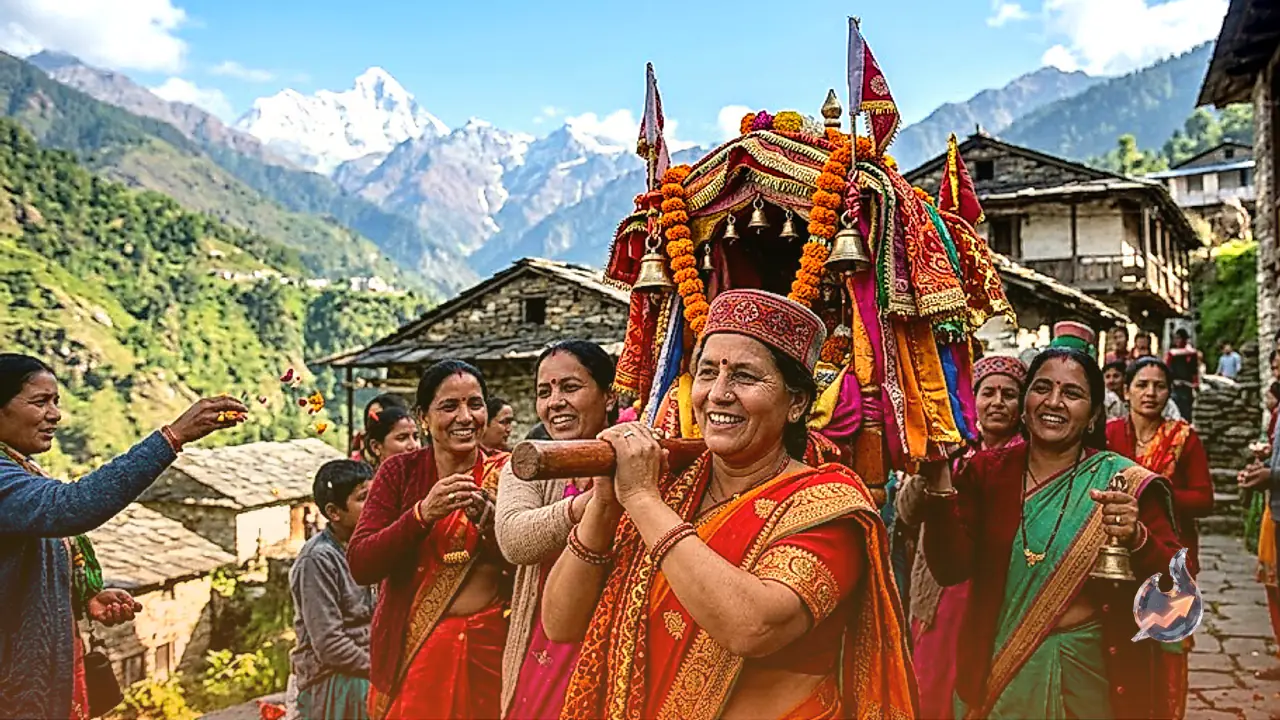

The sacred 'Badi Jat' pilgrimage of Goddess Nanda Devi, which commenced from the Nanda Dham in Kurud, Chamoli, is currently traversing its rugged mountain path towards the high Himalayas. The start of this pilgrimage has once again ignited intense discussions among devotees regarding the historic 'Nanda Devi Rajjat' mega-pilgrimage, which is officially scheduled to take place next in the year 2027. Ordinary people and pilgrims often find themselves confused about the exact differences between these two separate journeys dedicated to the same deity. While both reflect a profound spiritual legacy, they differ vastly in their geographic scope, cultural scale, and traditional execution.
Local Tradition Versus Historic Mega-Pilgrimage
In the mountainous society of Uttarakhand, Goddess Nanda Devi is not merely worshipped as a divine entity but is deeply loved as a daughter of the household. This unique emotional bond shapes the profound difference between the Badi Jat and the Rajjat. While the Badi Jat is a regional event organized according to local religious customs and traditional beliefs of specific areas, the Rajjat is an extraordinarily grand, historic trek. The scale of the Rajjat is massive, integrating holy palanquins (dolis) and colorful ceremonial umbrellas (chantholis) from villages across various parts of Uttarakhand. The Badi Jat represents a periodic expression of regional faith, whereas the Rajjat is a colossal socio-cultural confluence that unites the entire Himalayan region.
The Twelve-Year Cycle and the Treacherous Trek
The Nanda Devi Rajjat cannot be categorized as a regular pilgrimage, as it is held only after long, specific intervals. According to traditional systems, this mega-journey is meant to be organized once every 12 years. Historian Dr. Ajay Rawat notes that after the successful completion of the Rajjat in the year 2000, the next pilgrimage was due in 2012. However, due to the catastrophic natural disaster that struck Uttarakhand around that time, the event had to be postponed and was eventually conducted in 2014. Based on this revised schedule, the next grand Rajjat is now set to be organized in the year 2027.
This trek is globally recognized as one of the most grueling and challenging religious journeys. It covers an approximate distance of 290 kilometers. While the initial leg of the journey can be traveled using motor vehicles, the vast majority of the distance must be covered on foot through extremely inhospitable Himalayan terrains. Pilgrims must navigate jagged rocky trails, dense virgin forests, steep mountain ridges, and freezing high-altitude glaciers. To ensure safety and accommodate the ancient religious protocols, the entire route is divided into 18 designated night halts, where travelers rest amidst nature.
The Mystical Four-Horned Ram and the Emotional Farewell
Among the most miraculous and unique traditions of this long pilgrimage is the presence of the 'Chousingya Khadu', which is a rare four-horned ram. According to local lore, this special ram is born in the Chandpur region just before the commencement of the Rajjat, a phenomenon regarded as a divine sign. Throughout the arduous journey, the ram plays a highly sacred role. Special saddlebags are strapped to its back, containing traditional gold and silver ornaments, cosmetics, garments, and other ritual gifts offered to Goddess Nanda Devi by her maternal family. Upon reaching the final destination of Homkund, special elaborate rituals are performed. Following this, the four-horned ram is left to travel completely alone towards the snow-clad peaks of the Himalayas, guided by no human hand.
The Nanda Devi Rajjat is far more than a series of religious rituals; it is a deeply poignant narrative of bidding farewell to a daughter of the hills as she leaves for her husband's home. In the folk culture of Uttarakhand, Goddess Nanda Devi is revered variously as a daughter, sister, or daughter-in-law. The Rajjat represents the tradition of sending her away from her maternal home to her husband's abode, the sacred Mount Kailash, the home of Lord Shiva. This emotional connection is why, as the pilgrimage nears its end, the joy of the devotees is overtaken by overwhelming sadness and tears. This entire ceremony beautifully showcases the deep-rooted familial bonds of the mountain communities.
The Administrative Rift and the Roles of Kurud and Nauti
The co-existence of the Badi Jat this year and the upcoming Rajjat in 2027 stems largely from administrative and traditional disagreements between different organizing bodies. According to local sources, differences in opinion emerged between the Nauti Organizing Committee and the Kurud faction. The Nauti committee was initially preparing for the Rajjat to take place, but they later decided to postpone the pilgrimage, citing the inauspicious astrological phase of Malmas. On the other hand, the Kurud faction, asserting the vital and non-negotiable importance of their traditional role in the annual rituals, decided to proceed with their ancestral Badi Jat pilgrimage. This divergence is the primary reason why the Badi Jat is being held now, while discussions about the 2027 Rajjat continue to gain momentum.
In the grand layout of this pilgrimage, historic locations like Kurud, Nauti, and Kansuva hold distinct and ancient responsibilities. Traditionally, the organization and leadership of the Nanda Rajjat have been closely associated with the Kunwar Rajputs of Kansuva. Meanwhile, the holy palanquins originating from the Nanda Devi temple in Kurud form the spiritual core of the rituals. As the procession moves forward, palanquins and sacred umbrellas from various other regions join the main caravan. This collective convergence elevates the event from a regional ceremony to an unparalleled symbol of collective faith and social unity across the entire Garhwal region.
Social Solidarity and the High-Altitude Challenges
The defining feature of the Nanda Rajjat is its mass participation, where villagers from across the mountain terrain spontaneously join the journey. As the caravan advances, villagers from nearby settlements bring their local deities' palanquins to join the main stream. The hospitality of the local mountain residents makes this journey truly extraordinary. They selflessly provide free food and shelter for the incoming waves of pilgrims. In many remote villages, the locals completely vacate their own homes for the travelers, choosing to sleep in cold cattle sheds (locally known as Goth). This unwavering spirit of service transforms a rigorous religious trek into a grand celebration of social harmony and mutual love.
The most exciting and dangerous phase of the Rajjat begins as the pilgrims enter the high-altitude zones of the Himalayas. The route winds through treacherous but breathtaking locations such as Bedni, Patar Nachauniya, Roopkund, Shila Samudra, and finally, the remote basin of Homkund. Located at an altitude of approximately 4,010 meters above sea level, Homkund hosts the final complex rituals on the auspicious day of Nanda Ashtami. Once these intense prayers are completed, the four-horned ram is officially released to accompany Goddess Nanda Devi to Mount Kailash. This final departure remains the most emotionally charged moment of the entire pilgrimage, leaving almost every devotee in tears.


