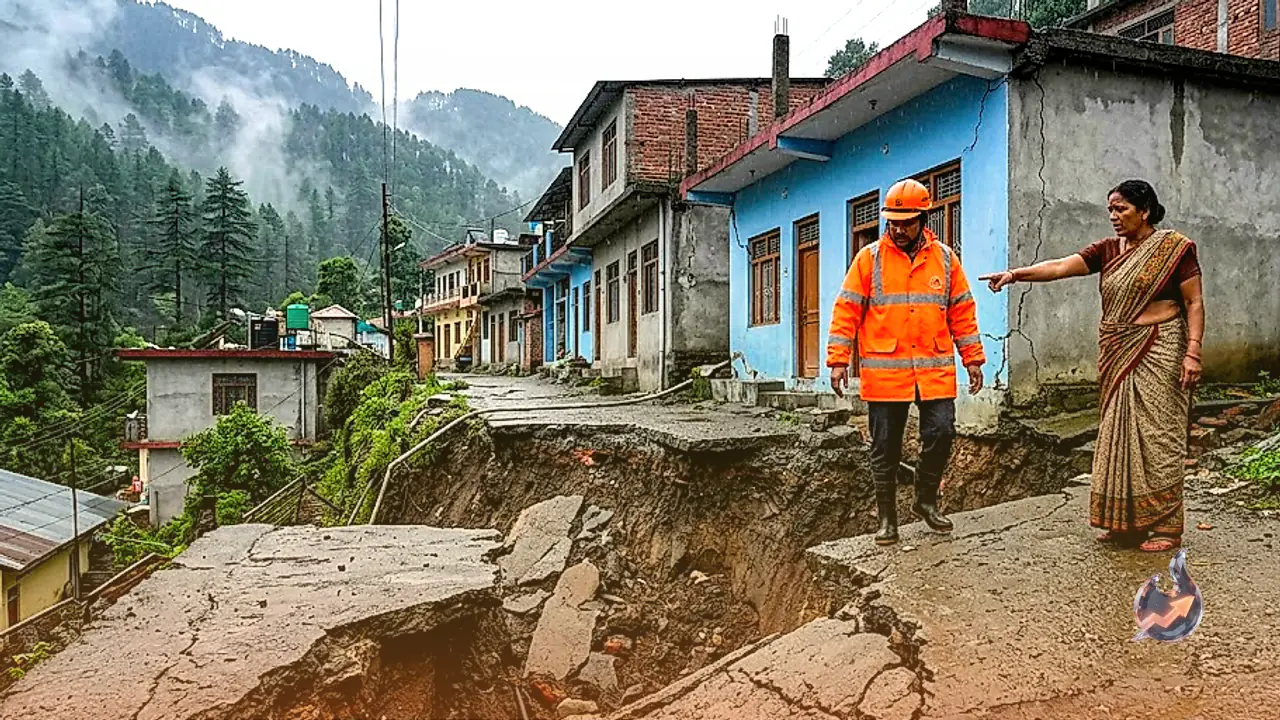

























Continuous heavy monsoon rains persisting for the past three days across the mountainous regions of Uttarakhand have dramatically reshaped the state's riverine landscape. Seasonal rivulets and streams that typically run dry during the summer months are currently roaring with intense hydraulic force. Among them, the revered Shipra River in Nainital district, known for its unique north-flowing trajectory, is flowing in full spate. Near the famed Kainchi Dham pilgrimage center, video clips capturing the river's turbulent and powerful surge have gone viral on social media platforms, leaving local residents and visiting devotees awestruck by the sheer magnitude of the water flow.
Current Water Surge and Safety Infrastructure Around Kainchi Dham
The sudden influx of rainwater from the upper reaches of Nainital district has led to a significant rise in the Shipra River's water level. Large crowds of devotees and tourists have been gathering along safe vantage points near Kainchi Dham to witness the rare spectacle of the swollen river. Despite the terrifying velocity of the current, local authorities confirmed that no loss of life or property damage has been reported in the vicinity of Kainchi Dham or neighboring settlements. The main temple complex of Kainchi Dham remains completely safe and unaffected. The dramatic transition of what is ordinarily a tranquil mountain stream into a tempestuous torrent has sparked widespread curiosity, while district authorities maintain a vigilant watch along vulnerable banks.
Origins Near Bhowali and the Geographical Rarity of an 'Uttarvahini' River
Emerging from the lush green hills of the Bhowali region, located approximately 11 kilometers from Nainital, the Shipra River holds a distinct geographical distinction as an 'Uttarvahini' river. Unlike the overwhelming majority of rivers in the Indian subcontinent that travel from north to south or east to west, the Shipra flows in a reverse direction from south to north. This rare orientation confers immense spiritual and ecological significance upon the river. Its primary source lies in the forested slopes of Gagar near Bhowali, where dozens of minor natural springs unite to form the central river channel. Meandering past Bhowali, the river skirts the edge of the sacred Kainchi Dham shrine before eventually terminating into the Kosi River near Khairna.
1916 Discovery, Historical Context, and Revenue Mapping Status
The historical roots of the Shipra River are deeply intertwined with the development of the Kumaon region. According to Sanjay Verma, former chairman of the Bhowali Municipal Council, official archival records trace the formal discovery of the river back to 1916. However, Verma points out that the river's precise alignment and administrative boundaries remain ambiguous in present-day government revenue maps. Notwithstanding these administrative record gaps, the Shipra River has historically functioned as an indispensable ecological lifeline, sustaining agricultural needs and drinking water supplies for Bhowali and surrounding rural hamlets for generations.
Ecological Crisis: How a Lifeline Degraded into a Sewage Channel
Witnessing the roaring torrent of the Shipra today makes it difficult to imagine that just a few years ago, the river was fighting an existential battle for survival. Decades of unmanaged urban growth, plastic dumping, and untreated domestic sewage turned its pristine waters into a heavily polluted drain. Due to the absence of a functional Sewage Treatment Plant (STP) in the town of Bhowali, raw household wastewater was routinely discharged directly into the river channel for years. This persistent contamination severely degraded the river's water quality, reducing it to a stagnant, malodorous channel during non-monsoon periods.
Formation of Shipra Kalyan Samiti and Identification of 7 Recharge Zones
Alarmed by the alarming environmental degradation of the river, local citizens, environmentalists, and community leaders banded together in 2017 to form the Shipra Kalyan Samiti (Shipra Welfare Committee). Jagdish Negi, president of the committee, explains that a detailed hydrological survey of the river catchment was conducted to formulate a scientific restoration strategy. The survey successfully identified 7 major water recharge zones along the surrounding hills. These recharge zones act as natural sponges, collecting surface runoff and feeding the subterranean aquifers that keep the Shipra alive.
1,000 Recharge Khals and Forest Revival Through ANR Techniques
To maximize groundwater recharge, the Shipra Kalyan Samiti partnered with the Forest Department to construct nearly 1,000 'khals'—traditional rainwater harvesting earth pits—across the forested recharge zones. These khals intercept torrential monsoon runoff, preventing soil erosion while allowing rainwater to percolate deep into the water table. Simultaneously, conservationists employed the Assisted Natural Regeneration (ANR) method to restore degraded forest patches. Rather than planting nursery saplings, ANR focuses on strictly protecting existing forest areas from forest fires and livestock grazing. This protection enables dormant root systems and stumps of native tree species cut down decades ago to naturally sprout new shoots. Through ANR, approximately 40,000 native broad-leaved trees, including Banj oak, Kafal, Buransh (rhododendron), Ayar, and Mehal, have been successfully rejuvenated across the watershed.
20 KM Course, 3 KM Dry Stretch, and the Rs 13.45 Crore Masterplan
From its origin in the Gagar forests down to its confluence with the Kosi River at Khairna, the Shipra River spans a total length of approximately 20 kilometers. However, owing to seasonal hydrological imbalances, a 3-kilometer stretch near its source dries up completely once the monsoon rains recede, rendering the river ephemeral in its upper reaches for much of the year. To address this crisis, the state government formulated a comprehensive Rs 13 crore 45 lakh (Rs 13.45 crore) rejuvenation plan in 2018. Under this initiative, government departments including the Forest Department expended over Rs 2 crore on critical watershed management works, such as building earthen bunds and khals within the Sanatorium and Kulethi forest reserves.
Recent Interventions at Ghorakhal and the Critical Need for Sewage Infrastructure
Restoration efforts have continued into the current year through persistent advocacy by the Shipra Kalyan Samiti. The committee facilitated a joint field inspection of the primary Ghorakhal catchment area with senior officials from the Irrigation Department. Following the inspection, water conservation works worth approximately Rs 10 lakh were sanctioned and executed, involving the construction of check dams and water storage khals. Nevertheless, committee president Jagdish Negi emphasizes that physical conservation structures alone cannot ensure long-term river health. He stresses that constructing dedicated sewage treatment facilities in Bhowali to intercept municipal wastewater remains an absolute prerequisite for permanently saving the Shipra River.
The Legend of Baba Neem Karoli: The Miracle of Water Turning into Ghee
Beyond its geographical uniqueness, the Shipra River is deeply entwined with the spiritual legacy of Neem Karoli Baba, the venerated saint who established Kainchi Dham. Bhuvan Tiwari, a devotee associated with Kainchi Dham, recounts a famous legend associated with the river and the saint. According to local lore, during a major foundation day celebration at Kainchi Dham, the temple kitchen unexpectedly ran out of clarified butter (ghee) required to prepare traditional malpuas for the public feast (bhandara). Upon being informed of the shortage, Baba Neem Karoli instructed disciples to fetch buckets of water directly from the flowing Shipra River.
When the river water was poured into the hot cooking vats, it miraculously transformed into pure ghee, allowing the kitchen staff to fry all the malpuas without interruption. Later, when fresh supplies of commercial ghee arrived at the ashram, Baba Neem Karoli stated that three canisters of ghee had been borrowed from Mother Shipra and had to be returned. In accordance with his divine command, three canisters of pure ghee were poured back into the river's current to fulfill the spiritual obligation. This miracle remains one of the most cherished stories recounted by devotees visiting Kainchi Dham.
Inter-Departmental Coordination and the Future Roadmap for Shipra
While current heavy rainfall has temporarily restored the Shipra River to its majestic, surging glory, long-term administrative and community efforts are required to maintain perennial flow. The Uttarakhand Irrigation Department, Jal Sansthan, Forest Department, and local municipal bodies are collaborating on integrated river management plans. Concurrently, grassroots organizations like the Shipra Kalyan Samiti continue to organize regular cleanup drives, plastic waste removal, and community tree plantation events. Experts maintain that combining effective rainwater harvesting with strict municipal sewage treatment will ensure that the north-flowing Shipra River continues to nurture the ecology and spiritual heritage of Nainital district for generations to come.