















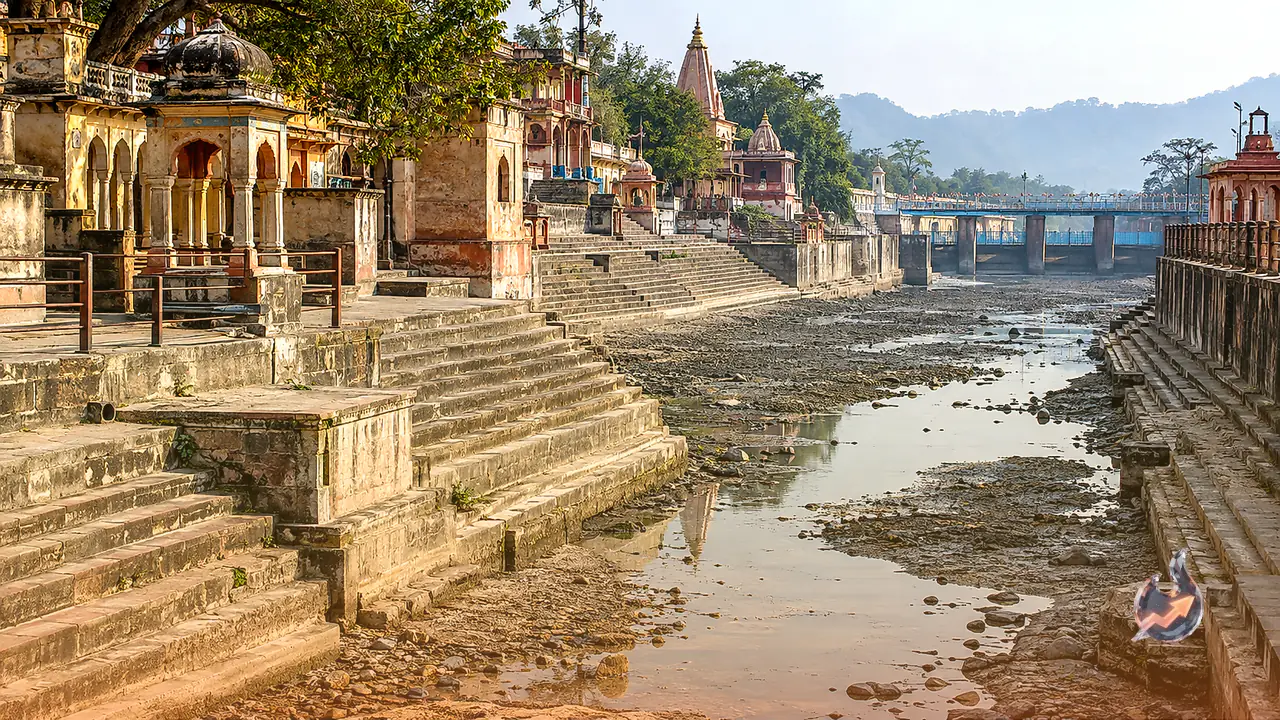

The onset of the annual maintenance shutdown of the Northern Division Upper Ganges Canal on Dussehra night has triggered a severe water crunch across the primary ghats of Haridwar. Following the restriction of water flow by the Uttar Pradesh Irrigation Department, the natural stream at the sacred Har Ki Pauri, including Brahmakund, has almost completely run dry. Thousands of pilgrims traveling from across India and abroad to perform indispensable Hindu rituals like Pind Daan, Tarpan, and Mundan are facing extreme disappointment. Instead of the flowing holy Ganga waters, visitors are greeted by stagnant, muddy pools, rendering traditional ceremonies nearly impossible to perform according to sacred scriptures.
Historic Accord and Mandatory Water Thresholds
A century-old historic agreement explicitly governs water levels at Har Ki Pauri during the canal's routine maintenance period. Under the terms of this historic accord, a continuous minimum flow of at least 1,000 cusecs of water must be mandatorily maintained along the main course of Har Ki Pauri even when the Upper Ganges Canal remains closed for desilting and repairs. However, local priests assert that the irrigation authorities routinely fail to honor this benchmark.
Pandit Kaushal Sikhola, a priest associated with the Ganga Sabha, highlighted that non-compliance by the authorities subjects pilgrims to immense distress year after year. Traditional beliefs mandate that religious rites and ash immersion require a freely moving, uninterrupted current of the Ganga, as rituals conducted in stagnant water are considered invalid under religious norms.
The 1914 Protests Against British Engineering Plans
The origins of this administrative agreement trace back to 1914, when the British colonial administration formulated plans to dam the river at Har Ki Pauri and divert its natural flow. Although the priestly community lacked a unified formal association at the time, local priests and members of the Panda community launched a firm agitation against the project. Their core argument was that damming or stalling the river would violate sacred traditions that require unhindered running water for death rituals and religious offerings.
As negotiations stalled over several months with colonial officials refusing to compromise, the local community sought the leadership of Mahamana Pandit Madan Mohan Malaviya, who was invited to Haridwar from Banaras to guide the agitation.
Two Years of Agitation and the 1916 Pact
Under Malaviya's stewardship, the protest transformed into a nationwide movement that spanned nearly two years, from 1914 to 1916. The cause garnered overwhelming support from royal families, princely state rulers, and religious leaders across India. Faced with mounting public outrage and unified opposition, the colonial government was forced to negotiate terms with the protesters.
Sir James Meston, a senior British official representing the colonial administration, signed a landmark treaty with the priests. The agreement formally guaranteed that even during the annual closure of the Ganges Canal, a minimum depth of two feet of water and an uninterrupted discharge of 1,000 cusecs would be maintained at Har Ki Pauri without fail.
Formation of Ganga Sabha and Present Mismanagement
To oversee the daily management, upkeep, and religious dignity of Har Ki Pauri, Pandit Madan Mohan Malaviya founded the Ganga Sabha in 1916. The institution has since served as the custodian of the holy ghats.
Reflecting on current conditions, Pandit Kaushal Sikhola alleged that the Uttar Pradesh Irrigation Department consistently disregards the terms of this historic agreement. Each year during the canal's maintenance closure, water flow drops precipitously, inflicting unnecessary hardship on visiting devotees. Priests have urged officials to rigorously enforce the 1916 pact to ensure the holy stream at Har Ki Pauri remains perpetually active.