





















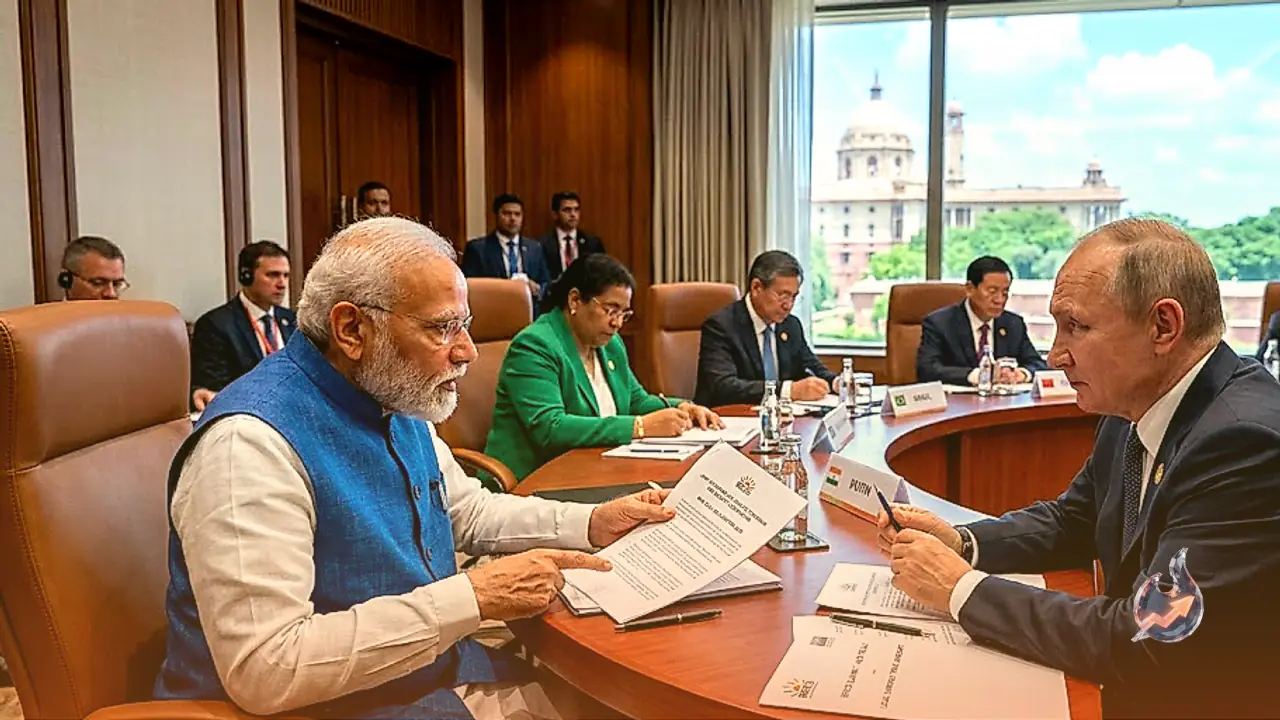

Viewing the New Delhi Declaration of 2026 as merely another routine diplomatic document spread across 45 pages and 140 extensive paragraphs would be to miss the deeper transformation of global dynamics. In reality, this comprehensive declaration serves as a vivid mirror showing how the BRICS alliance has fundamentally reshaped its priorities and strategic direction over the last five years. In 2021, the coalition was largely occupied with managing the socio-economic recovery from the global pandemic, strengthening healthcare systems, and fostering local economic cooperation. Fast forward to 2026, and the focus of the alliance has evolved dramatically. Today, the collective agenda is dominated by pressing security concerns, escalating military conflicts, international terrorism, energy supply lines, maritime trade safety, the protection of peaceful nuclear installations, local currency payment frameworks, resilient supply chains, and the governance of artificial intelligence.
This latest declaration illustrates a highly strategic evolution in the alliance's language and diplomatic posturing. Compared to the Rio Declaration of 2025, the phrasing in the New Delhi document is significantly more balanced, objective, and practical. This shift indicates that BRICS is transitioning from a forum that primarily delivers high-level political rhetoric on major global issues into an active mechanism capable of building concrete and functional systems for economic, financial, and strategic cooperation among its members.
A Strategic Triumph on Counter-Terrorism for India
One of the most notable aspects of the New Delhi Declaration is its strong stance on counter-terrorism, which is widely recognized as a major diplomatic success for India. The document explicitly and strongly condemns the deadly terrorist assault that occurred in Pahalgam, located in Jammu and Kashmir, on April 22, 2025. This brutal attack resulted in the tragic loss of 26 innocent civilian lives. Elevating this specific incident to the level of a consensus document among a diverse group of emerging economies represents a significant achievement for Indian foreign policy.
While the declaration strategically avoids naming Pakistan directly, its implications for regional security are unmistakable. The text places a robust emphasis on the urgent need to dismantle cross-border terrorist networks, choke the flow of terror financing, and deny safe havens to terrorist operatives. The BRICS nations collectively reasserted that terrorism cannot and should not be linked to any particular religion, nationality, civilization, or ethnic community. Furthermore, the alliance emphasized the necessity of holding those who support or sponsor terrorist activities accountable, demanding they be brought to justice. This sends a strong diplomatic signal to any nation that continues to leverage proxy networks or offer safe harbor to terrorist organizations.
The Six-Year Evolution: Recharting the Path from 2021 to 2026
To truly understand the current trajectory of this influential alliance, it is essential to trace the chronological shifts in its agenda over the last six years. This retrospective analysis highlights how the group has adapted to successive global crises.
2021: Post-Pandemic Cooperation and Economic Recovery
During 2021, under India's presidency, the primary focus of BRICS was on recovering from the devastating impact of the COVID-19 pandemic. Member nations dedicated their efforts to accelerating economic and social reforms, enhancing healthcare collaboration, promoting the digital economy, and addressing climate change challenges. Additionally, to strengthen collective security, the group emphasized the implementation of the Counter-Terrorism Action Plan. At this point, the core mission was to solidify mutual trust and expand economic ties among the five founding nations.
2022: Geopolitical Fractures and Global Supply Shocks
By 2022, the geopolitical landscape had changed dramatically. The outbreak of the Russia-Ukraine war, alongside severe disruptions in global food and energy supplies, began to heavily impact the global economy. Consequently, the Beijing Declaration placed heightened emphasis on securing food and energy chains. Around this time, calls grew much louder for comprehensive reforms within international financial institutions like the IMF and the World Bank. The goal was to ensure that the voice and representation of the Global South were adequately recognized, shifting the group's focus toward building a multipolar global order.
2023: Initiating a Historic Phase of Expansion
The Johannesburg summit in 2023 was defined by a historic decision to expand the membership of the group. This move was a clear indication that BRICS did not want to remain an exclusive club of five nations. Instead, it sought to transform into a much larger coalition representing emerging economies and developing nations worldwide. During this period, the group also strongly backed the aspirations of India, Brazil, and South Africa to play a more prominent and influential role within the United Nations Security Council.
2024: Managing the Diverse Realities of Kazan
In 2024, the expansion plans became a tangible reality at the Kazan summit. With the official entry of Iran, UAE, Egypt, Ethiopia, and Indonesia, the political and strategic architecture of BRICS underwent a profound shift. The group now had to balance a diverse array of national interests, some of which involved deep-seated regional rivalries. The Kazan Declaration responded by prioritizing practical cooperation on local currency trade settlement, alternative cross-border payment structures, energy supply security, and resisting unilateral economic coercion and sanctions.
2025: Direct Political Messaging in the Rio Declaration
The Rio Declaration of 2025 adopted a noticeably more assertive and politically explicit tone. It directly condemned military strikes on Iran and raised serious concerns regarding the safety of civilian infrastructure and peaceful nuclear facilities. The document also featured a direct condemnation of the Pahalgam terrorist attack, highlighting the need to actively target cross-border networks and financial funding lines. On the economic front, the focus remained on securing cross-border payments, utilizing local currencies, and building highly resilient supply chains.
2026: Striking a Mature Balance in New Delhi
The 2026 New Delhi Declaration marks a return to a highly balanced and diplomatic consensus. Unlike the previous year's document, which explicitly named Iran when discussing military strikes, the 2026 declaration avoids direct political finger-pointing at countries like the United States or Iran. Instead, it expresses broad concerns over rising tensions in West Asia, emphasizing the protection of civilians, the safety of civilian infrastructure, and the preservation of peaceful nuclear facilities through diplomatic dialogue, restraint, and negotiations.
This diplomatic recalibration reflects the realities of a larger BRICS membership, where different countries hold diverse and sometimes conflicting strategic interests in West Asia. By opting for broad international principles rather than taking specific partisan sides, the alliance has managed to preserve its internal cohesion while presenting a unified, stable, and highly mature front to the rest of the world.


