






















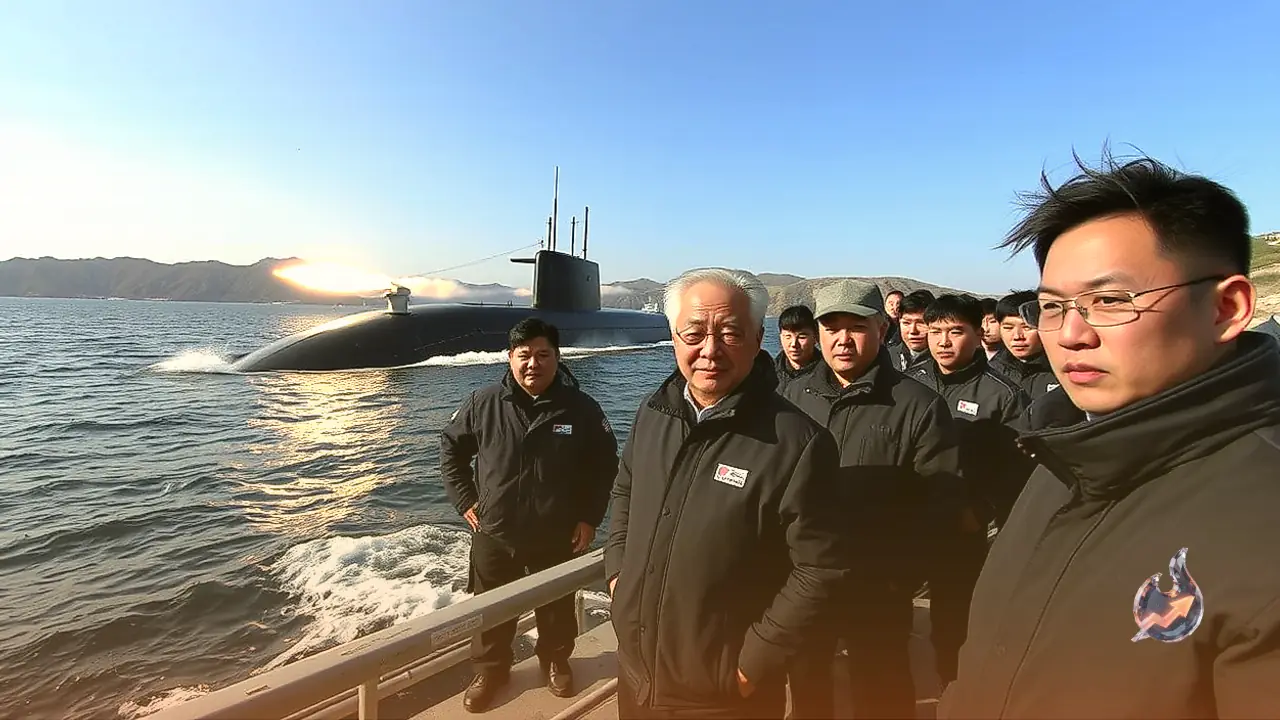

Pyongyang has conducted a fresh set of military tests involving cruise missiles designed to launch from submarines, further expanding its underwater combat technologies amid prolonged diplomatic stalemate. The latest launches in eastern waters underscore North Korea's unwavering focus on advancing its military reach while relations with the United States and South Korea remain frozen. By demonstrating weapons designed to evade surveillance, Kim Jong Un continues to step up pressure across the peninsula.
Two Separate Missile Systems Tested in Eastern Waters
State media announced on Thursday that the military had test-fired two distinct variants of cruise missiles on Wednesday into the country's eastern seas. The official report described these weapons as strategic, a term conventionally used by Pyongyang to signal nuclear capability. However, the announcement stopped short of detailing whether the missiles were launched from an operational submarine or fired from an underwater test barge.
The South Korean military did not immediately provide an official comment following the release of the state media report. Regional defence monitors continue to track North Korea's underwater capabilities closely, given the strategic advantage hidden launch platforms offer.
Evaluating Underwater Combat Readiness and Deterrence Reliability
State media outlined that the central objective of the operation was to assess the operational readiness of North Korea's underwater warfare systems. The tests were also designed to refine the navy's capability to execute strategic missions and validate the operational reliability of the country's nuclear deterrence posture.
Submarine-capable cruise missiles fly at lower altitudes compared to ballistic systems, making them harder for regional tracking radars to intercept. Developing this dimension of naval warfare provides Pyongyang with added flexibility in deploying potential retaliatory or surprise strikes.
Succession of Trials Following Hypersonic Launches
The latest activity builds on a rapid succession of military hardware demonstrations by Pyongyang. Notably, the military conducted trials of multiple hypersonic missile systems on 20 September and 3 October. The stated purpose behind those launches was to accumulate an inventory of weapons specifically engineered to penetrate and overwhelm the missile defence shields deployed across South Korea and Japan.
In recent weeks, North Korea has also engaged in live combat drills and integrated a newly built warship into its naval fleet. Kim Jong Un has consistently highlighted these military achievements, maintaining an assertive posture while dismissing calls to re-engage in diplomatic negotiations.
Complete Severance of Diplomacy with Seoul and Washington
Over the past several years, Kim Jong Un has dismantled all diplomatic communication channels and cooperative initiatives with South Korea, explicitly designating Seoul as a permanent adversary. Concurrently, broader denuclearisation talks between Washington and Pyongyang have remained at a standstill for years.
Kim has so far rejected appeals by US President Donald Trump to revive the diplomatic momentum that collapsed following talks in 2019. Pyongyang continues to insist that Washington must discard what it describes as a hostile policy toward the nation. Furthermore, North Korean officials maintain that abandoning demands for unilateral denuclearisation must precede any potential return to the negotiating table.