



















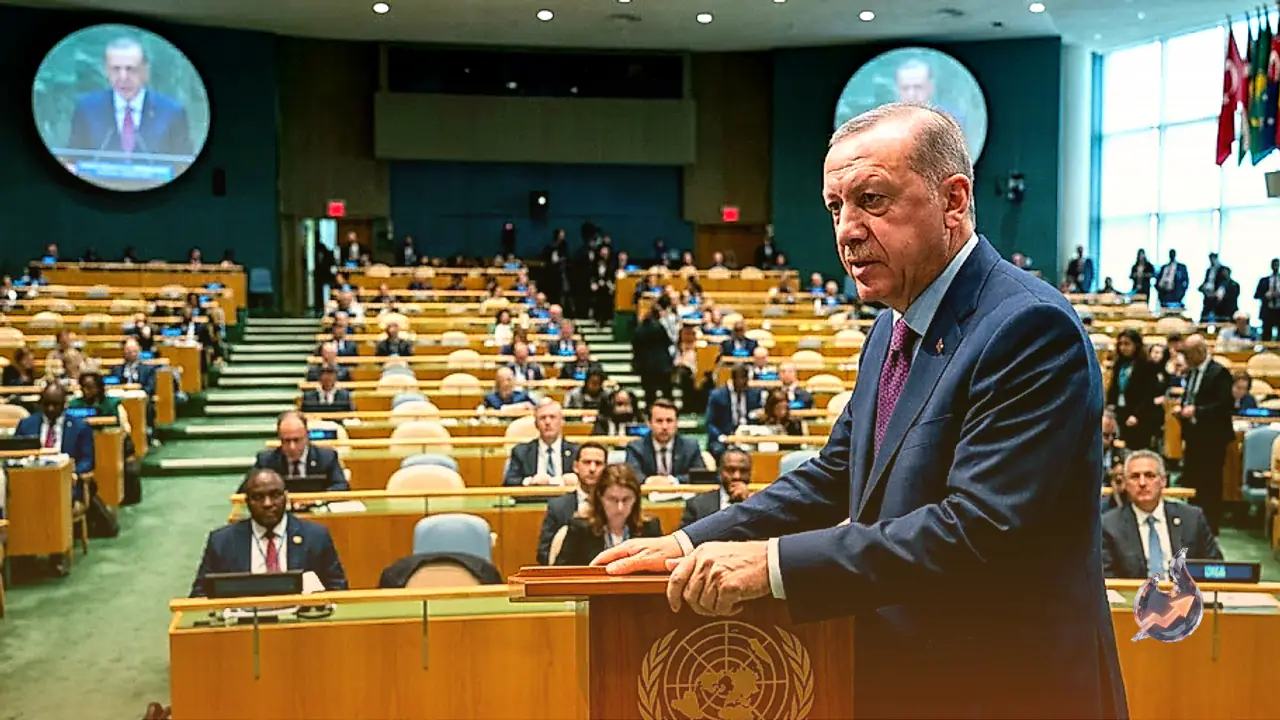

Turkish President Recep Tayyip Erdogan has once again brought the topic of South Asia and Kashmir to the forefront during his address at the United Nations General Assembly. Speaking before world leaders at the global diplomatic forum, he shared his perspective on regional disputes and emphasized that the Kashmir issue should be resolved through dialogue. The remarks were delivered in the presence of Pakistani Prime Minister Shehbaz Sharif, who was attending the gathering at the UN headquarters.
Turkish President Calls for Dialogue at UNGA
Addressing the General Assembly on Tuesday, Recep Tayyip Erdogan commented on stability in South Asia, stating that it is essential to resolve all disputes in the region, including the Kashmir issue, through dialogue within the framework of the United Nations Charter and relevant resolutions. The statement is widely viewed as a continuation of Ankara's persistent diplomatic posturing on the subject over recent years.
Beyond South Asia, Erdogan used his address to articulate Turkey's position on several pressing international conflicts. He addressed the ongoing war in Gaza, demanding robust international action and reiterating the need for the renewed recognition of the Palestinian state. Additionally, he renewed his calls for comprehensive reforms within the United Nations Security Council and urged an end to the international isolation faced by the people of Turkish Cyprus.
Focus on Palestine and Global Issues
During his address, the Turkish president highlighted the absence of Palestinian President Mahmoud Abbas, noting that Abbas was unable to attend the UNGA session in person for the second consecutive year. Erdogan affirmed that Turkey will continue to utilize the United Nations platform to voice the concerns of the Palestinian population. He directed strong criticism toward Israel's military operations in Gaza, characterizing the resulting humanitarian conditions as exceptionally severe.
A Recurring Stance Since 2019
Erdogan's invocation of the Kashmir issue at the UNGA follows a pattern that began prominently in 2019. While his tone and specific phrasing have shifted over time, the topic has regularly appeared in his speeches before the international body. The initial and most intense controversy arose shortly after the Indian government abrogated the special status granted to Jammu and Kashmir under Article 370 in August 2019.
During the 74th session of the UNGA in September 2019, Erdogan remarked that eight million people were virtually under blockade, adding that the international community had failed to pay sufficient attention to the conflict over the preceding 72 years.
Diplomatic Fallout and New Delhi's Consistent Position
The 2019 statement drew a swift and firm diplomatic rebuttal from New Delhi. Indian authorities stressed that Turkey must respect the territorial sovereignty of other nations and refrain from commenting on India's internal affairs. The diplomatic rift led to tangible consequences: a planned official visit to Turkey by Prime Minister Narendra Modi was called off, and India took steps to curtail its defence cooperation with Ankara.
Despite New Delhi's objections, Erdogan has continued to reference the matter. In his 2021 UNGA address, he described Kashmir as a 74-year-old problem and called for a resolution reflecting the aspirations of the Kashmiri people. For its part, India has consistently maintained that the Union Territories of Jammu and Kashmir and Ladakh are integral parts of the country, dismissing outside commentary and rejecting any scope for third-party mediation on its domestic matters.