



















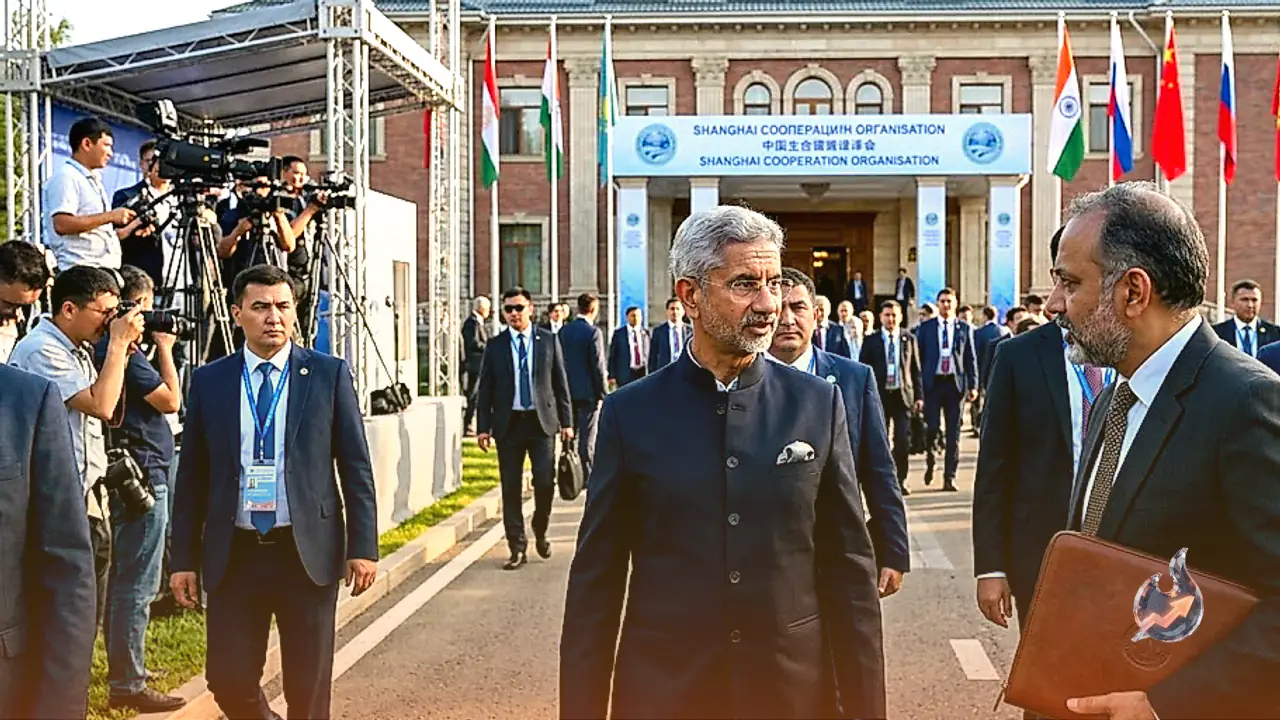

The capital of Kyrgyzstan, Bishkek, is set to host the annual summit of the Shanghai Cooperation Organisation (SCO) next week. Spanning a vast transcontinental domain across Europe and Asia, this Eurasian grouping focuses on political, economic, international security, and defense cooperation. By virtue of its total population footprint and geographic expanse, it is widely recognized as the largest regional organization in the world. At the core of this multilateral alliance stand major powers including India, China, Russia, and Pakistan, alongside several Central Asian and Middle Eastern nations. However, India was not part of this Eurasian grouping from its inception. Despite securing observer status in 2005, New Delhi maintained a deliberate wait-and-watch stance for twelve years before formally acceding as a full-fledged member in June 2017. A closer look at this historical trajectory reveals a complex mix of geopolitical calculations, institutional concerns, and strategic balancing imperatives.
From Soviet Collapse to the Creation of the Shanghai Cooperation Organisation
The historical origins of the SCO are rooted in the aftermath of the dissolution of the Soviet Union in 1991. The breakup of the Soviet bloc led to the emergence of newly independent Central Asian republics, specifically Kazakhstan, Kyrgyzstan, and Tajikistan. These young nations shared extensive, porous land borders with both China and Russia. During that volatile transition period, resolving longstanding border disputes, reducing military concentrations, and preventing cross-border ethnic separatism became urgent national security priorities for all surrounding states.
To address these mutual security challenges, a collaborative framework known as the 'Shanghai Five' was established in 1996, comprising China, Russia, Kazakhstan, Kyrgyzstan, and Tajikistan. The mechanism achieved remarkable success in building military trust and establishing border tranquility. Encouraged by these tangible security dividends, member nations decided to expand the scope of their engagement beyond border security into a comprehensive framework for regional economic and political cooperation.
With the official induction of Uzbekistan, the grouping was formally renamed the Shanghai Cooperation Organisation (SCO) on June 15, 2001. The foundational SCO Charter was signed in June 2002 and officially came into force in September 2003. To support its operational framework, two permanent bodies were created: the SCO Secretariat located in Beijing, China, and the Regional Anti-Terrorist Structure (RATS) headquartered in Tashkent, Uzbekistan.
Key Geopolitical Factors Behind India's Delayed Full Membership
Although India gained observer status within the SCO in 2005, its transition to full membership did not materialize until June 2017. This protracted twelve-year gap was shaped by delicate geopolitical realities and strategic caution on multiple fronts.
During its formative years, the SCO functioned primarily around a Russia-China power center. Decision-makers in Beijing harbored apprehensions that granting full membership to India could alter the internal power dynamics of the group or lead to the formation of a counter-balancing faction. On the Indian side, strategic analysts viewed the SCO as a club dominated by Moscow and Beijing with potential anti-Western overtones. Participating too deeply was seen by some as potentially conflicting with India's long-standing doctrine of non-alignment and strategic autonomy.
When New Delhi eventually initiated formal bids for full entry, Beijing leveraged the situation to demand the simultaneous admission of its all-weather partner, Pakistan. China utilized Pakistan's entry as a bargaining tool to balance India's stature and preserve regional parity within South Asia. This intricate diplomatic bargaining prolonged the consensus-building process among member states, culminating finally in the joint accession of both India and Pakistan at the Astana Summit in Kazakhstan in June 2017.
Strategic Imperatives That Drove India to Join the Eurasian Bloc
Despite persistent geopolitical friction and the inclusion of adversary Pakistan, Indian policymakers recognized that staying outside the SCO meant ceding influence and foregoing a vital voice in its immediate neighborhood. Several strategic objectives underscored New Delhi's eventual decision to join.
On the security front, the Tashkent-based Regional Anti-Terrorist Structure (RATS) provides India with direct access to regional intelligence sharing, counter-terrorism methodologies, and joint efforts aimed at curbing religious radicalization and cross-border drug trafficking.
From an economic and connectivity perspective, Central Asia is immensely rich in natural resources, including crude oil, natural gas, and uranium. India views the region as its 'extended neighborhood'. SCO membership offers New Delhi a crucial platform to revive stalled energy projects such as the TAPI pipeline and advance alternative trade routes like the International North-South Transport Corridor (INSTC).
Eurasian Equilibrium and India's Long-Term Geopolitical Outlook
India's presence inside the organization ensures that no single power, particularly China, can unilaterally dictate political, economic, or security arrangements across Central Asia. This engagement aligns seamlessly with India's foreign policy of multi-alignment, enabling New Delhi to actively participate in non-Western forums like the SCO and BRICS while simultaneously deepening strategic partnerships with Western democratic nations.
In summary, the Shanghai Cooperation Organisation has evolved from a post-Soviet border dispute forum into one of Eurasia's most dominant geopolitical blocs. While superpower rivalries, the China-Pakistan strategic nexus, and cautious institutional evaluation delayed India's full entry, the imperative to secure energy corridors, combat regional terrorism, and maintain a strategic footprint in Central Asia ultimately guided India's historic decision to join.