

















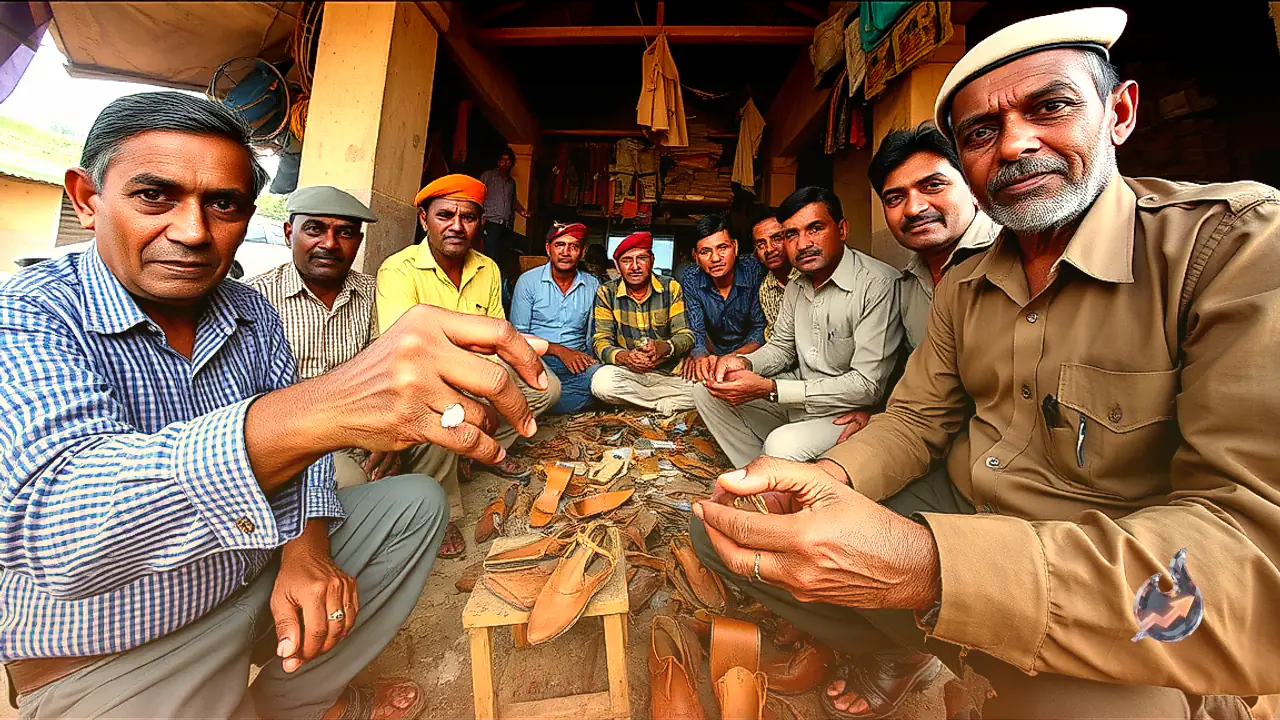

A modest workshop in the Rohini area of Jharkhand's Deoghar district serves as a living testament to time-honored artisanal dedication. Even as modern retail markets are inundated with mass-produced, factory-made footwear, a loyal customer base continues to place its faith in the hands of an experienced craftsman. Operating under the name Fashion Shoe, this humble establishment does not feature assembly lines or robotic presses. Instead, every single stage of the process, from precision leather cutting to meticulous lasting and shaping, is carried out entirely by hand. The footwear produced here represents far more than daily utility; it embodies an invaluable craft that the artisan has preserved and refined across several decades of persistent labor. While modern industrial manufacturing has undeniably reshaped the shoemaking landscape, handcrafted leather footwear retains an enduring reputation for durability and authenticity.
A Craft Learned at Fifteen and Four Decades of Dedication
The artisan behind this venture is 62-year-old Ramdas, whose entire life has been intrinsically linked with leatherwork. He began learning the delicate trade at the young age of 15 under the tutelage of his father. Having now crossed his sixth decade, Ramdas has dedicated approximately 47 continuous years to this single trade. Crafting authentic leather footwear without mechanized assistance demands patience, intense physical effort, and refined tactile judgment. Selecting suitable leather hides, measuring accurately, cutting cleanly, and assembling components requires complete concentration. According to Ramdas, producing a single pair of leather shoes from scratch takes roughly 40 to 45 minutes of intensive manual work.
Capital Constraints and the Superior Strength of Manual Pasting
The modern footwear sector relies heavily on sophisticated machinery that automates cutting, gluing, stitching, and finishing. Ramdas explains that installing industrial machinery requires significant capital investment, an expenditure far beyond his financial capabilities. Constrained by limited financial resources, he could not modernize his setup with expensive machinery. Rather than abandoning his vocation, he transformed manual craftsmanship into his core strength, continuing to invest long hours at his workbench. Ramdas points out that this constraint actually offers a distinctive structural benefit to his customers. According to his practical experience, adhesive pasting executed manually yields a much firmer bond between the sole and the upper than standardized machine processing typically delivers. This structural integrity is the primary reason why local residents continue to favor his handmade footwear over industrially manufactured alternatives.
Affordable Pricing and Reliable Repair Services
Beyond constructing brand-new footwear, Fashion Shoe also functions as a vital repair clinic for worn-out shoes and sandals. Ramdas ensures that quality footwear remains accessible to ordinary working individuals. Handcrafted leather shoes at his workshop start at an accessible price point of around 500 rupees and go up to 1000 rupees depending on the design and leather grade. In an era where genuine leather footwear sold by commercial brands often commands exorbitant price tags, obtaining a custom-fitted, durable leather pair within the 500 to 1000 rupee range provides substantial financial relief to local buyers. Furthermore, patrons who cannot afford brand-new pairs rely on his repair services, where torn stitching, damaged soles, or cracked heels are restored at minimal cost, extending the usable life of their existing footwear.
A Clientele Spanning 14 Villages and Police Personnel
The reputation of Ramdas's craftsmanship extends well beyond the immediate confines of Rohini. Customers routinely travel from around 14 surrounding villages to commission custom shoes or purchase ready pairs. Among his most loyal patrons are on-duty police personnel. Officers and constables assigned to local police stations are required to wear sturdy leather boots and shoes as an essential component of their duty uniform. Because law enforcement duties involve long hours on foot, patrolling, and active physical movement, standard factory shoes often wear down quickly under demanding conditions. Consequently, police personnel frequently visit Fashion Shoe to obtain robust, custom-crafted leather pairs capable of enduring rigorous daily use. Customers return because they know genuine leather is utilized rather than cheap synthetic substitutes. Ramdas emphasizes that his reputation has been built without formal marketing, relying entirely on decades of consistent quality.
Preserving Heritage Craftsmanship Amid Industrial Disruption
The rapid expansion of mechanized shoe manufacturing has presented serious economic hurdles for traditional cobblers. Machines can generate hundreds of identical units rapidly at lower manufacturing costs, saturating markets with inexpensive options. In contrast, crafting footwear by hand requires prolonged manual engagement, patience, and physical strain. Despite these market shifts, Ramdas remains committed to his traditional methods. For him, shoemaking is not merely a commercial livelihood, but an inheritance received from his father during his teenage years. At 62, he continues to sit in his small workshop with unflagging enthusiasm, shaping leather with his hands and preserving a legacy of trust that has sustained Fashion Shoe for generations.