














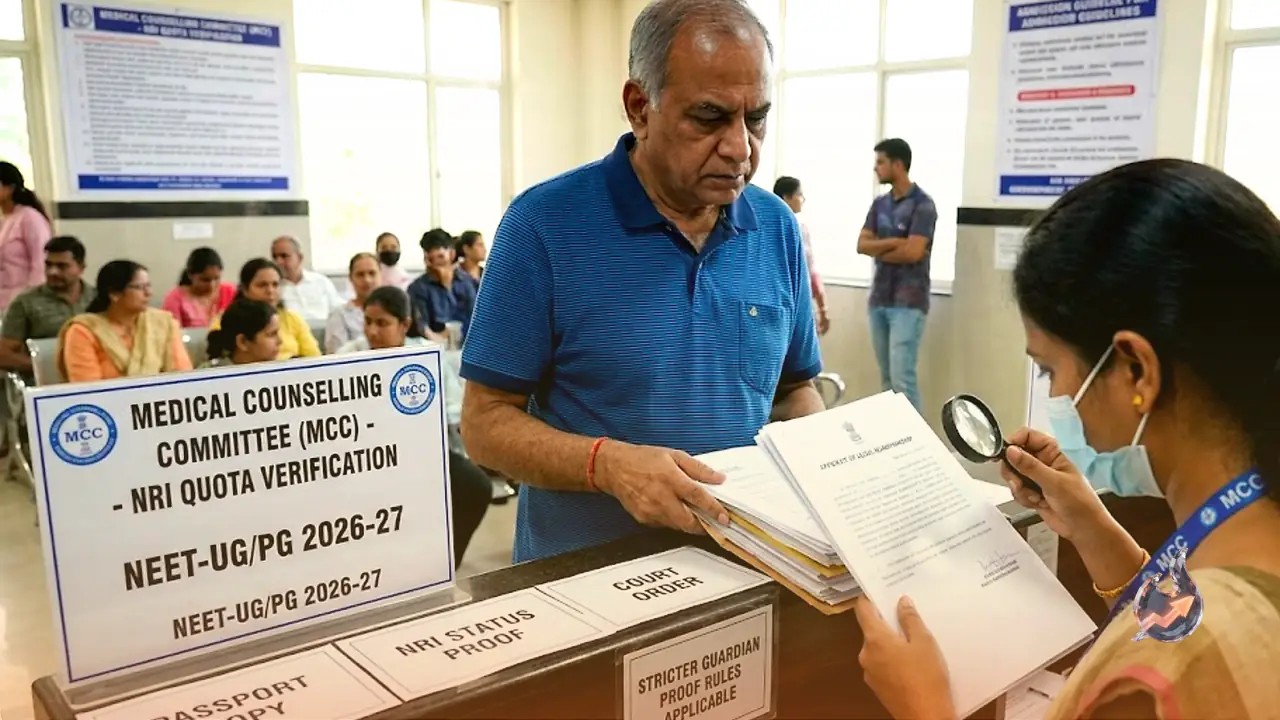

Rules for students entering medical colleges through the NRI quota have been tightened considerably this year. The Medical Counselling Committee (MCC) has issued clear instructions to all medical colleges and state governments stating that in the 2026-27 NEET-UG and NEET-PG counselling, only candidates who meet every eligibility condition laid down by the Supreme Court will be allowed to avail the NRI quota benefit. In effect, securing a seat under this quota will no longer be as simple as before.
Just naming a relative is no longer enough
Until now, students could often secure an NRI quota seat simply by naming a relative settled abroad. That route has now been closed. Candidates will have to prove that the NRI relative being cited is, in fact, their legal guardian. This requires submitting an affidavit along with documents establishing guardianship under the Guardians and Wards Act, 1890. The tightened rule is not limited to direct NRI candidates alone, it applies equally to those in the Overseas Citizen of India, or OCI, category. Candidates who have switched from Indian citizenship to NRI status will also have to meet the same conditions.
Madhya Pradesh's position remains unclear
Whether these new rules will be implemented immediately in Madhya Pradesh is still uncertain. Dr Aruna Kumar, Director of Medical Education (DME) at the Medical Education Department, said the state currently conducts medical counselling under rules framed back in 2018. If the new central rules are to be enforced in Madhya Pradesh, the state government will first need to amend its gazette notification. Only after that process is completed can the new rules take effect in the state, meaning students and parents in Madhya Pradesh may have to wait a while longer.
How many seats and how much fee
Six private medical colleges in Madhya Pradesh reserve roughly 15 percent of their seats under the NRI quota. In absolute numbers, that works out to somewhere between 100 and 110 seats. Candidates admitted against these seats pay an annual fee of around Rs 30 lakh, several times higher than seats under the general quota. This steep fee is precisely what has made the quota an attractive target for fraud.
Fake documents pushed the crackdown
Over the past few years, several cases of admission through fake NRI certificates and fake sponsors have come to light. Last year, a private medical college in Indore admitted a student based on a fake NRI certificate issued in the name of the Indian embassy in Belarus. Separately, a case emerged in NEET-PG counselling where 48 doctors had submitted fake NRI documents. These incidents raised serious questions about the credibility of the quota, prompting the Medical Counselling Committee to tighten the entire system.