






















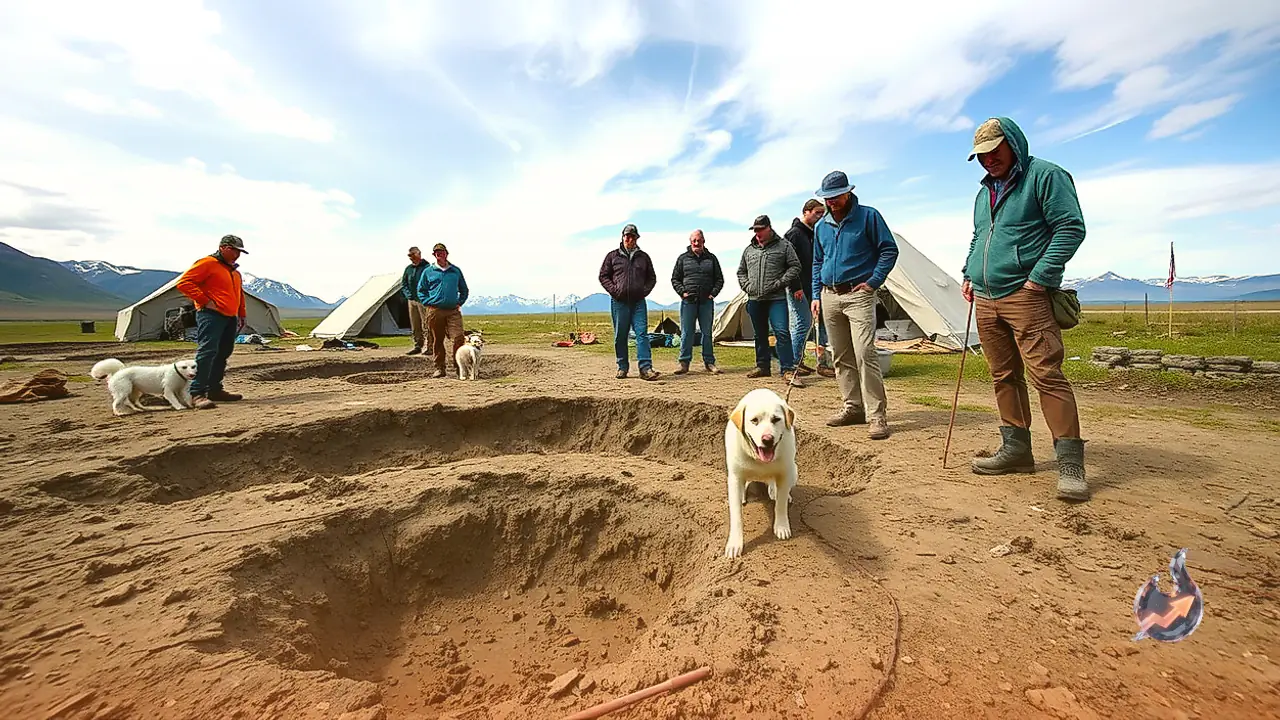

A remarkable archaeological breakthrough in the remote interior of Alaska has uncovered deep insights into the earliest human inhabitants of the Americas. Digging into the subarctic soil, an excavation team identified a 13,800-year-old prehistoric base camp that represents the oldest known human domestic settlement discovered in the Western Hemisphere. The excavation yielded thousands of flaked stone tools, preserved animal fossils, and traces of everyday life from the terminal Pleistocene. Among the most notable findings are canine skeletal remains that point toward the earliest domesticated dogs in the entire American continent, alongside tailored sewing needles that now rank as the oldest ever documented across the Western Hemisphere.
The Location And Origin Of The Shégˊ Xdaltthˊíˊ Site
Situated roughly 34 miles (55 kilometers) southeast of Fairbanks, Alaska, the archaeological site is known locally by its indigenous Athabascan designation, Shégˊ Xdaltthˊíˊ. In the indigenous Athabascan tongue spoken across the region, the phrase translates directly to 'they were there.' Geographically, the area belongs to eastern Beringia, an ecologically significant region that once served as a primary gateway into the continent.
During the last Ice Age, Beringia formed an immense land mass connecting northeastern Asia with northwestern North America, commonly known as the Bering Land Bridge. Contemporary genetic and archaeological investigations indicate that the ancestors of modern Native Americans navigated across this frozen bridge approximately 21,000 years ago to enter the Americas. The full findings from this intensive excavation have been documented and published in the peer-reviewed journal Science Advances.
Extensive Base Camp Artifacts Surpass Expectations
Kelly Graf, an archaeologist from the University of Kansas and the lead researcher of the project, explained that the team originally anticipated uncovering little more than a brief hunting stop featuring scattered projectile points and a fireplace or two. Instead, deeper excavation exposed a fully developed, recurrently utilized base camp containing thousands of cultural artifacts, lithic blades, and functional domestic implements.
Field researchers uncovered a preserved hearth, a shallow domestic pit, and distinct soil impressions left by a structural wooden post that once supported an ancient tent or residential framework. Positioned adjacent to this domestic structure was a substantial earth oven filled with dense charcoal layers and charred faunal remains. Investigators deduce that this underground thermal pit was engineered to slow-cook large portions of game meat for an extended family band over long stretches of time.
Siberian Tool Designs And Long-Distance Obsidian Networks
The flaked stone implements recovered from Shégˊ Xdaltthˊíˊ carry profound technological significance. The tools feature distinct diamond-shaped hafted bifaces meticulously chipped from basalt and rhyolite raw materials. The morphological contours and production methods behind these bifacial blades correspond closely to lithic traditions documented in northern Siberia across contemporary eastern Asia.
Furthermore, researchers recovered sharp microblades and tools manufactured from obsidian, a dark volcanic glass that does not occur naturally in the immediate vicinity of the camp. Geological testing traces the obsidian to quarry sources located hundreds of miles away in the northwestern interior. This material trail proves that groups surviving in subarctic environments 13,800 years ago maintained extensive overland supply networks and carried specialised stone resources across vast wilderness corridors.
Evidence Suggests America's First Domesticated Canines
Excavations across the camp deposits produced more than a dozen wolf-like skeletal elements. When analysts conducted detailed morphological examinations on an excavated lower jawbone, the results proved unexpected. The bone structure did not belong to the extinct dire wolf, nor did it match the typical Pleistocene gray wolves that roamed the interior during that epoch; it represented an entirely distinct canine lineage native to central Alaska.
Modern genetic lineage research confirms that North America's earliest domestic dogs shared ancestral roots with Siberian wolf populations. Consequently, the canine bones retrieved from Shégˊ Xdaltthˊíˊ indicate that the hunter-gatherers dwelling at this site were among the earliest documented dog keepers in the Americas. Like their human companions, these proto-dogs likely journeyed across the Bering Land Bridge from Asian Beringia during the closing centuries of the last Ice Age.
Bone Sewing Kits And Carved Antler Ornaments
In addition to heavy hunting implements and cooking installations, the campsite preserved an exceptionally rare textile crafting kit. The team unearthed eight distinct fragments of polished bone sewing needles. Prior to this discovery, eyed bone needles in North America had been discovered primarily in more temperate, southern zones. The specimens recovered from Shégˊ Xdaltthˊíˊ currently stand as the oldest verified sewing needles anywhere in the Western Hemisphere.
Archaeologists also retrieved a carefully shaped ornamental pendant carved from cervid antler, featuring a neatly drilled suspension hole at one edge. The craftsmanship of this decorative pendant mirrors similar prehistoric personal ornaments identified at contemporary Paleoindian sites further south in North America. These artifacts collectively demonstrate that the early inhabitants of interior Alaska maintained shared technological practices and symbolic traditions that linked them both to northeastern Asia and to expanding populations across North America.
Uncovering Further Chapters Of Subarctic Prehistory
Kelly Graf emphasized that Alaska's geographic scale and remote terrain mean researchers have surveyed only a minimal fraction of its potential archaeological wealth. The research team intends to conduct further excavation campaigns in surrounding drainage valleys over upcoming field seasons. The ongoing investigation works in close partnership with local Alaska Native communities and elders, integrating indigenous oral histories and regional perspectives into the scientific analysis. The early human record of 14,000-year-old Beringia continues to yield crucial pieces detailing how ancient humans adapted and thrived on the frontier of a new world.