






















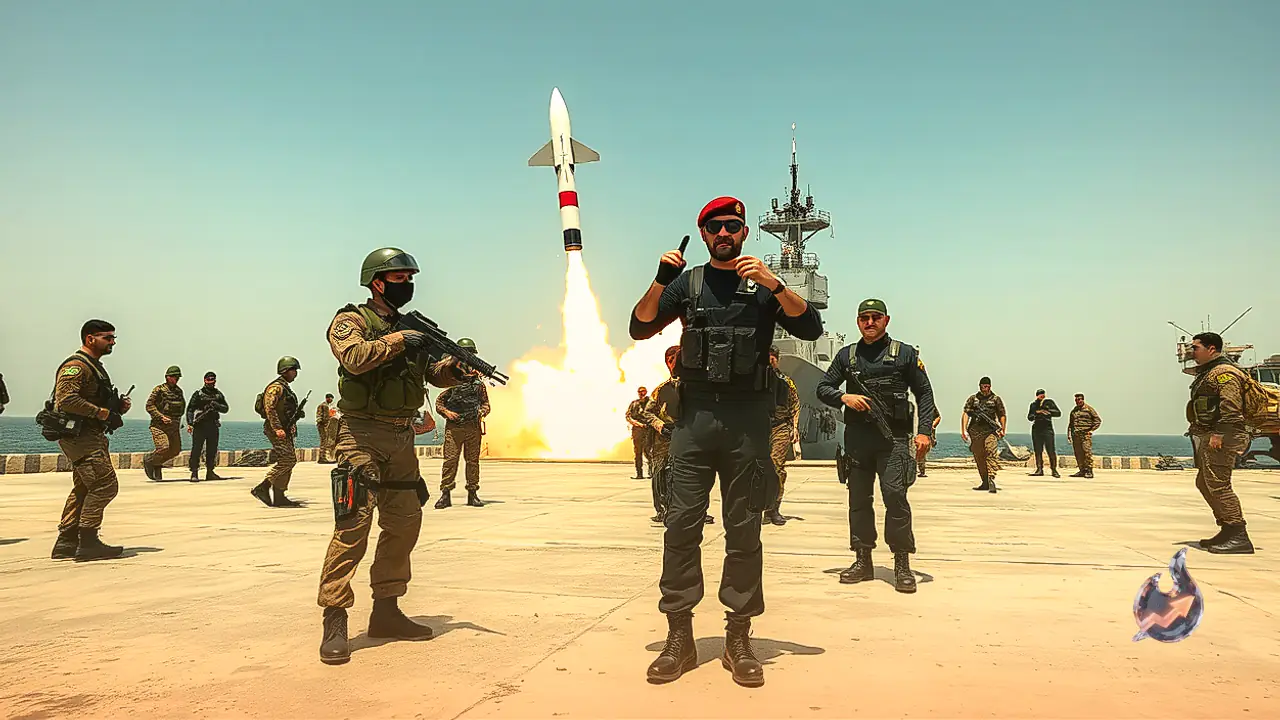

The military confrontation between the United States and Iran has breached the confines of the Persian Gulf and spilled directly into the open waters of the Arabian Sea. In a sharp escalation of hostilities, American forces executed a targeted strike against Iran strategically vital Konarak naval base located along the southeastern shoreline. Iranian authorities in Tehran confirmed the operation, stating that two naval personnel sustained injuries during the predawn assault. Situated at the mouth of the Gulf of Oman near Chabahar, the targeted installation occupies an indispensable position right outside the Strait of Hormuz, amplifying regional security concerns across key global shipping lanes.
Targeted Assault on the Konarak Installation
Konarak naval base, positioned in the Sistan and Baluchestan province, serves as a cornerstone of Iranian maritime posture in the Gulf of Oman. Iranian naval officials detailed that early on Tuesday, two lightweight projectiles struck specific defensive emplacements within the base perimeter, directly impacting a 35-millimeter anti-aircraft cannon stationed on site. The explicit strategic justification for singling out this particular artillery piece remains undisclosed, and it remains uncertain whether the weapon had featured in any prior engagements with American units operating offshore. The strike appeared deliberately calibrated in scope, leaving limited infrastructural damage beyond the targeted gun emplacement. The United States military did not issue an immediate statement regarding the operational parameters of this engagement.
Engagement Against US Destroyer in Northern Arabian Sea
Simultaneously, the theater of conflict broadened rapidly across international maritime waters. In the Northern Arabian Sea, Iranian armed units launched advanced anti-ship cruise missiles and a ballistic missile aimed at an Arleigh Burke class guided missile destroyer belonging to the US Navy. The warship had been navigating in international waters toward Iranian maritime zones when the tracking and missile launch occurred. In response to the engagement, the US military scrambled F/A-18 Super Hornet multirole fighters from the flight deck of the aircraft carrier USS George H.W. Bush. These strike aircraft flew operational sorties targeting naval facilities operated by the Islamic Revolutionary Guard Corps (IRGC) situated around Konarak in southeastern Iran.
Missile Launches from Isfahan and Qom
The cross-border engagements were accompanied by heavy missile activity deep within Iranian sovereign territory. Multiple ballistic missile launches were detected originating from launch sites across both Isfahan and Qom provinces. While granular assessments concerning their exact impact coordinates and battle damage remain undisclosed, the deployment of ballistic assets from deep inland staging grounds underscores the widening footprint of the engagement. The activation of ballistic infrastructure across multiple provinces marks an aggressive shift from localized coastal skirmishes to theater-wide military operations spanning vast oceanic and continental sectors.
Vulnerabilities Surrounding Kharg Island and Global Energy Flows
The geographic shift of the conflict toward the Arabian Sea has intensified concerns over critical commercial choke points and export installations. American naval vessels have established operational presence within sectors of the Arabian Sea adjacent to Pakistani waters, heightening scrutiny over Iranian economic arteries. Foremost among these vulnerabilities is Kharg Island, an energy transit hub in the northern Persian Gulf that facilitates roughly 90 percent of all Iranian crude oil exports. Any disruption or potential expansion of hostilities targeting Kharg Island infrastructure would jeopardize Tehran fiscal lifeline while triggering acute disruptions across international energy markets. With direct attacks hitting naval bases and warships, commercial shipping navigation through the region faces unprecedented operational hazards.