























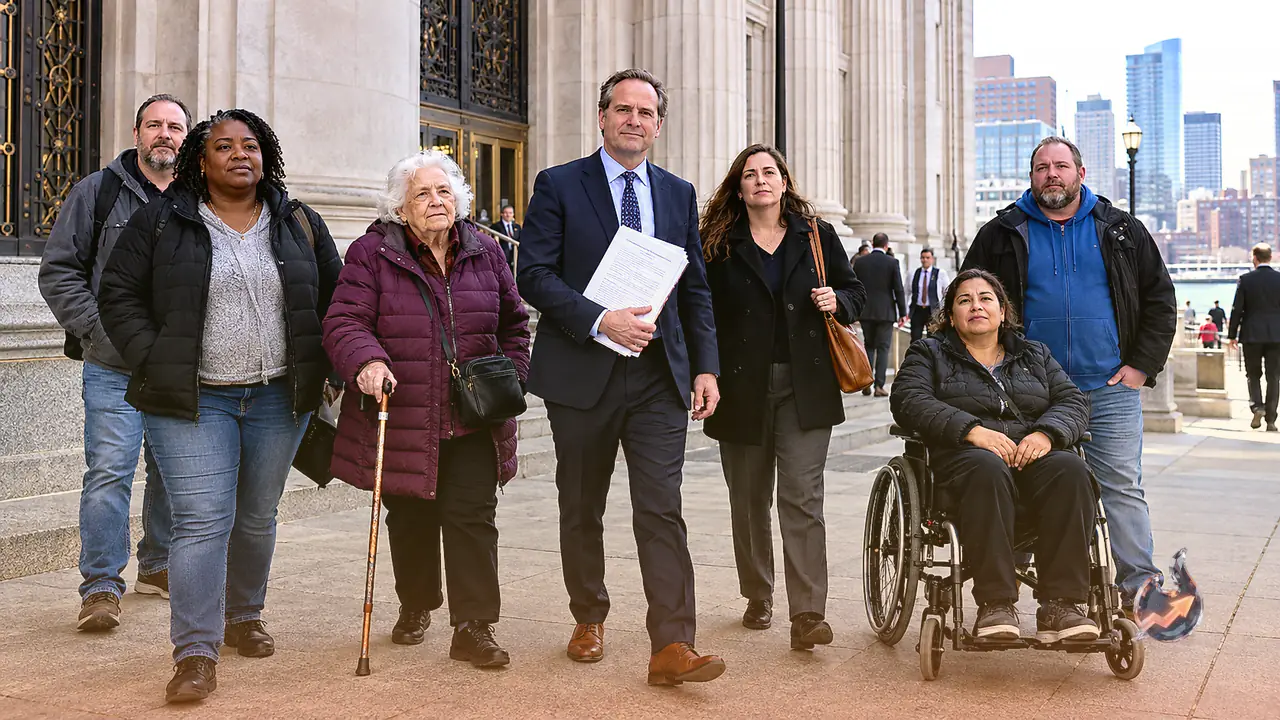

Medicaid recipients dealing with persistent and complex medical conditions have secured significant legal protection against new administrative barriers. In Boston, a federal judge ordered an immediate halt to federal health guidelines that forced chronically ill individuals to prove their health issues actively prevented them from fulfilling mandatory labor guidelines. The ruling allows people categorized as medically frail to retain their health insurance exemptions without having to satisfy an extra layer of bureaucratic compliance.
Partial Victory for States in Federal Court Challenge
U.S. District Judge Richard Stearns delivered the 16-page ruling in Boston following a legal challenge directed at the Centers for Medicare and Medicaid Services. The lawsuit was initiated in June by a coalition comprising 25 states alongside the District of Columbia. Their joint complaint targeted federal agency guidance implementing the One Big Beautiful Bill, a major tax and domestic policy statute enacted in 2025 under the Trump administration. While providing targeted relief on the exemption verification process, Judge Stearns kept the underlying framework of the mandatory work policy intact.
Judge Stearns emphasized in his 16-page decision that state administrative operations faced imminent and severe disruptions without judicial intervention. States adequately demonstrated the danger of irreparable injury that cannot be resolved through financial reimbursement, Stearns noted, observing that states faced the immediate burden of financing and executing costly, intensive alterations across their beneficiary verification systems.
The Core Dispute Over Legislative Wording
When lawmakers drafted the 2025 statute, they explicitly outlined which enrollees qualify as medically frail under the Medicaid safety net. The statutory definition encompassed individuals who are blind or living with physical disabilities, individuals experiencing substance use disorders, patients with disabling psychiatric disorders or impairments that restrict activities of daily living, and patients suffering from severe or complex medical conditions.
Attorneys representing the suing states argued that the Centers for Medicare and Medicaid Services exceeded statutory boundaries by imposing requirements not found in the original legislation. The agency guidance instructed states to require these vulnerable populations to furnish additional documentation proving their medical conditions specifically inhibited their capacity to meet monthly activity targets. The coalition maintained that this unauthorized barrier threatened to arbitrarily strip eligible residents of health coverage.
Reactions From Healthcare Economists and Officials
Analyzing the broader practical implications of the decision, Morgan Henderson, a healthcare economist specializing in Medicaid at The Hilltop Institute, noted that people who were in danger of losing coverage because they are sick but were not considered sick enough under strict compliance tests might now see their healthcare access preserved.
In North Carolina, Health and Human Services Secretary Dev Sangvai stressed the importance of shielding patients from operational friction. Sangvai stated that one of their top priorities is ensuring people can access essential health services without encountering confusing paperwork or enduring constant anxiety about losing coverage mid-treatment. Sangvai added that the court's intervention enables health departments to dedicate their energy to delivering dependable care to the state's most vulnerable populations when they need it most.
Validation of Procedural Limits on Documentation
Even as the court struck down the double test linking physical frailty to work capacity, it upheld two other federal procedural limits governing medical verifications. Under these provisions, states are instructed to discard medical documentation if the underlying diagnostic assessment is older than one full year. Furthermore, the rules restrict enrollees to a single self-attestation per continuous enrolment stretch.
Judge Stearns ruled that the federal government provided a non-frivolous rationale for adopting both operational restrictions and sufficiently articulated why it did not view state concerns regarding disenrolment as compelling enough to discard them. The Centers for Medicare and Medicaid Services opted not to release any public comment regarding the outcome of the litigation.
Rollout Timeline and Activity Thresholds
The revised eligibility mandates originate from the broad fiscal package passed in 2025 during Trump's term. These operational mandates primarily govern adults enrolled under Medicaid expansion programs across the majority of states, which historically broadened safety-net healthcare access for low-income residents.
Starting January 1, expansion beneficiaries between the ages of 19 and 64 must verify participation in qualifying qualifying activities. Enrollees are required to complete at least 80 hours per month in standard employment or community service programs. Alternatively, enrolling as at least a half-time student satisfies the condition. Statutory exemptions remain available for individuals who are medically frail as well as those actively enrolled in supervised addiction treatment programs.