























Washington has officially granted regulatory clearance for the sale of 500 Patriot air defense missiles to Ukraine, providing a major reinforcement framework designed to counter sustained Russian missile and drone bombardments. The overall procurement package carries an estimated valuation of approximately $2.1 billion. However, the announcement has failed to provide immediate comfort to Ukrainian President Volodymyr Zelenskyy. His primary apprehension centers on the extended manufacturing timelines required for these weapons, which could delay actual deliveries by several years even as Ukrainian civilian centers and vital installations face immediate aerial bombardment.
According to information released by the United States Department of State, the financial burden of this massive weapons transaction will not fall upon American taxpayers. Instead, the procurement is being financed entirely through a collective funding mechanism backed by Canada and European allies. The transaction draws directly on specialized defense contributions from Canada, Germany, and Norway, supplemented by financial resources made available through the European Union Ukraine Support Loan facility. Defense industrial giant Lockheed Martin has been designated as the primary contractor tasked with producing the interceptors. Officials in Washington maintained that facilitating this weapons transfer is critical to preserving broader political and economic stability across Europe.
Urgent Calls for Immediate Stockpile Transfers
Reacting to the news following the formal announcement from Washington, Volodymyr Zelenskyy took to the social media platform X to welcome the sale authorization. Nevertheless, the Ukrainian leader emphasized unequivocally that his armed forces require defensive interceptors right now rather than years in the future. He expressed deep concern that relying purely on fresh assembly lines means front-line units could wait several years before receiving a single newly manufactured missile. Consequently, Zelenskyy appealed to American and allied defense planners to formulate immediate operational workarounds to bridge the perilous security gap.
The specific proposal put forward by Volodymyr Zelenskyy involves a phased backfill arrangement. Under this approach, the United States and European partners would immediately release operational Patriot missiles from their own active military inventories to Ukraine. Once Lockheed Martin completes the production runs authorized under the newly signed $2.1 billion agreement, those fresh missiles would be routed back to allied armed forces to fully replenish their drawn-down stockpiles. The urgency of this request stems from escalating Russian operations aimed directly at disabling Ukraine's power generation capabilities ahead of freezing winter weather. Over the span of just two weeks, Russian forces launched more than 30 targeted strikes against essential nodes of the national electrical grid, making advanced surface-to-air interceptors an indispensable safeguard for basic societal functioning.
Architecture and Interception Mechanics of the MIM-104 Patriot
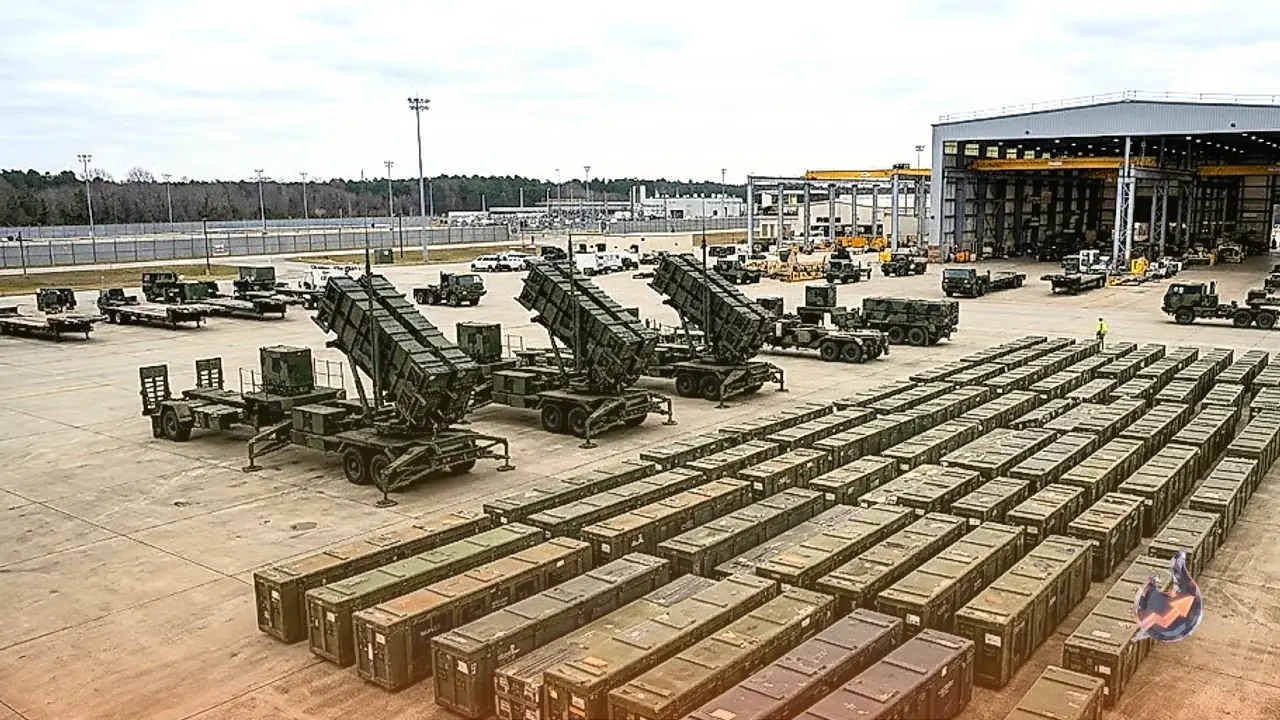
The MIM-104 Patriot represents the premier surface-to-air missile architecture developed by the United States to counter high-velocity aerial ordnance. The comprehensive battery is engineered to intercept and destroy advanced ballistic missiles, low-flying cruise missiles, modern combat aircraft, and loitering attack drones before they reach high-value ground targets. Conceptually, the Patriot network functions as a coordinated aerial shield over designated defensive sectors, relying on four core integrated modules operating in tandem
- Phased Array Radar: The sensory foundation that continuously searches the horizon, tracking airborne signatures and identifying incoming hostile threats from vast operational distances.
- Command and Control Center: The tactical computational brain that ingests radar telemetry, analyzes threat trajectories, calculates interception vectors, and issues real-time firing commands.
- Launching Stations: Mobile missile canisters configured to deploy defensive interceptors instantly upon receiving validated launch authorizations from the control node.
- Interceptor Missiles: High-speed kinetic guided rounds that close the distance to airborne threats and destroy incoming projectiles mid-flight through direct impact or detonation.
Within this family of munitions, the PAC-3 variant holds particular strategic importance due to its optimized hit-to-kill performance against terminal-phase ballistic missiles. Given the heavy reliance of Russian forces on ballistic missile barrages, securing continuous quantities of PAC-3 interceptors has become the highest defensive priority for military planners in Kyiv.
Global Inventory Shortages and Production Constraints
Ukraine's defensive challenges extend far beyond administrative delays, reflecting a profound worldwide shortage of Patriot interceptors. Heavy deployment and expenditure of these systems by the United States during broader military operations against Iran-backed regional threats have sharply intensified demand on global inventories. According to data from the United States Department of Defense, total manufacturing throughput stands at approximately 600 Patriot missiles per year. With multiple global partners placing orders against this limited industrial capacity, delivery backlogs have expanded dramatically.
Because the current $2.1 billion contract finances brand-new production runs rather than drawdowns from existing American depots, the manufacturing timeline inevitably pushes physical arrivals into future years. Compounding these constraints, United States President Donald Trump confirmed in July that Washington had not agreed to grant Ukraine a production license to manufacture Patriot missiles domestically within its own borders. That formal refusal came just three weeks after Trump had publicly floated the prospect of extending domestic manufacturing rights to Kyiv, leaving Ukraine entirely dependent on external factories.
Diplomatic Tensions Flare at Atlanta G20 Ministerial Gathering
Parallel to the weapons discussions, severe diplomatic frictions surfaced during the gathering of G20 foreign ministers convened in Atlanta. Chaired by United States Secretary of State Marco Rubio, the high-level international session witnessed direct confrontation stemming from the attendance of Russian Foreign Minister Sergey Lavrov. Several European diplomats voiced vehement opposition to Lavrov's presence at the summit table, registering their protest by walking away and refusing to stand alongside the Russian representative for the traditional official family photograph.
The diplomatic rift deepened further when British Foreign Secretary Ed Miliband directly confronted Sergey Lavrov during the proceedings. Miliband asserted to the Russian envoy that the global community is fully aware of who initiated the war in Eastern Europe, explicitly condemning the Moscow government for inflicting extensive civilian casualties across Ukraine. Russian armed forces launched their comprehensive full-scale invasion of Ukraine in February 2022, building upon the earlier territorial seizures carried out when Moscow annexed Crimea and occupied strategic parts of the Donbas region in eastern Ukraine.