






















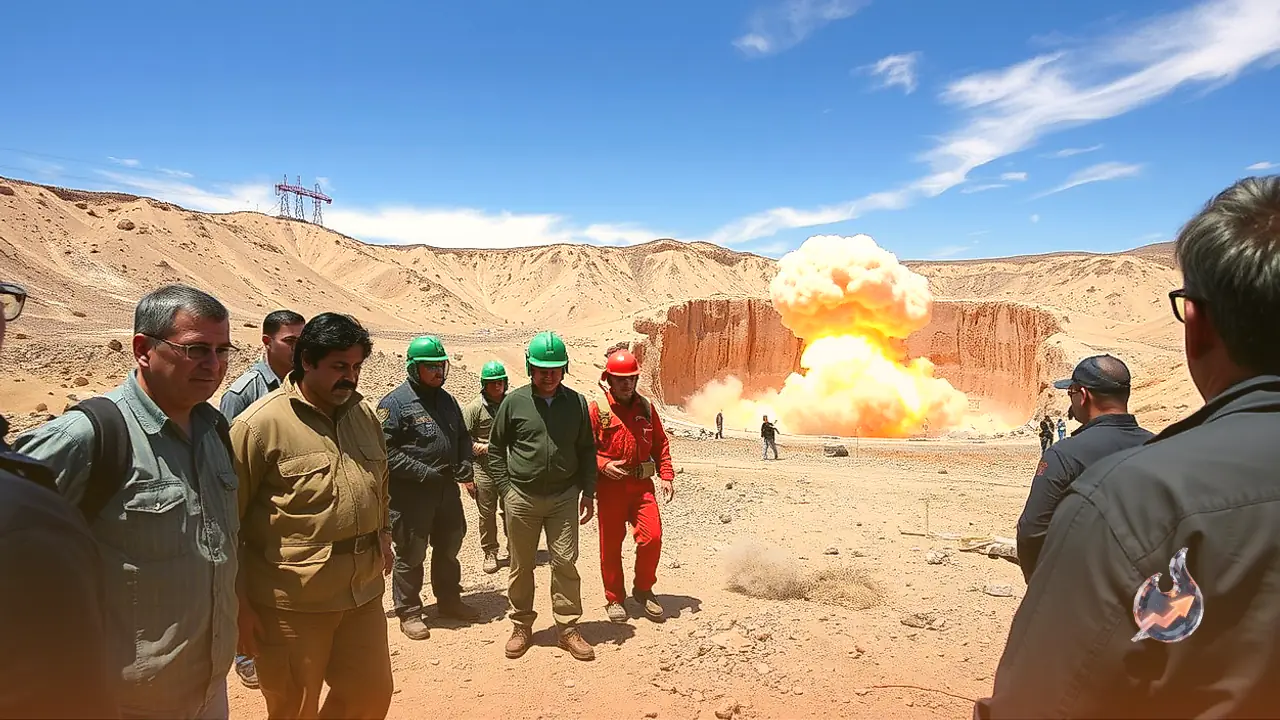

In an effort to upgrade global monitoring capabilities against clandestine nuclear tests, the United States conducted a controlled underground non-nuclear explosion. Although the test utilized conventional chemical explosives rather than nuclear material, it served as a critical preparation for identifying covert weapons activities. The objective behind the experiment is to refine technological capabilities so that even low-yield, concealed nuclear tests conducted anywhere in the world can be accurately identified. This development comes amid ongoing international concerns and past allegations regarding undetected sub-surface testing.
Data Gathering at Nevada National Security Site
According to the US Department of Energy, the underground non-nuclear chemical blast was carried out on Wednesday at the Nevada National Security Site. During the test, scientific teams recorded detailed seismic signatures and analyzed the physical impact generated beneath the surface. The collected empirical data will be fed into advanced computer modeling and detection algorithms designed to track nuclear explosions. In essence, the operation acted as a physical simulation to practice and improve the detection of covert test signatures.
The Difficulty in Detecting Low-Yield Testing
High-yield nuclear tests produce massive kinetic energy, making them relatively straightforward to monitor. A massive underground detonation triggers powerful seismic waves that register on sensor networks worldwide, often causing visible surface craters. In contrast, extremely low-yield explosions present a severe verification challenge because their seismic signals are faint and difficult to distinguish from natural subterranean events. The experiment in Nevada is directly tailored to close this gap by enhancing the sensitivity and accuracy of detection systems.
Context of the 2020 Allegations Concerning Lop Nur
The technical push follows earlier US claims alleging that China conducted a low-yield nuclear test at its Lop Nur site in June 2020. China explicitly rejected those allegations. On June 22 of that year, monitoring stations recorded two very minor seismic signals separated by an interval of approximately 12 seconds. However, those signals were insufficient to confirm whether a nuclear detonation had occurred. The international nuclear test monitoring organization stated that no definitive evidence of a nuclear explosion was detected on that day, leaving the incident without a conclusive finding despite lingering suspicions.
Countering Decoupled Underground Explosions
A central objective of the US experiment is detecting decoupled explosions, a method where an explosive is detonated inside an underground cavity rather than in direct contact with solid rock. When a detonation occurs in direct contact with dense rock formations, shockwaves travel efficiently through the ground; however, an open chamber muffles the shockwaves, drastically reducing the seismic signature transmitted outward. Countries could theoretically use decoupling to conceal low-yield nuclear experiments. By analyzing controlled underground blasts, US systems aim to train sensors and automated models to catch even these heavily suppressed signals.