




















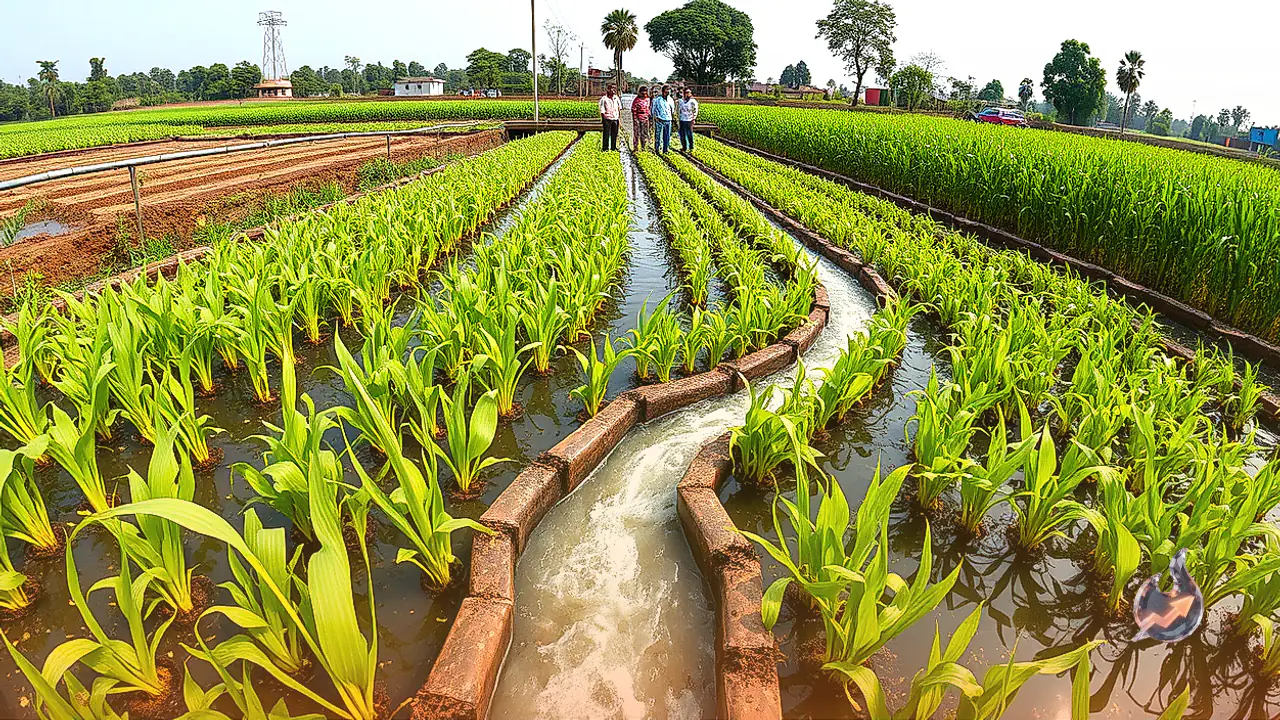

Expanding livestock production across rural belts brings severe waste disposal hurdles, particularly where conventional municipal sewage networks are physically or financially unviable. Tackling this growing environmental risk, researchers at the Indian Institute of Technology (IIT) Guwahati have engineered a nature-based, compact wastewater treatment mechanism explicitly built for heavily polluted swine wastewater. The low-energy solution pairs common taro plants (Colocasia esculenta) with a specialized zig-zag flow mechanism, creating an accessible filtration system for resource-limited agricultural regions.
Tackling High-Load Agricultural Effluent at the Source
Liquid discharge from swine farming ranks among the most challenging agricultural wastes to manage safely. Piggery wastewater consists of a dense blend of animal manure, urine, stall-cleaning washdown, uneaten feed, and occasional domestic sewage from farm personnel. Left untreated, this nutrient-saturated and pathogen-heavy liquid severely degrades rivers, freshwater lakes, and local soil systems. Ajay S Kalamdhad, Professor in the Department of Civil Engineering at IIT Guwahati, highlighted that the project directly addresses the urgent need to neutralize such toxic runoff before it can breach surrounding ecosystems.
The Engineering Behind the Zig-Zag Flow and Baffles
Standard constructed wetlands let wastewater run straight through an open bed, which frequently results in short contact intervals and incomplete biological processing. Monish Goswami, a PhD Scholar at IIT Guwahati, explained that this new setup introduces internal partitions known as baffles. These barriers channel the effluent through an elongated zig-zag circuit, driving deliberate transitions between aerobic and anoxic treatment stages.
"This increases the contact time between wastewater, plant roots, beneficial microorganisms and gravel media, allowing multiple biological and chemical treatment processes to occur more efficiently."
Goswami noted that because the configuration maximizes retention and surface interaction, it holds immense practical value for small and mid-tier swine operations operating far from municipal processing plants.
Research Collaboration and Peer-Reviewed Findings
The experimental trials utilized authentic swine slurry obtained from the ICAR-National Research Centre on Pig (ICAR-NRCP) in Assam, under an active collaborative research initiative with the technical institute. The peer-reviewed findings have appeared in the Journal of Environmental Management, an Elsevier-published scientific journal covering natural resource oversight and environmental sustainability.
Scaling Beyond the Laboratory for Wider Rural Impact
Professor Kalamdhad observed that the project proves how targeted engineering can drastically elevate the performance of standard biological wetland designs. Beyond swine pens, this engineered wetland architecture can be customized for broader agricultural wastewater streams and rural village applications, curbing nutrient runoff and safeguarding freshwater reservoirs. With the laboratory phase validated, the research group is now working to deploy the design across extensive field-scale tests, aiming to supply affordable, decentralized wastewater filtration to livestock producers nationwide.