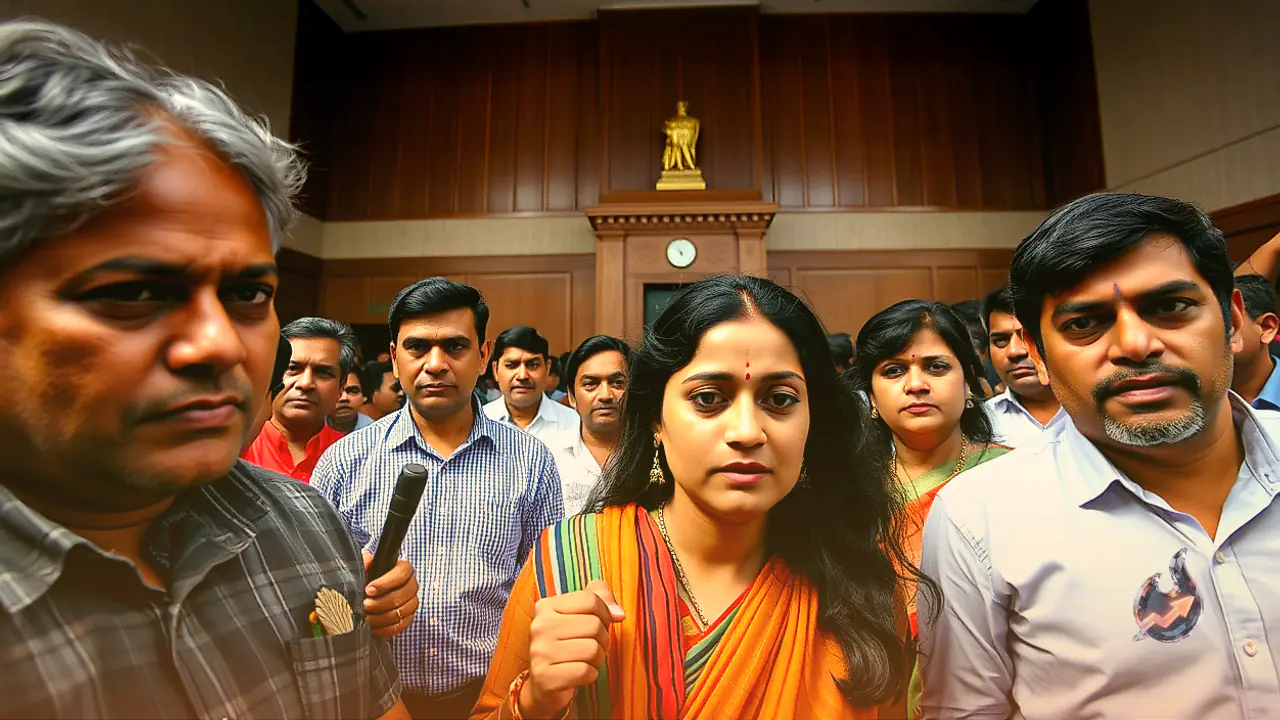


















A prominent student activist has suddenly found herself at the center of intense political debate amid ongoing agitations targeting the election machinery and demanding the removal of Chief Election Commissioner Gyanesh Kumar. All India Students Association national president Neha Bora has emerged as a visible face across several major opposition gatherings. Demonstrators have been raising allegations regarding the voter revision exercise, and her consistent presence at these events has drawn significant attention from political observers.
Prominent Presence on Opposition Platforms
The student activist has been afforded notable visibility across public rallies as well as formal media interactions led by key political figures. She was frequently seen in demonstrations organized by the opposition bloc under the leadership of Leader of Opposition Rahul Gandhi. Beyond coalition rallies, she participated in independent civil society agitations, including a large gathering of her supporters organized at Jantar Mantar on October 2, marked by high decibel sloganeering.
A similar scene unfolded during an opposition march conducted on October 12. As opposition figures traveled atop an open truck, Samajwadi Party chief Akhilesh Yadav was seen reaching out into the gathering to secure an AISA organizational flag and hand it over to her. Such backing from heavyweight political personalities swiftly amplified her profile across digital networks and national news broadcasts.
Controversy Surrounding Cross-Border References
Amid this mounting spotlight, a video recording surfaced on October 15 that triggered widespread controversy. In the footage, the student representative stated that recent disruptive public unrest and the unseating of the government in a neighboring country served as motivation for organizing large-scale demonstrations domestically. She claimed that those events represented an effort to reclaim democratic norms and that similar resistance methods could be mobilized here.
The statement instantly ignited intense debate across social platforms. Observers pointed out that the collapse of Sheikh Hasina's elected administration had led to severe instability, damaging industrial sectors like textiles and resulting in targeted violence against minority communities. Critics questioned how such volatile outcomes could be cited as an aspirational benchmark in a functioning constitutional democracy, labeling the comparison reckless.
Ideological Lineage and Historical Origins
The student body AISA draws its organizational roots from the Communist Party of India (Marxist-Leninist) Liberation, commonly known in political circles as CPI(ML) Liberation. The ideological origins of this formation date back to the late 1960s. Following the 1967 peasant uprising in Naxalbari, West Bengal, spearheaded by Charu Majumdar, Kanu Sanyal, and Jangal Santhal, the movement gained momentum across rural tracts.
On April 22, 1969, the party was formally established as a new radical faction. During its early phase, the movement operated outside constitutional bounds, relying heavily on armed resistance and coercive tactics against landed interests and capital. Over the subsequent decades, areas across Bihar, undivided Andhra Pradesh, Madhya Pradesh, and Maharashtra witnessed episodes of armed conflict and killings. It was later, under the stewardship of Comrade Vinod Mishra, that the underground outfit gradually navigated towards electoral competition and accepted constitutional frameworks.
Current Electoral Footprint and Coalitions
In modern Indian politics, the party has adapted to conventional democratic mechanisms, contesting regional and national ballots. The outfit is currently steered by General Secretary Deepankar Bhattacharya, who hails from Bihar. Its electoral influence is predominantly concentrated in select rural belts across Bihar and neighboring Jharkhand.
The party has solidified its standing within broader political fronts, serving as a constituent partner in Bihar's regional grand alliance as well as the national opposition coalition. Photographs highlighting the young student leader confronting police barricades have even been showcased prominently on the party's official online portal. Meanwhile, administrative authorities under Home Minister Amit Shah have repeatedly emphasized strict operational timelines to curb remnants of Left-wing extremism. In this charged backdrop, the activist's remarks have rekindled fierce arguments over the ideology and evolving strategies of Left politics.