





















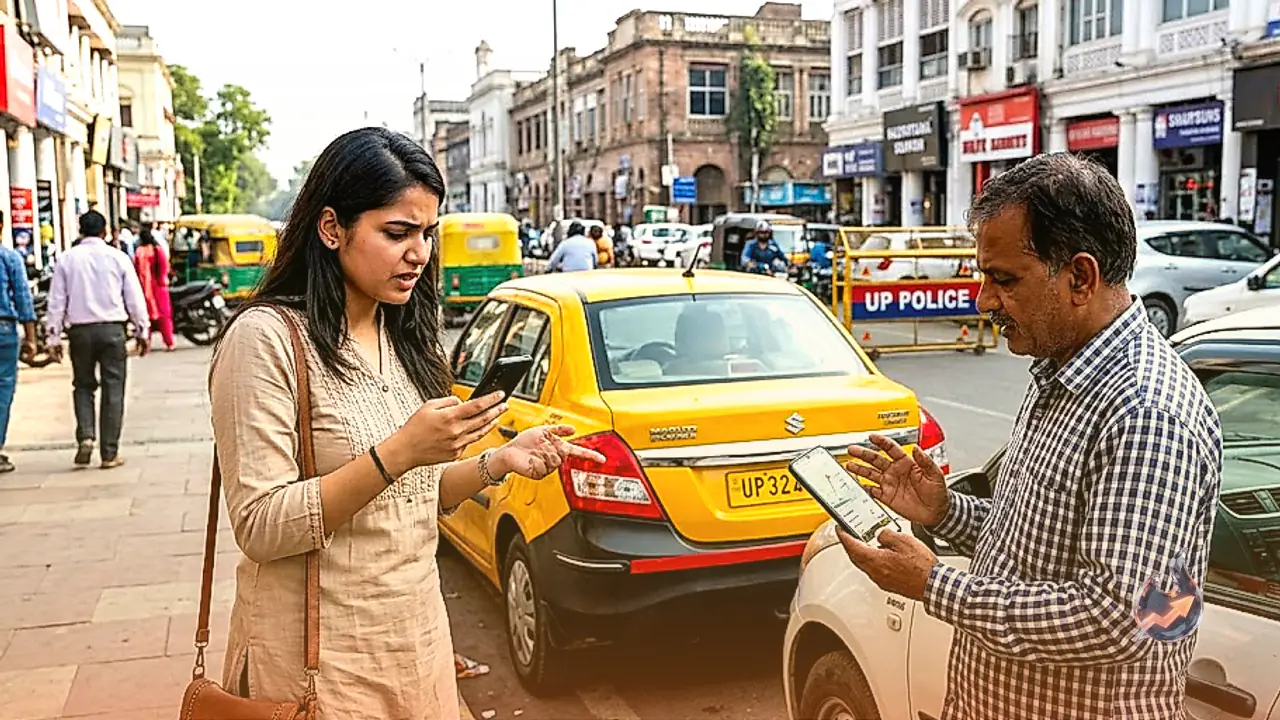

Anyone who has ever booked a ride only to watch the app promise a five-minute arrival while the vehicle takes fifteen minutes knows the frustration of unreliable cab services. To address this common commuter grievance, the Uttar Pradesh government has introduced sweeping changes to its cab aggregator policy. Under the newly implemented guidelines, if a booked cab arrives more than 10 minutes past the scheduled pickup time, a penalty of 100 rupees will be imposed on the driver. The financial benefit of this penalty will directly pass on to the consumer as a credit for their next cab booking, ensuring accountability from the service providers.
State transport minister Dayashankar Singh announced these major revisions to make ride-hailing services more accountable and structured for everyday users. Alongside holding drivers responsible for punctuality, the government has also extended welfare measures for the drivers themselves by announcing health insurance coverage of up to 5 lakh rupees. The transport policy now mandates that any entity wishing to start a cab service must apply exclusively through a designated government portal. Officials emphasized that no new aggregator will be permitted to operate as a service provider without obtaining a proper official license first.
To curb arbitrary and exorbitant fare hikes by cab companies, the new policy strictly limits surge pricing. Under this rule, operators can only increase fares by a maximum of 50 percent above the established base fare, preventing sudden price gouging during peak hours or adverse weather conditions. If companies or drivers violate these prescribed conditions, heavy financial penalties will be levied directly on the operating company. These regulations are designed to bring fairness and predictability to the urban transport ecosystem.
The administrative framework for operating in the state has also been formalized with clear financial requirements. The application fee for an aggregator is set at 25 thousand rupees, while the operational license fee stands at 5 lakh rupees. Furthermore, companies must deposit a security money amount based on their fleet size. Operators managing 100 buses or 1,000 cars must deposit a security amount of 10 lakh rupees. For those managing 1,000 buses or 10,000 cars, the security deposit rises to 25 lakh rupees, and fleets exceeding 1,000 buses and 10,000 cars require a security deposit of 50 lakh rupees.
Safety and security have been given paramount importance, particularly for women and children traveling across the state. Every cab must now be equipped with live tracking systems to monitor real-time movement, and rigorous character validation must be conducted for every registered driver. Additionally, companies are required to arrange psychological evaluations for all cab drivers and conduct periodic training sessions to maintain professional standards.
To handle consumer disputes effectively, aggregator companies must appoint a dedicated grievance redressal officer to resolve passenger complaints in a timely manner. On the insurance front, every passenger will be covered by insurance at the time of booking. Simultaneously, companies must provide drivers with a 5 lakh rupee health insurance policy and a 10 lakh rupee term insurance policy to safeguard their financial well-being.