
In a major infrastructural leap aimed at resolving urban traffic congestion, the city of Bilaspur has launched Chhattisgarh's first automated multilevel car parking facility. Located at the heavily congested Old Bus Stand, this multi-tiered vertical structure replaces traditional manual parking garages with a modern, robotic approach. Motorists no longer have to navigate through tight ramps, search frantically across multiple floors for an open bay, or worry about bumper-to-bumper scrapes. The facility relies on synchronized robotics and smart software to park and retrieve vehicles autonomously.
RFID authentication streamlines entry points
The entire customer journey has been kept straightforward and touch-free. Upon reaching the facility entrance, a driver is issued an RFID card. Holding the card before the smart scanner at the barrier instantly validates the access credentials. Once authenticated, the computerized access controller lifts the automated barrier gate and raises the heavy-duty automated shutter in tandem.
The motorist simply drives forward into a designated entry bay and aligns the vehicle following the stall markers. Before stepping out, the driver shifts the vehicle into gear, pulls the handbrake, secures personal belongings, and locks all doors. After walking outside the bay, the motorist hits an enter button situated on the external terminal. The barrier drops, the shutter lowers, and the computerized system takes complete custody of the car.
Shuttles, elevators, and robotic lifts manage internal logistics
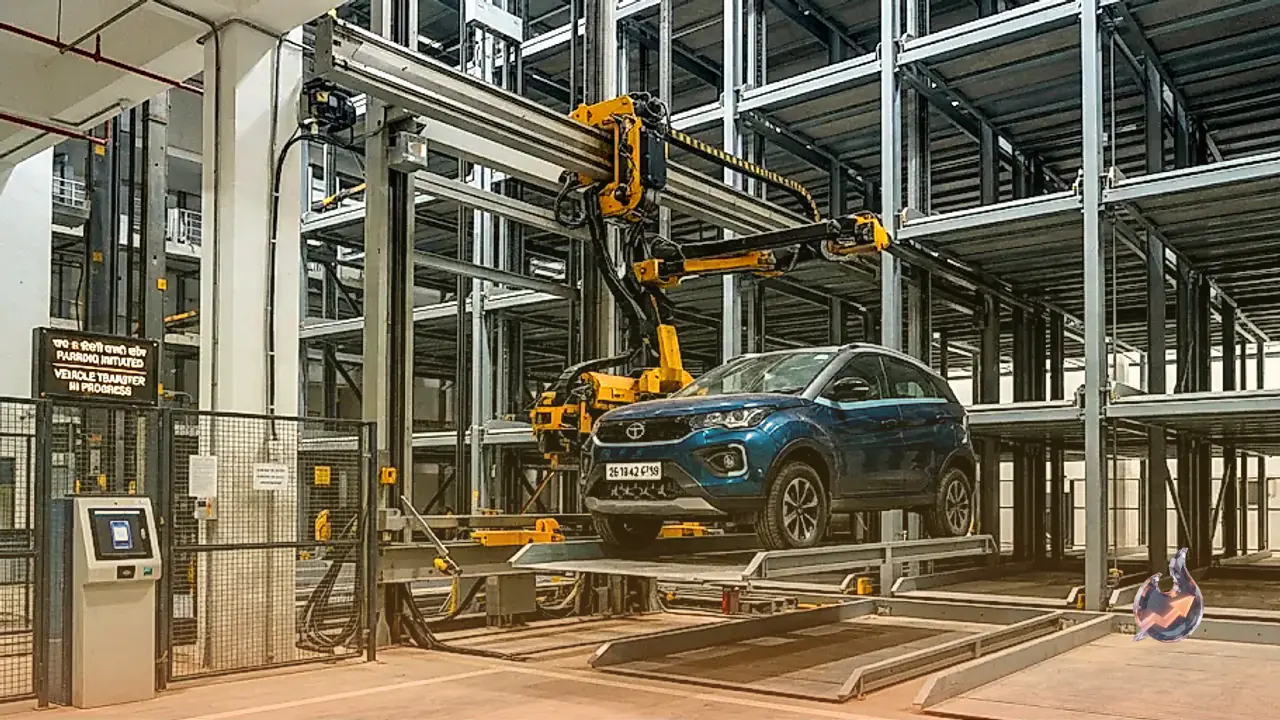
Inside the enclosed vertical structure, the vehicle transfer relies entirely on precision machinery. The system combines vertical elevators with motorized lateral shuttles and specialized robotic undercarriages. Once the driver confirms departure at the terminal, the robotic mechanisms slide beneath the vehicle, lift it securely by the tires, and position it squarely onto a transport shuttle platform.
Working seamlessly together, the shuttle and hoist transport the automobile to the targeted floor level. Real-time slot management software continuously tracks the occupancy matrix across the entire garage, assigning each newly arrived car to the most optimal open space available. The machinery glides to the allocated rack and softly places the vehicle into position. Because every component communicates through synchronized industrial logic, human error, careless parking angles, and accidental dings are completely eliminated.
Automated vehicle retrieval eliminates manual searching
Retrieving the car at the conclusion of an errand requires just a single tap. The motorist walks up to the customer collection booth at the exit terminal and presents the original RFID card to the scanner. The integrated control system immediately decodes the token, maps the exact location of the stored automobile, and commands the robotics to begin retrieval.
The lift and shuttle travel directly to the designated slot, retrieve the vehicle, and transport it smoothly down to the ground-level exit bay. The automated door lifts, allowing the driver to step inside and drive away straight into city traffic. The motorist never needs to remember the floor number, row index, or slot coordinates. A real-time digital monitor at the exit bay also displays vehicular transit progress and status updates if verification is needed.
Single operator oversees centralized PLC network
According to technical expert Shantanu Banerjee, who is closely associated with the facility's engineering operations, the entire multi-level framework is monitored through a centralized control console. The machinery runs on industrial-grade programmable logic controllers, commonly known as PLCs, alongside an array of positioning sensors. A single trained technician is sufficient to supervise the complete setup. Shantanu Banerjee explained that while human oversight remains in place for safety protocols and routine monitoring, roughly 99 percent of the mechanical navigation and storage process operates entirely autonomously via algorithmic scheduling.
Bilaspur Municipal Corporation to determine rates and parking caps
While the mechanical testing and technical installation phases are complete, the commercial operating parameters remain subject to civic administrative guidelines. Shantanu Banerjee pointed out that comparable automated vertical facilities operating in other major Indian urban centers typically charge users anywhere between ₹50 and ₹100 per hour. However, the final rate structure, operational hours, and maximum duration thresholds for the Bilaspur site will be formally ratified by the Bilaspur Municipal Corporation.
Relief on the horizon for crowded downtown markets
Bilaspur has expanded rapidly into an important commercial hub, bringing with it a surge in vehicle ownership that has severely outpaced available roadside space. The market precincts surrounding the Old Bus Stand have historically suffered from bottlenecked lanes caused by disorderly curbside parking. By capitalizing on vertical height rather than sprawling lateral acreage, this robotic garage offers substantial vehicular density on a modest footprint. Residents, daily commuters, and local shopkeepers are now awaiting the civic body's announcement on commercial launch schedules and parking fee structures.