






















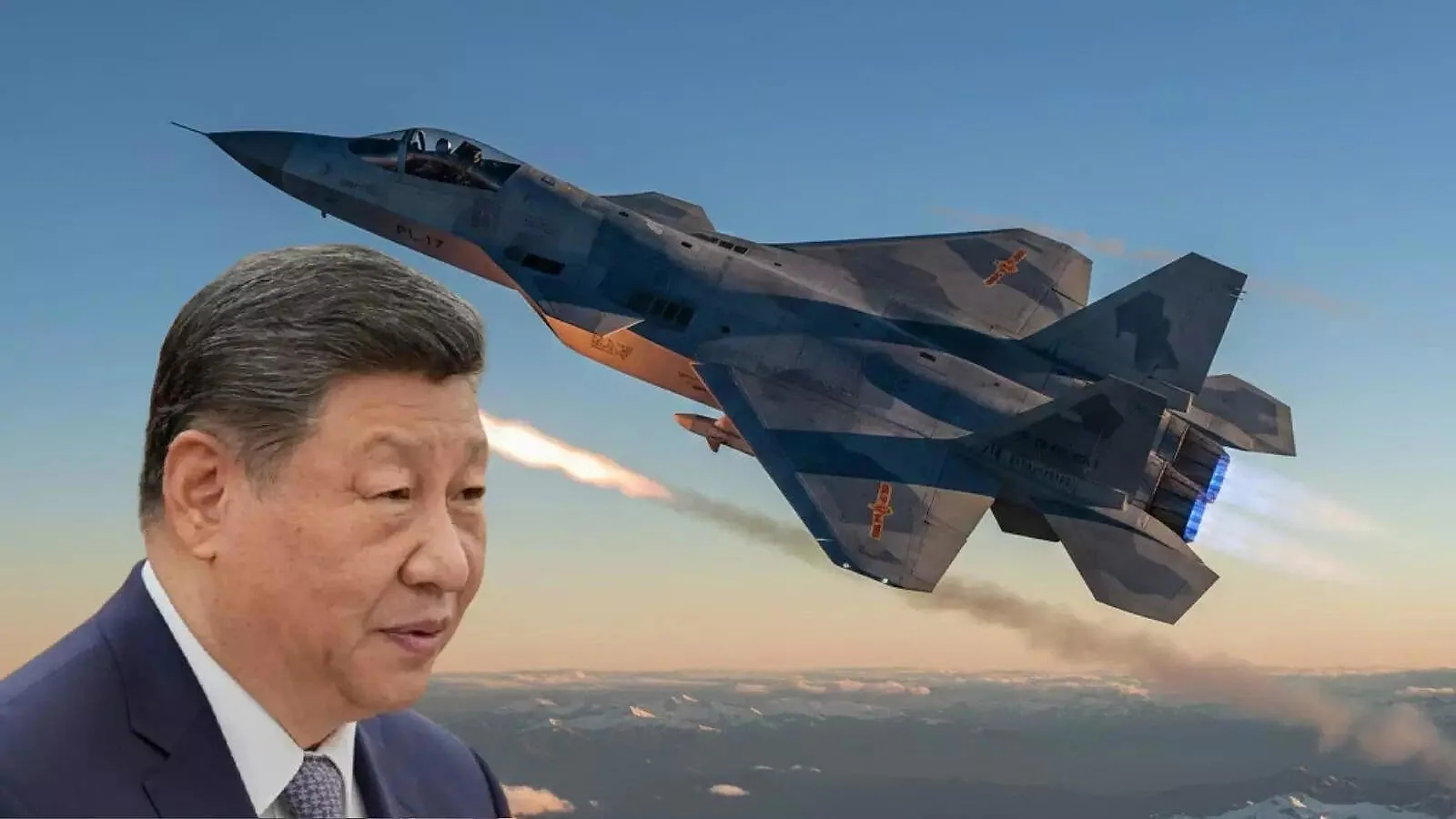

A significant military development has surfaced near the Indian border as high-resolution satellite imagery reveals China expanding its deployment of fifth-generation stealth fighter jets. Images captured in late June and early July show a total of 11 J-20 'Mighty Dragon' stealth aircraft stationed at two key frontline Chinese airbases close to Eastern Ladakh and Arunachal Pradesh. This strategic positioning underscores Beijing's continuous efforts to fortify its aerial combat capability along the Line of Actual Control, even as diplomatic discussions between the two nations persist.
Breakdown of Airbase Locations and Proximity to DBO and Leh
Detailed analysis of satellite photographs provided by Vantor indicates that the Chinese military has strategically split the deployment across two crucial sectors. At the Hotan airbase, located in the Xinjiang Uyghur Autonomous Region, 7 J-20 stealth jets were spotted lined up near the runway in images dated July 9. Hotan serves as a vital hub for Chinese air operations, situated approximately 389 kilometers from Leh and just 245 kilometers from the Indian Air Force's highly strategic Daulat Beg Oldi (DBO) airfield in Northern Ladakh. Defense experts note that having 7 stealth fighters assembled simultaneously at Hotan represents the largest recorded concentration of J-20s facing India at a single base.
Concurrently, satellite imagery of the Damxung airbase in the Lhasa region of Tibet shows 4 J-20 stealth jets parked along the flightline. Damxung lies roughly 344 kilometers north-west of Tawang in Arunachal Pradesh. By stationing advanced jets at both Hotan and Damxung, the Chinese military has effectively positioned stealth assets capable of covering both the western and eastern sectors of the contested border region.
Capabilities of J-20 Stealth Aircraft versus IAF Fleet
The J-20, developed natively by China as its premier fifth-generation combat aircraft, is engineered specifically to evade enemy radar detection. Equipped with sophisticated Active Electronically Scanned Array (AESA) radar systems, the aircraft offers low radar cross-section profiles paired with long-range sensor fusion. This stealth capability allows aircraft to penetrate contested airspace and engage targets before being detected by conventional air defense radar installations.
In comparison, the Indian Air Force currently operates advanced 4.5-generation multirole fighters such as the Dassault Rafale and Sukhoi Su-30MKI. While the Rafale possesses reduced radar signature characteristics, state-of-the-art electronic warfare suites, and lethal Beyond Visual Range missiles, it is not a dedicated stealth aircraft. The presence of true stealth fighters on the opposing side alters aerial tactical planning, requiring defensive networks to rely more heavily on integrated sensor arrays and advanced early warning systems.
Timeline for India's Indigenous AMCA Stealth Project
At present, India does not have operational fifth-generation stealth fighters in service. The nation's defense research organizations are actively developing the Advanced Medium Combat Aircraft (AMCA), an indigenous twin-engine stealth fighter designed to meet future requirements. However, induction of the first AMCA squadron into operational service is estimated to be at least a decade away. Achieving this milestone remains contingent upon successfully verifying critical technologies, stealth materials, and engine capabilities through extensive flight-testing programs over the coming years.
Rapid Acceleration in China's J-20 Production Capacity
While India works toward its future stealth roadmap, China has rapidly scaled up the manufacturing capacity of the J-20. Production statistics show that China possessed approximately 50 J-20 fighters in 2019, a number that grew to around 200 by 2022. Projections indicate that Beijing could field between 300 and 500 J-20 jets by mid-2026.
Furthermore, assessments by the Royal United Services Institute (RUSI), a UK-based defense think tank, suggest that China's inventory of J-20 stealth fighters could reach nearly 1,000 aircraft by 2030. This rapid expansion presents a significant long-term air defense challenge for India, highlighting an accelerating numerical and technological imbalance in fifth-generation air power along the border.