























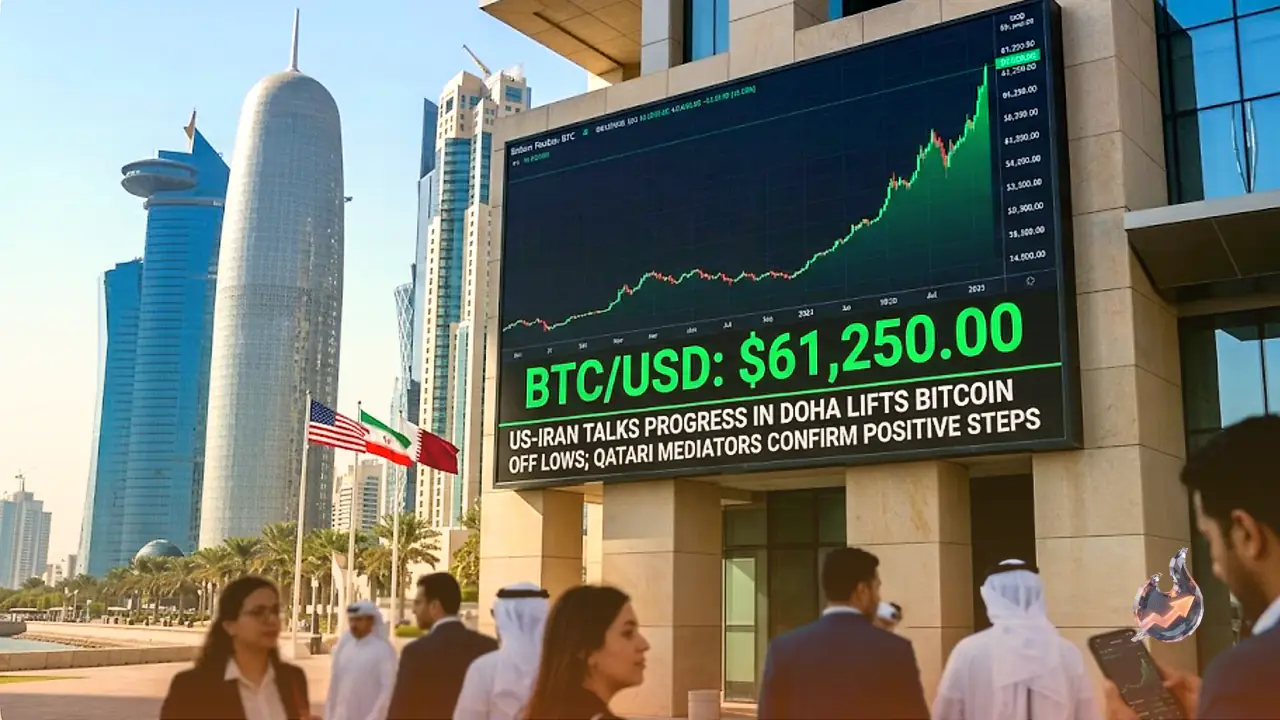

Bitcoin pushed its recovery further on Thursday, reclaiming the $61,000 mark just a day after sliding to a 21-month low. Live data show BTC changing hands around $61,196, up roughly 1.99% from the previous close of $60,004. The main reason behind the modest bounce is a wave of encouraging headlines out of Doha, where indirect talks between the United States and Iran are said to be making headway, which has nudged investor confidence higher. On the other side of the ledger, however, relentless institutional selling continues to weigh on the market, with US spot Bitcoin Exchange-Traded Funds (ETFs) posting yet another day of outflows.
Diplomatic progress rekindles risk appetite
An improving geopolitical backdrop is what lifted the mood and gave Bitcoin room to recover. Qatar's Foreign Ministry said the United States and Iran had made positive progress in indirect talks held in Doha, with the discussions advancing issues tied to the June ceasefire memorandum. The spokesperson added that negotiators were building on the outcomes of a recent summit in Switzerland, raising hopes for a more durable peace agreement.
Donald Trump echoed those comments, saying the talks delivered some progress on possible limits to Iran's nuclear program and that the denuclearization of the country is moving along well. JD Vance, meanwhile, said the nuclear matter would be addressed at a later time.
According to Qatar's Foreign Ministry, the next meeting will take place after the funeral processions for Iran's late Supreme Leader Ayatollah Ali Khamenei, who is due to be buried on July 9. The status of the key Strait of Hormuz, though, remains up in the air. Traffic through the corridor has picked up significantly, which has helped feed investor optimism, but it is still far short of the 160 ships that used to cross the waterway before the conflict began.
Traders should keep a close eye on developments across the Middle East, since the fragile situation continues to pose a risk to market sentiment. Even so, the recent diplomatic progress appears to have given near-term support to risk assets such as BTC.
Institutional money keeps heading for the exit
Despite the rebound, institutional demand keeps weakening. SoSoValue data show that spot BTC ETFs recorded an outflow of $294.62 million on Wednesday, marking the tenth consecutive day of withdrawals. If that outflow trend carries on through the week, Bitcoin could be in line for a further correction.
Live derivatives and flow figures tell a similarly cautious story. Over the past 24 hours, BTC turnover came in around $192.9 billion, down 2.14% on the day, while open interest slipped 4.38% to roughly $111.6 billion. About $418.8 million in positions were liquidated during the same window, and the long/short split sat at roughly 49.52% against 50.48%, pointing to an almost even tug-of-war. On the large-transfer front, 250 million USDC (about $250.04 million) was minted at the USDC Treasury, while 1,900 BTC (about $114.34 million) moved from one unknown wallet to another.
US jobs data could stir fresh volatility
The US Bureau of Labor Statistics will release the June Nonfarm Payrolls (NFP) report on Thursday at 12:30 GMT. With investors pricing in a hawkish Federal Reserve under new Chairman Kevin Warsh, the fine print of the employment report could shape the timing of any interest rate increase.
Automatic Data Processing (ADP) reported on Wednesday that US private sector employment rose by 98K in June, down from the prior month's unrevised 122K and short of the 113K consensus. On top of that, the Institute for Supply Management's Manufacturing PMI eased from 54 to 53.3 in June. Its Prices Paid subcomponent dropped to 73 from 82.1, signaling that inflation pressures are cooling, while the Employment Index ticked up to 49.7 from 48.6 in May.
Expectations around Fed policy remain a headwind for risk assets. The CME Group's FedWatch Tool shows traders still pricing in roughly a 63% chance the central bank raises borrowing costs in September and close to an 84% probability of such a move by year-end. Those bets were reinforced by Kevin Warsh's remarks on Wednesday, in which he said he would stick to the 2% inflation target and disappoint anyone expecting loose monetary policy, even as Donald Trump has called for rate cuts. Several Fed officials have also signaled that higher interest rates may be needed to bring inflation back to 2%. The prospect of tighter policy could underpin the US Dollar and Treasury yields, potentially capping Bitcoin's upside.
What the charts are showing
Bitcoin is extending its recovery around the $61,000 level on Thursday, after bouncing from a 21-month low of $57,800 the day before. Even so, BTC keeps a bearish lean, holding decisively below the 50-day, 100-day, and 200-day Exponential Moving Averages (EMAs) at $66,170, $69,972, and $75,913 respectively.
The Moving Average Convergence Divergence (MACD) has swung back into positive territory, hinting at some recovery attempts. Yet the Relative Strength Index (RSI) near 43 still points to subdued momentum, backing the view that rallies are more likely to be capped by overhead supply than to kick off a sustained uptrend. A professional technical read notes that, in the short term, Bitcoin has broken through the ceiling of a falling trend channel, which suggests the pace of decline is slowing.
On the upside, the first meaningful barrier sits near the recent horizontal level around $64,004, ahead of the 50-day EMA at $66,170, which lines up with a broader cluster of dynamic resistance formed by the 100-day EMA at $69,972 and the 200-day EMA at $75,913. A more distant structural cap is seen at $84,410. On the downside, a failure to reclaim the $64,000 area would leave BTC exposed to renewed pressure aimed at the key psychological level of $55,000.
A quick refresher on Bitcoin, altcoins and stablecoins
Bitcoin is the largest cryptocurrency by market capitalization, a virtual currency built to work as money. This form of payment cannot be controlled by any single person, group, or entity, which removes the need for a third party during financial transactions.
Altcoins are any cryptocurrency other than Bitcoin, though some also treat Ethereum as a non-altcoin, since it is from these two coins that forking happens. If that is the case, then Litecoin counts as the first altcoin, forked from the Bitcoin protocol and therefore an improved version of it.
Stablecoins are cryptocurrencies designed to hold a stable price, with their value backed by a reserve of the asset they represent. To pull this off, each stablecoin's value is pegged to a commodity or financial instrument, such as the US Dollar, with its supply regulated by an algorithm or by demand. Their main purpose is to offer an on/off ramp for investors who want to trade and invest in crypto, and they also let investors store value, since cryptocurrencies in general are prone to volatility.
Bitcoin dominance is the ratio of Bitcoin's market capitalization to the combined market capitalization of all cryptocurrencies. It offers a clear read on how much investor interest sits with Bitcoin. High BTC dominance typically shows up before and during a bull run, when investors lean toward a relatively stable, high market cap coin like Bitcoin. A drop in dominance usually means investors are shifting capital or profits into altcoins in search of bigger returns, which often sparks a burst of altcoin rallies.