

















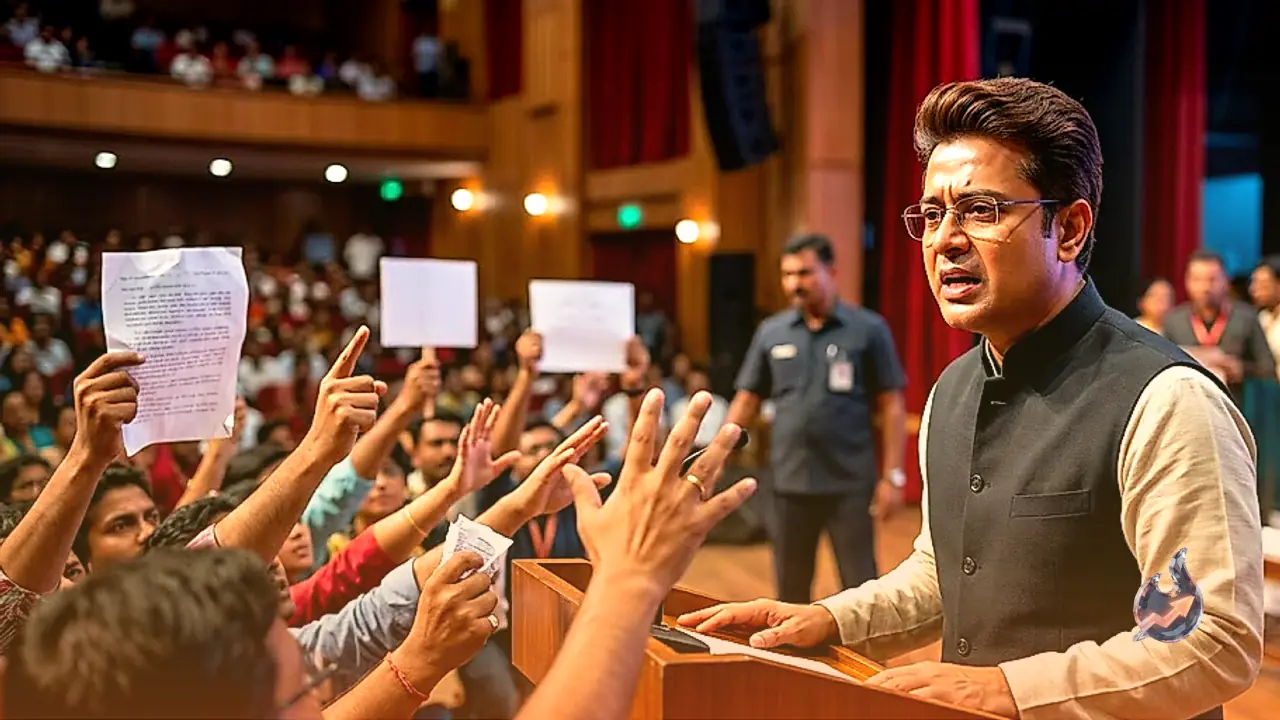

A special event organized on Saturday, August 1, 2026, to mark the symbolic homecoming of exiled Bangladeshi writer Taslima Nasreen to Kolkata after nearly two decades took a controversial turn when she invited celebrated Bengali poet Joy Goswami to join her on stage. As the Sahitya Akademi Award winning poet rose from his auditorium seat and walked toward the stage, a vocal section of the gathered audience erupted in fierce protest. The entire auditorium quickly reverberated with loud shouting, chanting, and sustained hooting, creating an unexpected disruption that temporarily brought the proceeding to a complete standstill.
Tension Erupts on Stage Leading to Taslima’s Appeal for Calm
The sudden outburst from the crowd left Taslima Nasreen visibly stunned for several moments. She remained standing on stage silently while event organizers repeatedly used the public address system to request order and plead with attendees to maintain decorum. After several minutes of relentless noise and disruption, Taslima took control of the microphone herself to address the agitated gathering. Speaking directly to the hall, she asked, "Can I speak? Please calm down and sit in your respective seats." Her direct intervention succeeded in calming the crowd, allowing the audience to settle down and enabling the interrupted program to move forward.
The Literary Prominence of Joy Goswami and Reasons Behind the Anger
Joy Goswami is widely recognized as one of the most prominent, respected, and popular contemporary poets in Bengali literature. His literary works are celebrated for capturing the daily struggles of ordinary people, pressing social concerns, and deep human emotions with exceptional sensitivity. Over his distinguished career, he has received numerous prestigious accolades for his contributions to literature, including the nationally renowned Sahitya Akademi Award, earning him immense respect across cultural and intellectual circles in Bengal.
Despite his high literary status, the opposition to his presence alongside Taslima Nasreen stems from long standing resentment dating back to 2007. During that year, Kolkata experienced violent street demonstrations targeting Taslima Nasreen over her controversial writings, ultimately forcing her to flee the city for safety reasons. A dedicated section of Taslima's supporters has long held the belief that Joy Goswami failed to voice strong public support or offer adequate backing to her during that critical period of distress. Furthermore, some attendees harbored ongoing dissatisfaction over Joy Goswami’s close political and social proximity to the then Chief Minister of West Bengal, Mamata Banerjee. These combined grievances led a portion of the gathering to strongly object to seeing him share a stage with the exiled author.
Past Regrets and Public Guilt Expressed by the Poet
The intense opposition witnessed on Saturday surprised many literary observers, given that Joy Goswami had previously expressed public regret regarding Taslima Nasreen’s expulsion from Kolkata. In an earlier public gathering, the poet had openly admitted feeling remorse for not doing enough to assist her when violent agitation forced her out of the city in 2007.
On that past occasion, Joy Goswami went so far as to publicly label himself guilty for his inability to stand up effectively for her during her crisis. However, despite his prior admission of fault and expression of regret, a vocal segment of Saturday's audience remained unwilling to move past the historical controversy. Their immediate protest upon his invitation onto the stage underscored how deep historical grievances continue to linger within the region's literary community.
A Emotional Return After 19 Years and a Message on Freedom
For Taslima Nasreen, the gathering marked an immensely significant and emotional milestone, representing her return to Kolkata after an exile lasting nearly 19 years. The occasion was framed as a symbolic homecoming to the city she was once compelled to abandon. Prior to the auditorium program, West Bengal Chief Minister Suvendu Adhikari had hosted a formal civic reception for her at a hall within the state secretariat, honoring her return to the state.
Addressing the auditorium after order was restored, Taslima expressed deep emotion, remarking that returning to Kolkata felt like rejoining a vital chapter of her life that she had been forced to leave behind years ago. Emphasizing resilience in her speech, she stated that "injustice can last long, but not forever." She concluded by voicing hope for global intellectual freedom, expressing her desire that no author in the future should ever be forced to abandon their home or country simply for exercising their freedom of thought and expression.