


















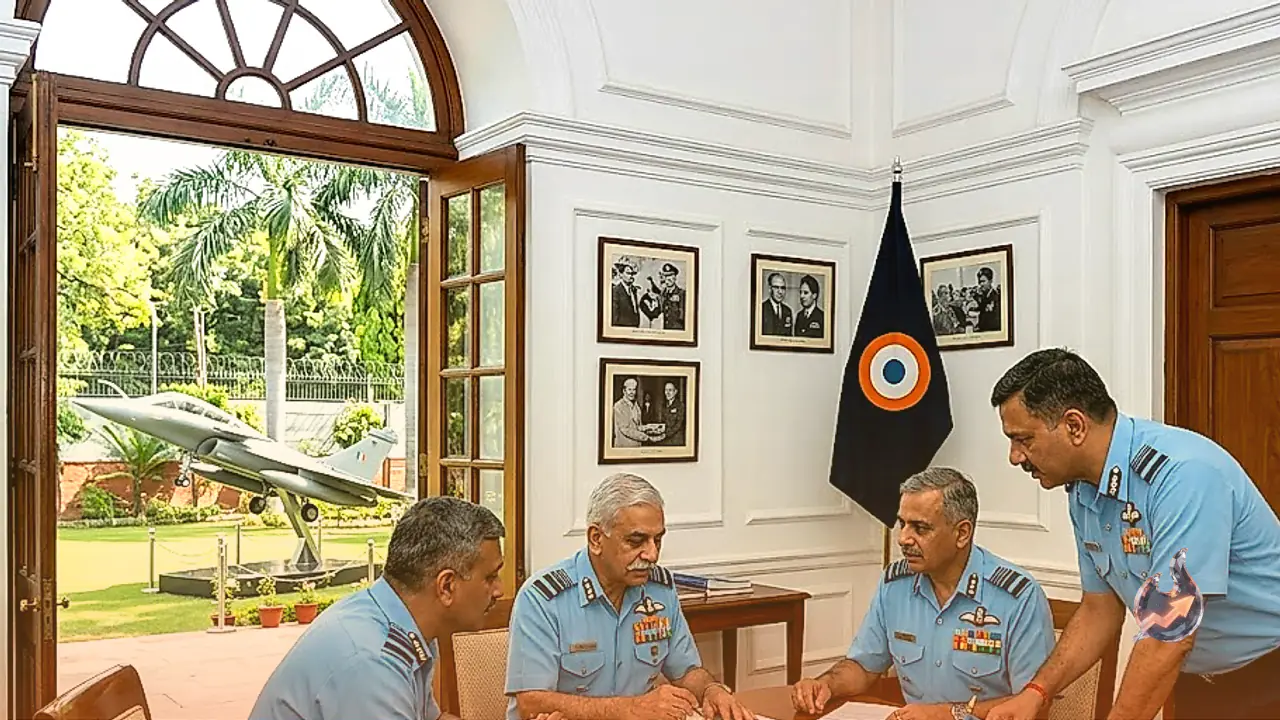

Nestled amid the lush avenues of Lutyens' Delhi, the bungalow at 23 Akbar Road represents far more than an expansive official estate. Within military circles, this storied property is revered as Air House, the long-standing official residence of the Chief of the Air Staff. For generations, this leafy enclave has stood as a quiet nerve center where commanders deliberate over border security and orchestrate strategies to safeguard the nation's skies. Today, Air Chief Marshal Amar Preet Singh resides within its secure perimeters, holding high-level strategy sessions with trusted deputies on aerospace defense.
From Colonial Post to Sovereign Air Force Headquarters
The operational heritage of this address traces back to the very inauguration of New Delhi as the seat of government. Prior to independence, the bungalow accommodated Air Vice Marshal Meredith Thomas of the Royal Indian Air Force. During that era, the officer posted at this location was attached directly to Britain's South East Asia Command. With India adopting its sovereign republican constitution in 1950, the colonial 'Royal' prefix was permanently discarded, and 23 Akbar Road was formally designated as the official residence of the head of the Indian Air Force.
The calendar year at Air House revolves around an essential milestone every 8 October, marked nationwide as Air Force Day. On this evening, the residence hosts a grand reception attended by the country's senior constitutional leadership, prominently including the President and the Prime Minister, to honor the service and courage of the nation's air warriors.
Subroto Mukerjee: Laying the Foundations of Aerial Might
The first Indian officer to occupy 23 Akbar Road was Air Chief Marshal Subroto Mukerjee, widely remembered as the 'Father of the Indian Air Force.' Born to Satish Chandra Mukerjee, an ICS officer, Subroto Mukerjee was commissioned in 1932. A daring fighter pilot, he saw rigorous action during the Second World War and subsequently played a pivotal role in modernizing the armed service after independence.
In April 1954, he created history by becoming the first Indian Commander-in-Chief of the air branch, an appointment re-designated in 1955 as Chief of the Air Staff. That very year, Mukerjee took the personal initiative to establish and inaugurate the Air Force School in the capital, ensuring that the children of serving personnel had immediate access to sound educational institutions near their cantonment homes.
Tragedy struck on 8 November 1960 during a visit to Tokyo, when a morsel of food became lodged in his windpipe at a local restaurant, leading to his untimely death. His mortal remains were flown back to the capital and conveyed from Palam to Air House, before receiving a full state funeral with military honors. His lasting contribution to the service is commemorated in Subroto Park in New Delhi, which houses major air force establishments, schools, and residential quarters.
War Heroes Who Defined the Spirit of the Residence
Over the decades, Air House has provided shelter to towering military figures including Arjan Singh, P.C. Lal, Idris Hasan Latif, and N.A.K. Browne. Many of these commanders were decorated fighter pilots who had tested their mettle in fierce combat operations against hostile adversaries.
Marshal of the Indian Air Force Arjan Singh retained vivid recollections of his first visit to 23 Akbar Road in January 1945. Having just returned from the grueling Burma campaign of World War II, he arrived at the residence to meet Air Vice Marshal Meredith Thomas. Decades later, Arjan Singh returned to reside in the house as air chief from 1964 to 1969. In recognition of his unparalleled wartime leadership, the Government of India subsequently elevated him to the singular rank of Marshal of the Indian Air Force.
Air Chief Marshal P.C. Lal, the tactical commander behind the triumphant 1971 war effort, was another distinguished resident. Having witnessed combat from World War II to the 1971 conflict, Lal took command in 1969 and dedicated his tenure to systematically preparing the force for imminent cross-border hostilities. This rigorous operational readiness yielded decisive air superiority during the 1971 campaign, crippling the adversary's air capability. His distinguished service was honored with both the Padma Bhushan and Padma Vibhushan.
Idris Hasan Latif: From Republic Day Flypast to Fleet Modernization
Another iconic figure to reside at Air House was Idris Hasan Latif. During the 1971 hostilities, serving as an Air Vice Marshal, he oversaw air operations across the eastern sector directly from the regional headquarters in Shillong. He monitored tactical sorties, combat progression, and supply logistics right up to the historic surrender of the adversary's ground forces. Latif went on to command the service as air chief from 1978 to 1981, becoming the first Muslim Chief of the Air Staff. In later years, his public career saw him serve as the Governor of Maharashtra and India's Ambassador to France, while a road in Delhi Cantonment bears his name.
Latif's bond with the nation's history also features a memorable milestone from India's inaugural Republic Day. On 26 January 1950, as a Squadron Leader and commanding officer of No. 4 Squadron, he spearheaded the very first aerial flypast over New Delhi flying a Hawker Tempest. The aircraft took off from Ambala, treating citizens gathered along Rajpath to their first glimpse of advanced combat maneuvers. Throughout his career, having fought in both the 1948 and 1965 wars, Latif championed fleet upgrade programs as chief, successfully persuading the central government to acquire the Jaguar strike aircraft.
Documenting Heritage, Vayu Bhavan, and Estate Logistics
In 2011, the rich architectural and operational history of 23 Akbar Road was compiled into a coffee-table volume titled 'Air House… Down the Years,' initiated by then air chief Air Chief Marshal P.V. Naik. On 19 July 2011, Marshal Arjan Singh formally unveiled the volume at the residence itself, capturing the structure's physical fabric alongside personal reflections of the families who dwelt within its walls.
Just a short distance away along Rafi Marg stands Vayu Sena Bhavan, the institutional headquarters of the Indian Air Force. Completed in 1964, its main entrance is distinguished by static fighter jet replicas that immediately identify its mission to passersby. While strategy blueprints and official directives are finalized across the desks of Vayu Sena Bhavan, Air House serves as the personal and strategic sanctuary where senior air commanders converse and deliberate.
Classified as a Type-8 official bungalow within the high-security Lutyens' zone, 23 Akbar Road features sprawling manicured lawns, domestic staff quarters, and comprehensive protective cordons. The residence requires round-the-clock security surveillance, continuous utility services, and ongoing horticultural maintenance, ensuring it remains fully equipped to host critical tactical briefings and high-profile diplomatic receptions.