


















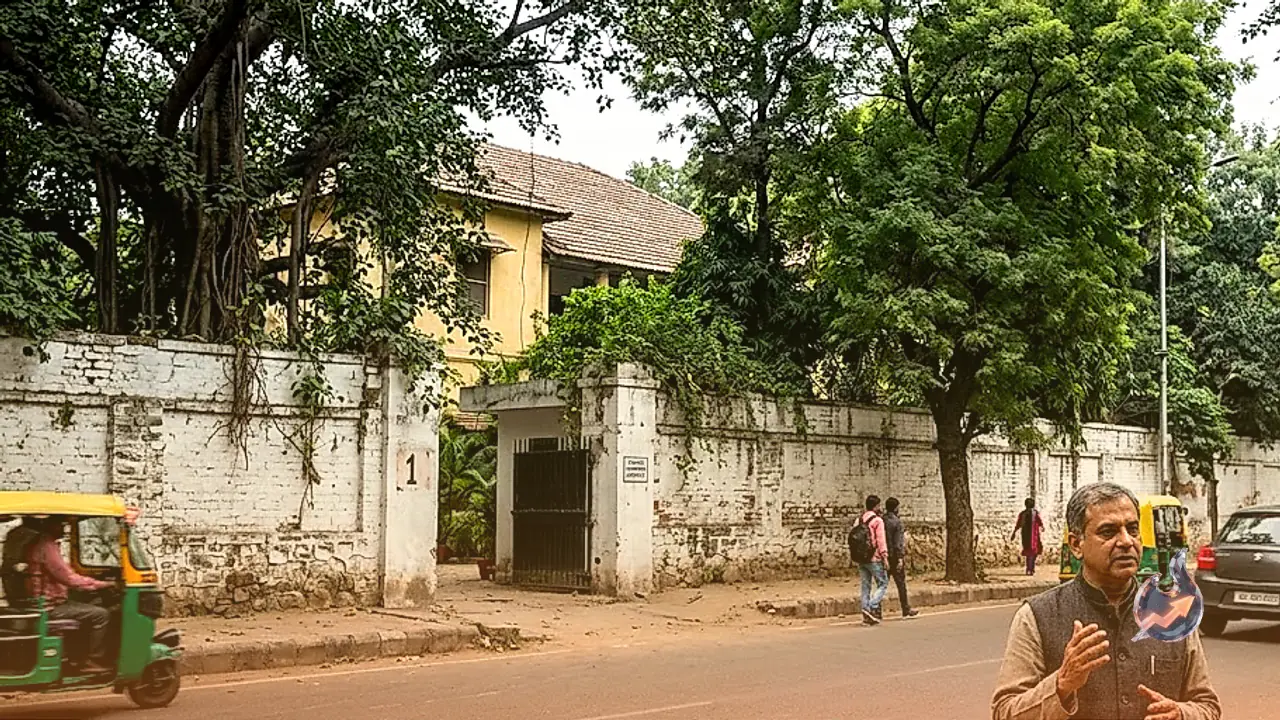

The geopolitical consolidation of post independence India was largely directed not from a grand ministerial palace, but from modest quarters tucked inside a private estate in New Delhi. Upon assuming charge of the Ministry of Home Affairs along with Information and Broadcasting inside Jawaharlal Nehru's interim government in 1946, Sardar Vallabhbhai Patel declined the customary allotment of an official bungalow. He instead accepted the hospitality of his friend Banwari Lal Purohit, taking up residence within a wing of his private property located at 1 Aurangzeb Road, a thoroughfare now renamed Dr APJ Abdul Kalam Road. Shrouded by mature tamarind, neem, and jamun trees, this quiet setting became the command center where the accession of 562 princely states was negotiated, with his daughter Maniben Patel managing his daily affairs and household needs.
The Operational Hub for Princely Integration
The study inside the Aurangzeb Road home functioned as an active war room during the delicate transition following the British departure. Key aides and strategists were regular visitors, notably VP Menon, who served as the administrative architect of the accession process, and Ramadhar, an advisor handling critical matters concerning Jammu and Kashmir. When diplomatic channels stalled regarding the accession of the princely state of Hyderabad, the decisive tactical strategy was formulated directly inside this private residence. Codenamed Operation Polo, the planned police action began at 4 am on September 13, 1948, culminating in the successful merger of the territory into the Indian union. Contemporaries like freedom fighter BD Santoshi recorded that the gates of Patel's home remained constantly open to the public, offering ordinary citizens direct access to the nation's foremost statesman.
Administrative Footprints from North Block to Metcalfe House
Patel's demanding executive routine extended across the capital's administrative institutions. Art scholar Amitabh Aadhar, the son of Patel's associate Ramadhar, noted that the Home Minister took operational control of the country's domestic security from a spacious first-floor suite in the historic North Block. Built of red sandstone and completed around 1930, the North Block complex had served as the seat of high-ranking colonial administrators until 1947. Patel typically reached his desk early in the morning, rarely returning to his Aurangzeb Road residence before 11 pm after exhaustive review sessions.
His institutional legacy was similarly cemented at Metcalfe House in Civil Lines, roughly 15 kilometers away from his residence. On April 21, 1947, Patel addressed the pioneering batch of independent India's administrative officers, articulating a doctrine of governance founded on public service and national cohesion. It was during this address that he famously characterized the administrative machinery as the steel frame of India, stressing that career civil servants formed an indispensable backbone necessary to preserve institutional continuity and uphold constitutional order.
Solemn Consultations and Final Conversations with Mahatma Gandhi
The residence was also deeply intertwined with the final chapters of Mahatma Gandhi's life. On October 2 October 1947, Gandhi observed his final birthday at Birla House through prayer, spinning, and fasting. Patel traveled from 1 Aurangzeb Road to be with him. During their conversation, an agonizingly sorrowful Gandhi asked what transgression he had committed to have lived to witness such painful days, an exchange recorded meticulously in the personal memoirs of Maniben Patel.
Four months later, on the cold evening of January 30, 1948, Patel was the last visitor granted a private audience with Gandhi before his assassination. Departing his residence shortly before a quarter to five in the evening, Patel arrived at Birla House on 5 Albuquerque Road, now known as 5 Tees January Marg. KD Madan, who was tasked by All India Radio with recording the evening prayer meetings, noted that Gandhi stepped out toward the gathering precisely at 5:16 pm. Gandhi was shot at 5:17 pm, just moments after Patel took his leave. The precise agenda and nature of the urgent conversation between the two leaders during those concluding minutes remain one of modern history's unsolved enigmas.
The Unrealized Memorial in the Capital
Following Patel's demise in Mumbai on December 15, 1950, proposals emerged for the central government to acquire the 1 Aurangzeb Road property and establish a permanent national memorial. However, the plan encountered procedural hurdles and private property constraints, ultimately causing the initiative to lapse. While modern Delhi hosts extensive memorial parks and institutions honoring various national figures, the modest residence where the Iron Man lived like an ascetic while uniting hundreds of disparate territories remains unmarked by even an official commemorative plaque.