























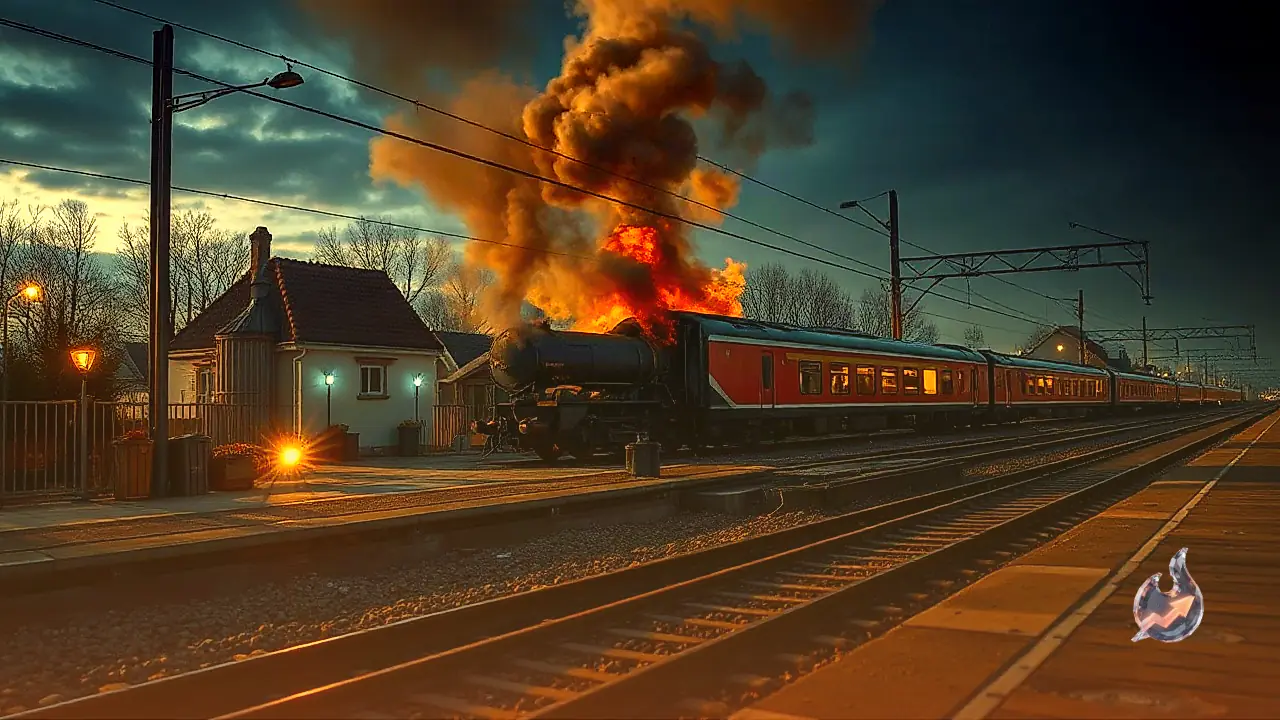

A major passenger train derailment in northern France on Friday night has triggered a full-scale investigation, with judicial authorities looking into whether the crash was caused by a deliberate act of sabotage or malice. The incident, which occurred on a busy regional transit line, has left dozens of passengers injured and thrown regional transport networks into a state of high alert. Investigators are currently focusing their attention on physical evidence recovered from the crash site to establish exactly what led to the train sliding off the tracks.
Details of the Derailment on the Normandy Route
The train was actively operating on the popular route connecting the city of Rouen with Caen, two major urban centers in the Normandy region. According to localized reports, there were approximately 186 passengers on board the train when the sudden accident occurred. The derailment took place near the commune of Cléon, located just to the south of Rouen. The timing of the incident was recorded shortly before 20:00 local time, which corresponds to 18:00 GMT on Friday. The sudden disruption on the tracks instantly halted all traffic on the line and initiated a massive response from local emergency networks.
Massive Emergency Mobilization and Casualty Reports
Following the derailment, a massive rescue operation was launched. Around 140 firefighters along with specialized emergency response teams were quickly dispatched to the crash site near Cléon. First responders worked tirelessly in the fading evening light to extract passengers from the damaged carriages and assess their medical conditions. In total, 44 individuals had to be treated for various physical injuries sustained during the crash. While most of the injuries were minor to moderate, the situation was far more severe for one young passenger. An 18-year-old woman suffered critical injuries and had to be airlifted immediately to a nearby hospital, where she remains in a serious condition. The logistical challenge of managing nearly two hundred passengers in a rural area south of Rouen required close coordination between medical services, local police, and railway safety officials.
Terrifying Moments Inside the Carriages
For the passengers inside the train, the derailment was a sudden and deeply traumatizing experience. One passenger, identified as Louis, shared his experience of the chaotic moments when the train went off the tracks. He described how the ride suddenly became bumpy with a few unexpected jolts. Within a matter of about three seconds, these vibrations grew exponentially stronger, making it impossible for him or others to remain in their seats. As the carriages violently shook, the windows partially shattered under the immense stress and impact. Ground stones and ballast gravel from the railway bed were kicked up by the derailed wheels and flew directly into the passenger compartments, adding to the danger and panic. Louis expressed his deep shock following the event, noting that he was still shaking long after being rescued from the scene.
Discovery of Track Obstruction and Sabotage Inquiry
The focus of the investigation has rapidly shifted toward potential interference with the rail infrastructure. Sébastien Gallois, the public prosecutor handling the case, confirmed on Saturday that investigators had discovered a physical fragment of rail lying on the active tracks. The prosecutor emphasized that the exact reason for the presence of this rail fragment remains completely unknown at this stage of the inquiry. While local media outlets have widely circulated theories suggesting that the train may have been deliberately sabotaged, official representatives have declined to confirm or comment on these specific reports. The presence of foreign metal objects or broken track components on an active high-speed line is highly unusual and suggests that either structural failure or human intervention played a decisive role in the crash.
Driver Cleared as Technical Forensics Begin
To rule out operational negligence, the driver of the derailed train was immediately subjected to standard post-accident screening. The Rouen prosecutor's office announced that the train driver tested negative for both drugs and alcohol, effectively clearing them of substance-related impairment. With human error on the part of the operator largely ruled out, technical teams and forensic investigators are now thoroughly examining the physical track, the recovered rail fragment, and the train's onboard data recorders. Investigators are working to determine if the rail piece was left on the track due to maintenance negligence, if it broke off from another passing train, or if it was placed there with malicious intent. The French national railway authorities are cooperating closely with judicial officials to secure the site and restore safety protocols across the regional rail network.