























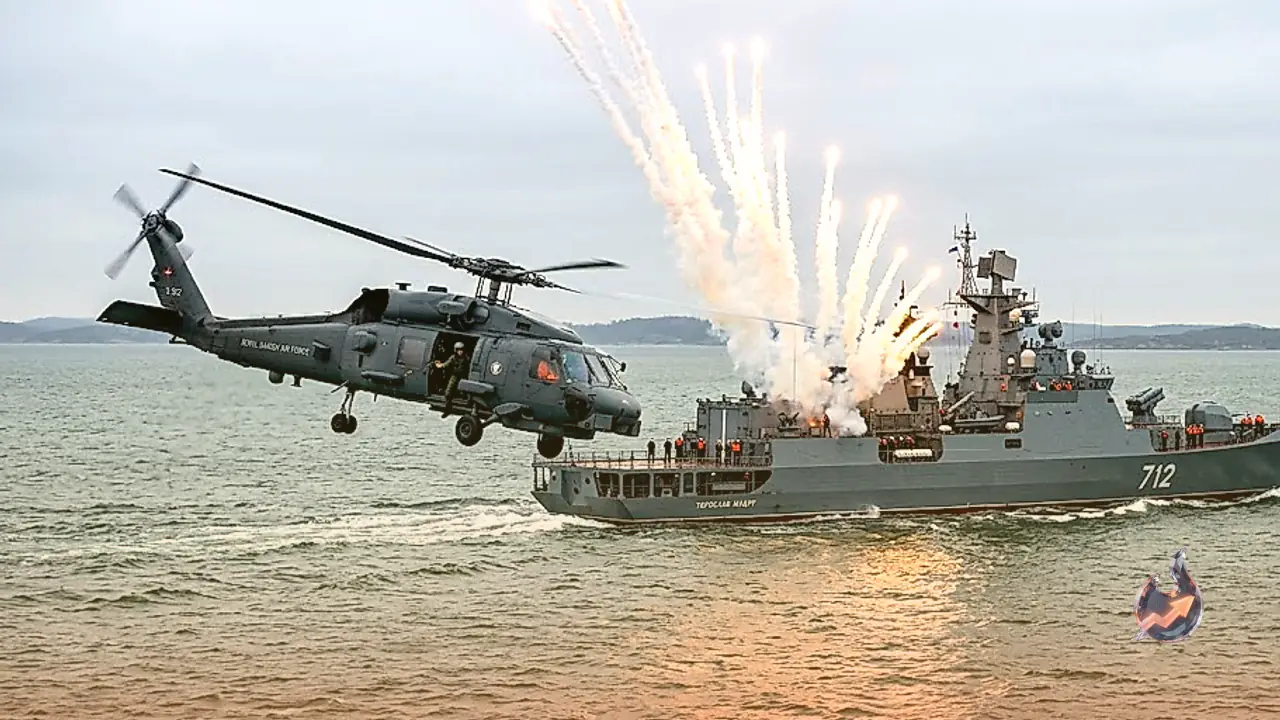

A high-stakes confrontation between European forces and the Russian military has unfolded in the Baltic Sea after a naval frigate fired pyrotechnic projectiles at a Danish military aircraft. The incident occurred in international waters off the coast of Gedser, where a Danish Air Force Fennec helicopter was conducting a routine surveillance mission. Following the dangerous encounter, the Danish government formally summoned Russia's ambassador in Copenhagen to register an official protest against what it termed deeply provocative conduct.
Dangerous Encounter During Routine Aerial Surveillance
According to an official account released by Denmark's armed forces, the Fennec helicopter was undertaking standard aerial photography to track the movements of a Russian frigate operating off Gedser on Monday. During this mission, the Russian naval vessel fired two emergency flares directly toward the aircraft. Military officials confirmed that one of the flares passed in extremely close proximity to the helicopter, creating a hazardous mid-air situation. Despite the close brush with the flares, the helicopter was unharmed. Moscow has so far remained silent and has not commented on the episode.
Danish Leadership Condemns Intimidation Tactics
The aggressive naval maneuver drew immediate and stern rebukes from top political leaders in Denmark. Prime Minister Mette Frederiksen described the Russian warship's actions as reckless, stating that such behavior is deliberately designed to intimidate and divide European allies. The Danish Foreign Ministry labeled the episode completely unacceptable. Danish Foreign Minister Lars Lokke Rasmussen took aim at Moscow's evolving military posture, accusing Russia of attempting to gradually shift the boundaries of acceptable international conduct and emphasizing that Denmark will not tolerate such normalization.
NATO Scrambles Fighters Over Baltic Drone Incursions
The naval friction coincided with elevated aerial vigilance and security breaches across NATO's eastern frontier. During the overnight hours, NATO fighter pilots intercepted and brought down a drone that crossed into Lithuanian airspace. Security officials indicated that the unmanned aerial vehicle likely crossed into southern Lithuania from neighboring Belarus shortly after midnight on Tuesday, approaching Kaunas, the country's second-largest city. The Lithuanian National Crisis Management Centre reported that an investigation into the drone's specific origin remains underway. Belarus shares a extensive border along Lithuania's southern and eastern frontiers and maintains close military ties as a key ally of Russia.
Highlighting the escalating regional risks, Lithuanian President Gitanas Nauseda addressed the interception on X, stating that heightened defensive readiness is essential as Russian aggression against Ukraine intensifies, reaffirming that Lithuania stands ready with its NATO allies to protect its skies. Simultaneously, Poland revealed that it had mobilized preventive aviation operations inside its own airspace on Monday night. Polish defense authorities stated the scramble was necessitated by the activity of jet-powered unmanned aircraft operated by the Russian Federation during strikes against Ukrainian territory, focusing on reinforcing airspace protections in zones neighboring vulnerable corridors.
Electronic Jamming and Airspace Complexities
The incident is part of an increasingly volatile security environment across the Baltic corridor. Throughout the year, NATO interceptors have repeatedly been scrambled to neutralize stray Ukrainian drones that have entered the sovereign airspace of Estonia and Latvia. Ukrainian authorities have attributed these navigational divergences to sophisticated Russian electronic warfare countermeasures, which are engineered to disrupt guidance systems and forcibly alter the predetermined flight trajectories of unmanned drones. The convergence of electronic jamming, airspace incursions, and direct encounters on the open seas underscores the expanding friction along the European defense perimeter.