























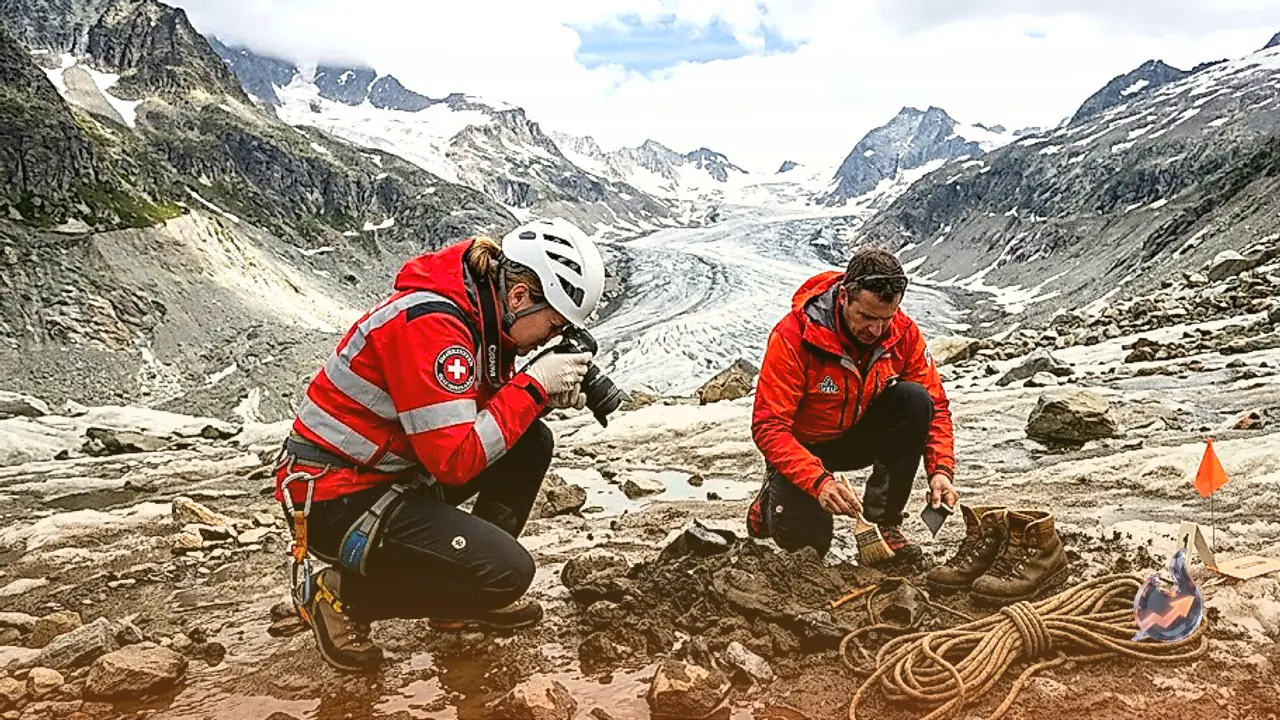

The continued retreat of glacial ice across the Swiss Alps has exposed the long-lost remains of two Belgian mountaineers who vanished without a trace in 1992. The men, who were aged 39 and 41 at the time of their disappearance 34 years ago, were lost in the hazardous high-altitude terrain of the Swiss mountains. Decades later, progressive ice melt driven by rising global temperatures brought their remains to light on the Trift Glacier, where positive identification was subsequently established through forensic DNA matching.
Discovery on the Trift Glacier and the Recovery Operation
The discovery was made on 26 July when a hiker trekking through the rugged landscape south of the Swiss city of Lucerne spotted human remains protruding from the melting surface of the Trift Glacier. The hiker alerted local authorities, prompting emergency services and law enforcement personnel in Switzerland's Valais region to quickly coordinate a specialized recovery operation amidst the challenging glacial environment.
Upon retrieving the remains from the ice field, police transferred them directly to the primary hospital in Sion, the capital of the Valais canton, to initiate formal identification protocols. Expert forensic teams conducted thorough physical examinations and processed DNA samples, which ultimately cross-referenced and confirmed the identities of the missing Belgian nationals. Historical missing-person files indicated that the duo had originally disappeared near the Weissmies mountain, a formidable peak standing over 4,000 metres high in the popular mountaineering district of the Saas Valley.
Rapid Glacial Shrinkage and Broader Climate Trends
Environmental researchers attribute the rapid retreat of Switzerland's glacial landscape directly to accelerating human-induced climate change. According to longitudinal data compiled by Glacier Monitoring in Switzerland (Glamos), the total volume of Swiss glaciers shrank by a staggering one-quarter in the ten-year period leading up to 2025. This dramatic loss of ice mass highlights the increasing vulnerability of high-altitude ecosystems to thermal shifts.
Global environmental observation systems reinforce these local findings. Monitoring datasets published by Copernicus, the Earth observation branch of the European Commission, reveal that global glacier volume reduction has been climbing steadily since the 1990s, with a sharp acceleration recorded after the year 2000. Higher average global temperatures have introduced unseasonably mild weather patterns to alpine regions, while decreased annual snowfall continues to compromise traditional winter sports facilities and disrupt long-standing competitive skiing events across Switzerland.
Regional Archives and Historical Alpine Finds
Police authorities in the Valais region maintain a centralized registry of missing individuals that spans more than a century, dating back to 1925. Officials note that a vast majority of the unresolved cases logged in the database involve individuals who went missing while attempting mountain ascents or who disappeared into the region's turbulent rivers and aquatic bodies.
The recovery of the two Belgian hikers is part of a growing trend as shrinking ice sheets regularly release items and remains frozen for decades. In a similar case in 2023, human remains discovered on a melting glacier near Switzerland's iconic Matterhorn were forensically identified as belonging to a German climber who had gone missing in 1986. As high-altitude glaciers continue to recede, regional authorities anticipate further discoveries from past decades buried beneath the ice.