























As the auspicious month of Sawan arrives, households across the region begin preparations for religious rituals, fasts, and traditional sweets. Whether people are crafting pedas as offerings to Lord Shiva or making ghevar, gujiya, and delicious halwas, the heart and soul of all these delicacies is pure khoya. However, as the festive season draws closer, public concern regarding the purity of commercial mawa in the market starts rising. Adulterated khoya can negatively impact both taste and health. Putting in a little effort to prepare fresh and pure khoya right at home not only enhances the flavor of your sweets multiple times but also brings the comforting assurance that your family and religious offerings are made with completely unadulterated ingredients.
Why Making Khoya at Home Is a Better Choice
The good news is that crafting khoya requires no special machinery or complicated techniques. With the right cookware, a little patience, and some simple tricks, around 400 to 450 grams of exceptional khoya can be prepared using just 2 liters of full-cream milk, and it can be safely stored for several days. During festivals, the demand for khoya spikes sharply, leading to frequent complaints of adulterated mawa in various places. Homemade khoya is entirely fresh with zero risk of impurities. If you plan to make sweets like peda, barfi, gulab jamun, kalakand, ghevar, or gujiya, preparing the khoya in advance and storing it in the refrigerator proves to be highly convenient.
How to Prevent Milk from Sticking to the Pan
The biggest hurdle while making khoya is preventing the milk from sticking to the bottom of the pan. To avoid this, always choose a heavy-bottomed vessel. Before pouring in the milk, spread a little water and a light touch of ghee across the entire base. This simple step prevents the milk from burning at the bottom and actually improves the overall flavor of the khoya. Pour the entire quantity of milk into the prepared pan and bring it to a boil over high heat. Once it boils, maintain the heat between medium and high.
Scraping the Cream and Constant Stirring
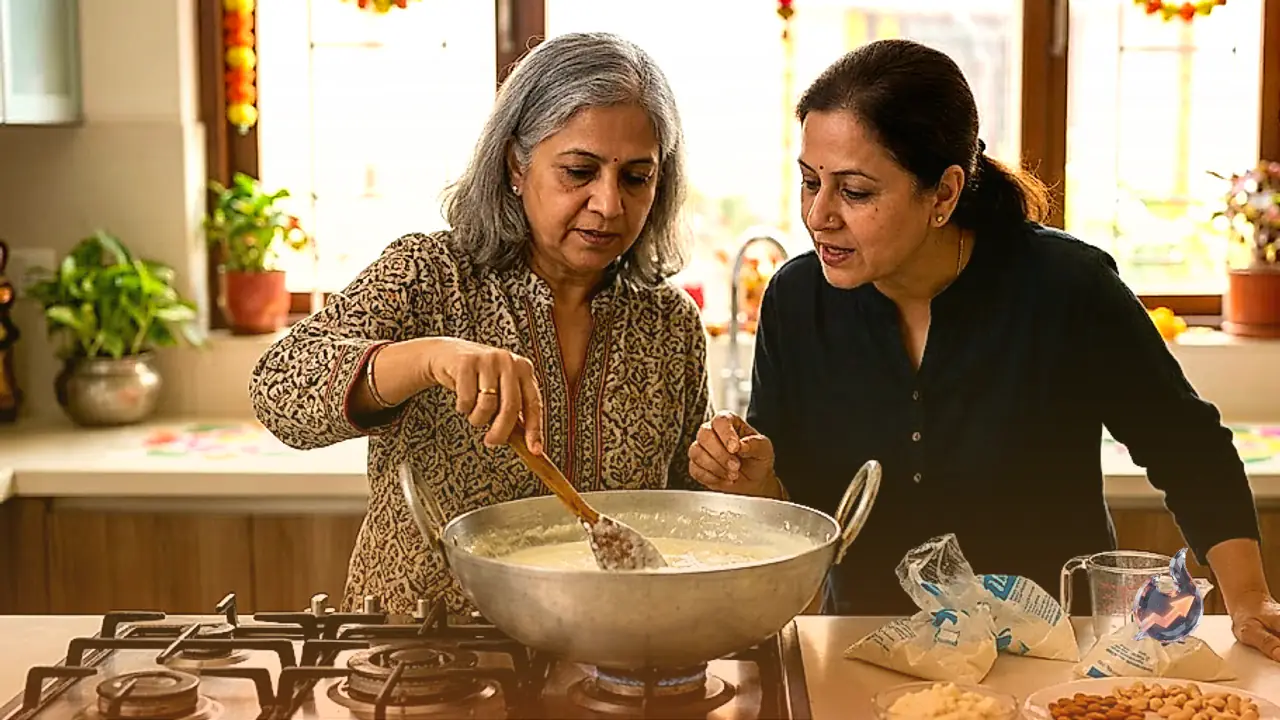
Next, use a large ladle to stir the milk continuously. An important step is to repeatedly scrape the cream that forms along the edges of the pan and mix it back into the boiling milk. This technique ensures the khoya turns out much creamier and more delicious. Gradually, the water content in the milk begins to evaporate. Once the milk reduces to about half its original volume, continuous stirring becomes even more critical, as failing to monitor it at this stage can cause the mixture to scorch at the base.
Recognizing the Right Consistency
After about 20 to 25 minutes of stirring, the milk starts transforming into a thick, rabdi-like consistency. During this stage, large bubbles may form in the mixture. When this happens, lower the flame slightly and keep the ladle moving all the way to the bottom of the pan. Once the mixture thickens, gathers into a single mass, and begins leaving the sides of the pan, your khoya is ready. Turn off the gas and let it cool down completely. The khoya will firm up further upon cooling.
Yield and Proper Storage Guidelines
When using full-cream milk, approximately 400 to 450 grams of pure khoya can be successfully prepared from 2 liters of milk, though the final yield depends slightly on the quality of the milk used. Once cooled, pack the khoya into an airtight container and place it in the refrigerator. It can be easily used for 8 to 10 days. If you need to store it for a longer duration, divide it into smaller portions and keep it in the freezer.
Traditional Sweets You Can Prepare
Fresh homemade khoya serves as a versatile base for a wide variety of traditional sweets. It significantly elevates the taste of pedas, barfi, kalakand, gulab jamun, gujiya, ghevar, rasmalai, halwa, and numerous other desserts. Preparing it in advance for Sawan, Rakshabandhan, Janmashtami, and other upcoming celebrations is an excellent idea. Nowadays, people are growing increasingly conscious about food purity, which is why the inclination toward homemade items is rising. Pure khoya prepared with a little bit of effort not only tastes superior but also remains completely safe for family consumption.