























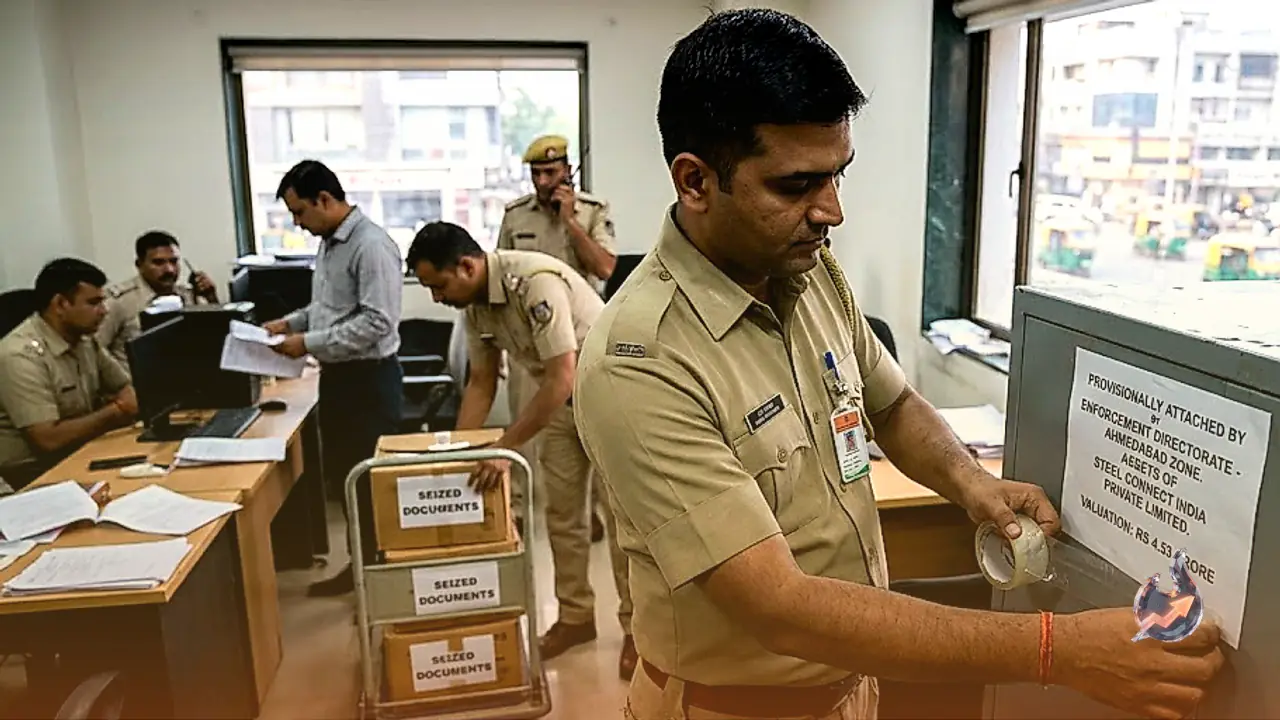

Federal financial investigation authorities have intensified enforcement actions against corporate entities involved in large scale banking defaults and misappropriation. The Ahmedabad zonal office of the Enforcement Directorate has made substantial progress in a major financial fraud inquiry by provisionally attaching assets valued at approximately Rs 4.53 crore connected to Steel Connect India Private Limited. These operational measures, executed under the statutory framework of the Prevention of Money Laundering Act, 2002, follow findings that individuals linked to the entity engaged in fraudulent transactions amounting to roughly Rs 79.56 crore.
Origin of the Multi-Agency Fraud Probe
The money laundering proceedings trace back to an initial criminal complaint and formal FIR registered by the Central Bureau of Investigation. That foundational case invoked penal provisions under the Indian Penal Code alongside statutory sections of the Prevention of Corruption Act. As the enforcement agency subsequently analyzed the flow of capital and banking records, investigators uncovered systematic breaches committed by the then directors of the corporate entity acting in concert with outside associates to undermine loan covenants.
Mechanism Behind Capital Siphoning and Cash Withdrawals
Detailed analysis of banking documentation revealed deliberate violations of credit terms established with lending institutions. Borrowed capital obtained under the formal justification of business operations was not deployed toward legitimate commercial activity. Instead, substantial portions of the sanction amounts were converted into liquid funds through large cash withdrawals, a tactic intended to break the evidentiary trail and obscure final beneficiaries of the sanctioned facilities.
Fund Routing Through Shadow Entities and Personal Accounts
Investigators documented that proceeds from the financial institutions were channeled to various sister concerns without any corresponding underlying trade or economic transactions. To evade monitoring by the lending consortium, the accused systematically routed funds through non-consortium bank accounts. Furthermore, significant capital flows reached the private personal bank accounts of former directors as well as subsidiary establishments. Following the conclusive establishment of this money trail, the agency issued a provisional attachment order seizing movable and immovable assets worth Rs 4.53 crore.