




















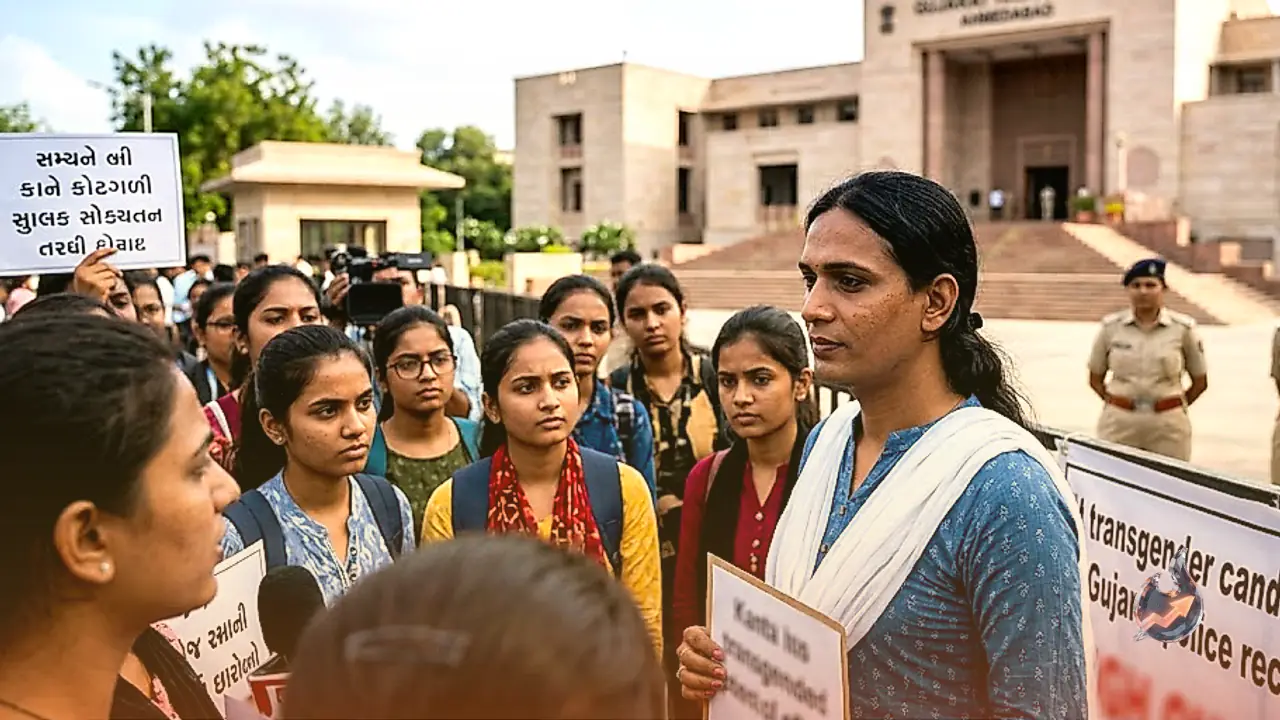

A legal challenge has emerged regarding the ongoing Class-3 recruitment drive in the Gujarat Police, calling for the establishment of a dedicated third-gender category and constitutionally compliant selection criteria for transgender candidates. Taking up the matter, the Gujarat High Court has issued formal notices to the state home department and the Director General of Police (DGP), seeking their stand by September 29.
Application Ambiguity and Progression Through the Female Category
The petitioner approached the court through advocate Hannan Qureshi, setting out the background of their application for the positions of unarmed constable and Police Sub-Inspector (PSI). When seeking guidance from the DGP office regarding how a third-gender applicant should fill out the recruitment form, officials advised applying according to the gender listed on the identity document. Because the petitioner's Aadhaar card indicated female, the registration was formally completed under the female category.
Proceeding under the female bracket, the candidate cleared both the Physical Standard Test (PST) and the Physical Efficiency Test (PET). However, in the subsequent written examination, the candidate scored 94 marks, while the cut-off for the SEBC female category was set at 98.5 marks. Following the publication of the final merit list on July 11, the aspirant requested authorities to evaluate the performance not under the male or female headers, but within a distinct third-gender classification.
Constitutional Equality and the Landmark NALSA Framework
Failing to secure that accommodation from recruiting officials, the candidate moved the High Court, asserting that limiting the recruitment framework exclusively to binary male and female options infringes upon Article 14 of the Constitution. The petition urges the implementation of the directives laid out in the Supreme Court's landmark NALSA judgment to ensure equitable public employment opportunities for gender-diverse individuals.
The plea further highlights that transgender individuals routinely encounter deep-rooted social stigma and structural hurdles, justifying tailored cut-offs or quota arrangements rather than direct competition against binary classifications. By omitting a dedicated cut-off list for third-gender participants, the recruitment authorities subjected the applicant to unconstitutional gender-based discrimination, leading directly to exclusion from the selection list.
Document Verification Deadline and Judicial Direction
With document verification scheduled to commence on September 30, the petitioner sought urgent interim relief from the court to participate in the scrutiny process under a distinct third-gender designation. Examples of inclusive recruitment frameworks implemented by other states were also cited during the hearing. Taking note of the statutory and constitutional issues raised, Justice Aniruddha Mayee directed the state home department and police leadership to submit their responses ahead of the deadline on September 29.