























Commuters navigating the congested road corridors of the National Capital Region face an exhausting daily ordeal, with bumper-to-bumper gridlock turning routine office trips and urgent meetings into unpredictable journeys. To address this relentless urban mobility bottleneck, modern aerospace innovation is stepping in to redefine how city dwellers move across regional commercial hubs. InterGlobe Enterprises, the parent entity behind India's largest domestic carrier IndiGo, has joined forces with US-based Archer Aviation to deploy an advanced fleet of battery-powered electric air taxis designed to shift regional travel from clogged highways straight into the sky.
Transforming Multi-Hour Commutes into Quick Flights
Under current surface conditions, traveling between Noida and Gurugram during peak traffic periods takes anywhere from 90 minutes to two and a half hours, and frequently stretches even longer during severe delays. The proposed urban air transit route will compress that entire ground journey down to an estimated aerial transit window of just 27 to 30 minutes. By directly linking key economic nodes separated by congested urban bottlenecks, the initiative aims to rescue commuters from losing half their working days to exhausting highway gridlocks.
Engineering and Capabilities of the Midnight eVTOL Aircraft
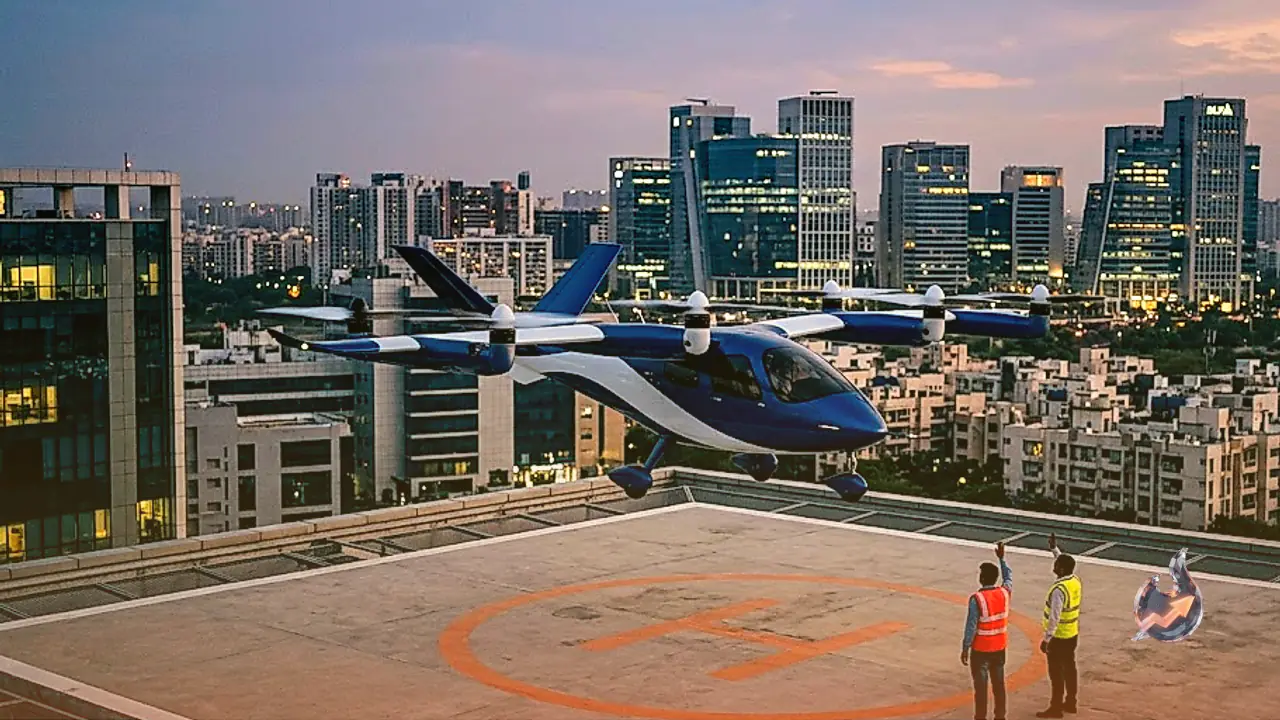
The aerial service will be powered exclusively by Archer Aviation's purpose-built Midnight eVTOL aircraft, an acronym denoting electric vertical take-off and landing technology. Unlike traditional commercial airliners that demand sprawling airport infrastructure, this aircraft operates without conventional paved runways. Mimicking the operational agility of a modern helicopter, it ascends straight into the air vertically from a designated spot and descends vertically back down onto landing pads.
Engineered specifically for short-distance, multi-stop intra-city hops, the Midnight cabin accommodates a licensed pilot alongside four passengers. Running entirely on electric power units, the platform delivers zero direct operational emissions while navigating urban corridors. Archer Aviation has also integrated specialized propeller configurations engineered to maintain acoustics at decibel levels significantly lower than standard rotary helicopters. Detailed acoustic evaluations and environmental assessments will form an integral part of ongoing regulatory safety certifications prior to public flights.
Fleet Rollout Strategy and 2026 Commercial Launch Timeline
Under the bilateral framework established between InterGlobe Enterprises and Archer Aviation, the partnership plans to deploy a robust fleet of approximately 200 Midnight eVTOL units across the country. This planned expansion signals the emergence of a dedicated urban air mobility network across major Indian growth centers. The commercial launch is scheduled for the conclusion of 2026, with initial operations serving Delhi-NCR before extending into Mumbai and Bengaluru, two financial centers equally constrained by surface vehicular congestion.
Rooftop Vertiports and Urban Infrastructure Integration
Because eVTOL aircraft require compact operational areas rather than vast airfields, cities must build specialized departure and landing nodes known as vertiports. Industry body Confederation of Indian Industry has offered proactive recommendations to accelerate this transition without acquiring vast new urban land parcels. The trade chamber suggested retrofitting existing urban real estate assets, proposing that structural rooftops on large hospital campuses, technology business parks, high-density corporate towers, and expansive high-rise residential societies be repurposed into certified vertiports. This distributed network design allows air travelers to board and disembark directly beside their workplace or neighborhood.
Regulatory Oversight and DGCA Certification Clearance
While the vision of electric flight across Indian skylines offers immense relief to urban congestion, transitioning the project from design blueprints to scheduled public transit demands navigating rigorous safety and operational clearances. Full commercial deployment in India remains contingent on rigorous technical certification, flight route approvals, and comprehensive safety clearances overseen by the Directorate General of Civil Aviation. Establishing collision-avoidance aerial corridors over dense populations, designing emergency safety protocols, and validating battery reliability across demanding regional climate cycles remain fundamental prerequisites before scheduled commercial tickets become available to commuters.