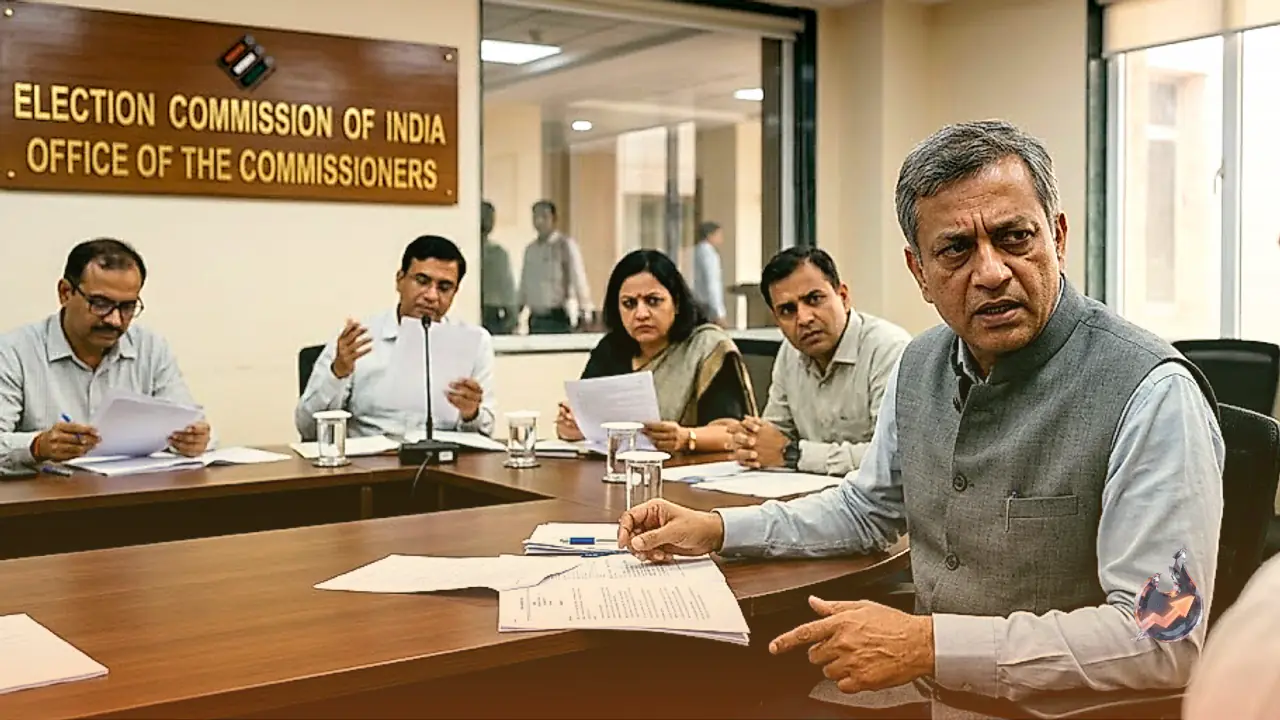






















Internal friction inside the highest echelons of the Election Commission of India has surfaced following disclosures that two of the country's three Election Commissioners recorded formal dissents on at least 14 occasions within a span of 10 months. These written objections challenged critical policy moves regarding voter roll updates, the legal sanctity of registration formats, and technological shifts governing electoral databases. Notably, four of these objections were entered into the record on a single day. The discord primarily pitched Election Commissioners Sukhbir Singh Sandhu and Vivek Joshi against the trajectory overseen by Chief Election Commissioner Gyanesh Kumar. While the poll panel has maintained that divergent opinions form an essential element of institutional deliberations and emphasized that all final determinations on the Special Intensive Revision remained unanimous, the disclosures have ignited an intense debate over administrative propriety and institutional independence.
The Core Disputes Over Special Intensive Revision and Form 6
The controversy is rooted in the execution of the Special Intensive Revision (SIR) of electoral rolls and the internal decision-making mechanics of the three-member body. Over the course of 10 months, Election Commissioners Sukhbir Singh Sandhu and Vivek Joshi submitted 14 specific objections concerning voter enrollment, the deletion and subsequent restoration of entries, revisions to voter registration instruments, electoral roll records, and the underlying digital architecture used to maintain database records.
A central flashpoint emerged over Form 6, the prescribed statutory application enabling eligible citizens to seek enrollment on the electoral rolls. In July 2026, an additional mandatory declaration was incorporated into the digital version of Form 6. This modification required applicants to explicitly state whether they, their parents, or their grandparents were listed on the voter rolls during the previous Special Intensive Revision exercise, barring users from finalizing the application without completing the field. Commissioner Vivek Joshi registered a formal objection against this inclusion, asserting that a statutory form established under electoral rules could not be legally altered without formal amendments to the underlying statutory provisions. Commissioner Sukhbir Singh Sandhu subsequently aligned with this stance, categorizing the addition as unauthorised and illegal while formally demanding its removal from the platform.
Centralised Databases and Regional Technical Glitches
The dissenting Commissioners also expressed serious reservations regarding the centralisation of electoral roll data repositories and the shifting terms of access for state and grassroots field machinery. They raised targeted inquiries about technological reorganisations that directly impacted how local election administrators interacted with voter data.
The tangible consequences of software handling became visible in regional administrations such as Goa. A technical breakdown in the system left 97 eligible citizens excluded from the final electoral rolls after ground-level administrative staff found themselves unable to enter mandatory modifications into the platform before the formal deadline elapsed. Simultaneously, procedures surrounding appellate reviews for contested voter identities in West Bengal triggered sustained scrutiny. Amid these widening operational fractures, the full Commission convened for its first comprehensive joint meeting in four months on 9 September. In its defence, the poll body rejected interpretations describing the memos as evidence of a fractured panel, reiterating that recorded observations are standard deliberative practice and that the ultimate outcomes governing the Special Intensive Revision were reached unanimously.
Statutory Hierarchy and the Limits of the Chief Election Commissioner
Under the Indian constitutional architecture, while the Chief Election Commissioner serves as the designated Chairperson of the Election Commission, the office does not possess unilateral authority to override fellow Commissioners. Section 18 of the Chief Election Commissioner and Other Election Commissioners Act, 2023 mandates that the Commission must strive to arrive at decisions unanimously wherever feasible. In the event of a division of opinion among the three members, the issue is decided strictly by a majority vote.
When all three members agree, the determination is recorded as unanimous. If two members endorse a measure while the third dissents, the view of the two-member majority constitutes the official verdict of the Commission. The Chairperson does not hold a separate veto power. This multi-member parity was definitively affirmed by the Supreme Court of India in the landmark 1995 judgment of T.N. Seshan v. Union of India, which rejected the proposition that Election Commissioners functioned merely as subservient advisers to the Chief Election Commissioner. In evaluating the 14 reported memos, political analyst Amitabh Tiwary observed that the fundamental legal and political question rests on determining exactly how many of those 14 recorded instances saw both Sukhbir Singh Sandhu and Vivek Joshi jointly opposing Gyanesh Kumar, as a single member's objection does not automatically represent a binding majority overturn.
Public Appearances and Institutional Facades Amid Internal Discord
The revelation of persistent internal friction raised immediate questions regarding why the two dissenting Commissioners continued to share public stages and media briefings with the Chief Election Commissioner throughout the dispute. Congress leader Rahul Gandhi initiated the political onslaught by hosting a press briefing on 7 August 2025, alleging vote theft and asserting that the ruling establishment had placed Chief Election Commissioner Gyanesh Kumar beyond legal accountability. Ten days later, on 17 August, Kumar addressed a nationally televised press conference to refute the allegations and defend the integrity of the electoral process, flanked by both Sandhu and Joshi.
Their joint appearance did not signify blanket concurrence with every administrative assertion made by the Chief Election Commissioner, nor did standing together indicate that internal objections had been resolved. In established constitutional governance, a collective body can harbour vigorous internal disagreements while maintaining an outward appearance of institutional solidarity. A similar pattern was witnessed in 2026. Following the deployment of ECINet on 22 January, and even as formal criticisms of electoral roll management were entered into official logs, all three Commissioners maintained joint public schedules. They appeared together at major events in March, including a press briefing on 10 March and the formal declaration of state Assembly election dates on 15 March.
Precedents and Observations from Former Poll Chiefs
Former Chief Election Commissioners have underscored the absolute necessity of maintaining rigid adherence to statutory procedures when altering electoral mechanisms. Former Chief Election Commissioner O.P. Rawat highlighted the friction surrounding Form 6 as an issue of substantial gravity, maintaining that alterations to any statutory instrument must never occur without following the legally mandated amendment protocols.
Addressing the broader mechanics of institutional voting, former Chief Election Commissioner T.S. Krishnamurthy previously observed that divergent perspectives within the panel are entirely natural, and whenever consensus proves elusive, the verdict delivered by the majority remains fully operational and legally binding. Concurrently, former Chief Election Commissioner S.Y. Quraishi has long advocated for institutional transparency, arguing that the public record should clearly disclose whether determinations by the Commission are achieved through unanimous agreement or decided by majority votes.
Political Outcry and Demands for Legal Action Against the Poll Chief
The emergence of the internal memos provided immediate political ammunition to Opposition leaders, who intensified their attacks against the Commission's neutrality and demanded punitive measures against Chief Election Commissioner Gyanesh Kumar. Rahul Gandhi and senior leaders within the Congress party spearheaded sharp critiques against the panel's administrative conduct. Key regional figures, including Samajwadi Party chief Akhilesh Yadav and Aam Aadmi Party convenor Arvind Kejriwal, joined the chorus in challenging the Commission's operations and demanding administrative accountability from Kumar.
Calls from across the political spectrum ranged from demanding Kumar's formal removal to instituting an independent inquiry into the recorded objections and procedural decisions undertaken throughout the Special Intensive Revision process. West Bengal Chief Minister Mamata Banerjee went further, demanding the outright arrest of the Chief Election Commissioner. Meanwhile, civil society groups, including Citizens for Justice and Peace (CJP), registered grave concerns regarding the overall transparency and functioning of the electoral watchdog.
Constitutional Foundations, Judicial Boundaries, and Public Redress
The constitutional foundation of the Election Commission dates back to its creation on 25 January 1950 pursuant to Article 324 of the Constitution of India. This provision entrusts the Commission with the comprehensive superintendence, direction, and control of all elections to Parliament, state legislative assemblies, and the offices of the President and Vice-President, alongside the fundamental task of compiling electoral rolls.
Initially functioning as a single-member entity led solely by the Chief Election Commissioner, the authority and public prominence of the institution expanded dramatically during the 1990s under Chief Election Commissioner T.N. Seshan, who served from December 1990 to December 1996. Institutional archives note Seshan's uncompromising enforcement of the Model Code of Conduct and widespread deployment of independent central election observers. Regulatory powers were further augmented by statutory instruments such as the Election Symbols (Reservation and Allotment) Order, 1968, which empowered the panel to recognize political parties and allocate electoral symbols. However, the Supreme Court in the 1995 T.N. Seshan ruling also circumscribed these boundaries, clarifying that Article 324 does not confer absolute or unbridled administrative dominance over general state governance.
Consequently, the Commission's modern authority stems from a confluence of Article 324, statutory enactments, judicial pronouncements, and historical administrative practices. While the body commands wide constitutional autonomy, its administrative determinations remain subject to judicial review. Aggrieved individuals retain the legal right to challenge electoral roll exclusions through prescribed statutory appellate officers, while systemic irregularities can be brought directly before the judiciary. A prominent ongoing instance involves West Bengal, where the Supreme Court has been reviewing appeals arising from the Special Intensive Revision exercise. The Commission apprised the apex court that 38.31 lakh appeals had been lodged across West Bengal, encompassing over 22 lakh petitions seeking the restoration or inclusion of deleted names, proving that constitutional oversight remains an active check on the Commission's powers.