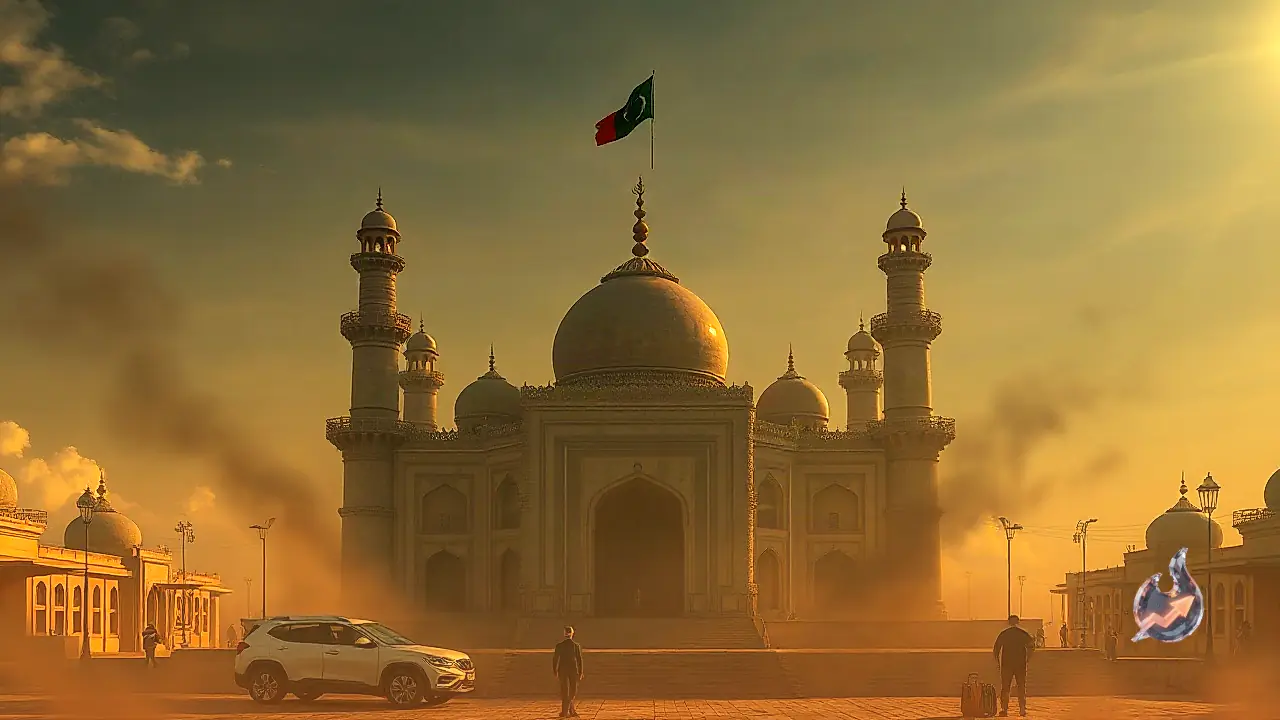


















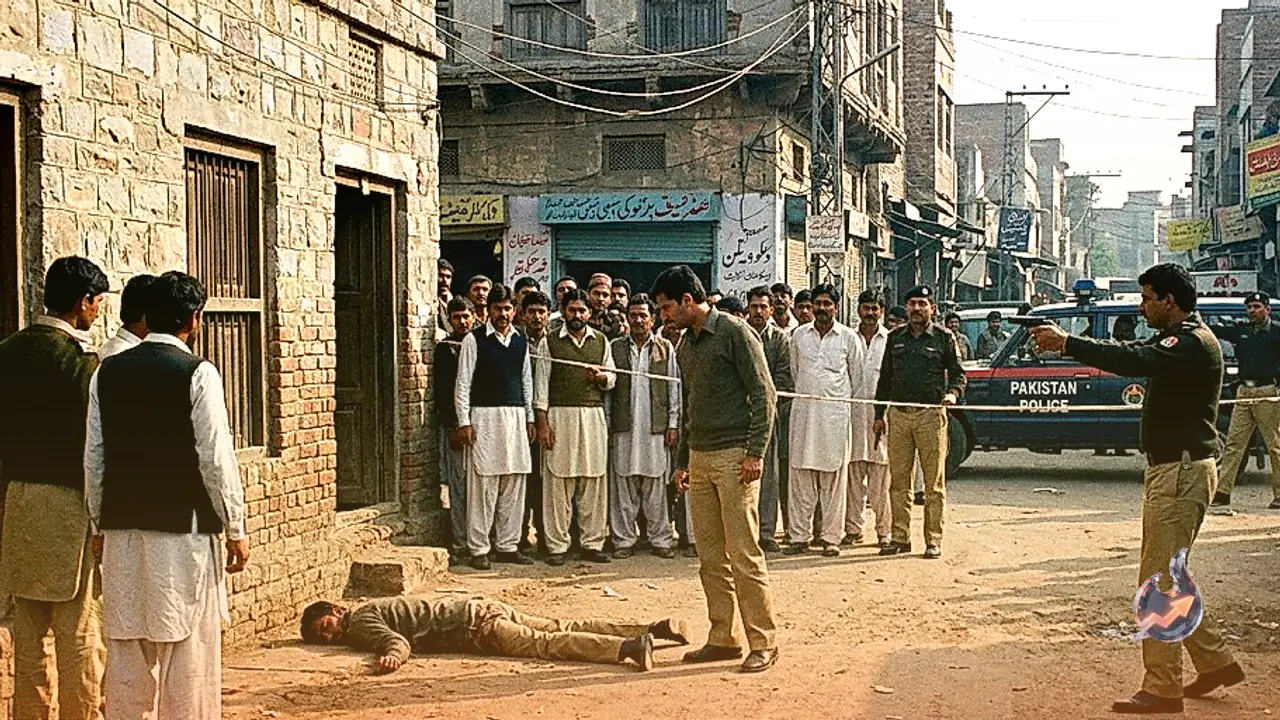

On a sweltering, sun-scorched afternoon in June 1987, a yellow taxicab pulled up along a main thoroughfare in the historic city of Lahore, Pakistan. It was around midday, and the intense, suffocating summer heat had rendered the city's busy avenues largely deserted as residents sought shelter indoors from the blistering sun. Despite the oppressive temperature exceeding 40 degrees Celsius, a man in his early 40s stepped out of the vehicle wearing a heavy, dark tailored overcoat. Carrying a substantial leather briefcase tightly in one hand, he used a linen handkerchief with the other to continuously wipe thick beads of perspiration from his forehead and neck. His countenance betrayed deep physical exhaustion and the weariness of long, continuous travel, yet his sharp, alert eyes remained intensely vigilant, constantly scanning his surroundings and turning around every few seconds to carefully observe the street behind him. Moving without hesitation, he ducked swiftly into a narrow pedestrian alleyway, navigating through the labyrinthine lane for several minutes until he arrived outside a prominent, mansion-like residential estate. A heavy iron padlock hung securely from the main wooden entrance gate. The man reached into his trousers pocket, retrieved a ring of brass keys, and muttered quietly to himself that he would take some much-needed rest inside the house before attending his scheduled meeting with Gul Sahib. However, at that precise moment, a high-speed motorcycle turned into the narrow lane carrying two male riders whose faces were entirely concealed behind black cloth masks. The motorcycle screeched to a halt directly in front of the mansion's entrance. The passenger sitting on the rear seat swiftly pulled out a handgun from beneath his jacket, aimed directly at the head of the man unlocking the gate, and pulled the trigger without warning. The initial bullet struck the man squarely in the temple, penetrating his skull and causing him to collapse instantly onto the doorstep as blood splattered across the white stone doorway. Without a single second's delay, the second assailant unholstered his own handgun and discharged eight additional rounds into the motionless body lying on the pavement. The rapid succession of gunfire echoed loudly through the narrow alley, after which the attackers accelerated away and vanished into the city traffic. News of the brazen execution spread rapidly across Lahore, triggering widespread panic and confusion throughout security circles. The victim was no ordinary civilian; he was Abdul Khan, a senior operational asset of Pakistan's Inter-Services Intelligence (ISI) who had been placed at the top of a secret hit list compiled by India's Research and Analysis Wing (RAW) under a covert campaign designated as Operation Hornet.
The assassination of Abdul Khan in Lahore was neither an isolated street shooting nor a random feud; it was the culmination of a meticulously planned intelligence strike conceived in the shadow of India's most devastating political tragedy. In June 1987, as intelligence reports confirmed Khan's death outside his residence, senior officials within India's Research and Analysis Wing recognized that a crucial objective of 'Operation Hornet' had been fulfilled. Khan had long served as a vital link between Pakistan's Inter-Services Intelligence infrastructure and armed insurgent groups operating across northern India. Eliminating him required years of patient reconnaissance across major European capitals including Paris, London, and Vienna, before field operatives finally located his residence in Pakistan. The intricate chain of events that culminated in his execution had been set in motion during the turbulent autumn of 1984, when the assassination of Prime Minister Indira Gandhi forced Indian intelligence agencies to fundamentally overhaul their counter-terrorism posture and strike directly at the external networks backing domestic subversion.
31 October 1984: Strategic Failures and the Assassination of Prime Minister Indira Gandhi
The origins of the targeted strike in Lahore were rooted in a national tragedy that had unfolded nearly two and a half years earlier in New Delhi. On the morning of 31 October 1984, an early winter chill was settling over the Indian capital, but the political atmosphere was intensely charged as nationwide parliamentary elections for the Lok Sabha were scheduled to take place within a month. Prime Minister Indira Gandhi awoke at her customary time of 6:00 am. At her breakfast table were two slices of toasted bread, fresh orange juice, and boiled eggs. After completing her meal, she spent time carefully reading through the morning's national newspapers. Her schedule for the day included an 8:30 am television interview with a visiting documentary crew from the British Broadcasting Corporation (BBC). A professional makeup artist had arrived at her official residence early that morning to assist in preparing her for the broadcast. At 8:00 am, her private secretary RK Dhawan arrived at 1 Safdarjung Road to inform the Prime Minister that the BBC filming schedule had been slightly delayed and would now commence at 9:20 am.
At approximately 9:10 am, Indira Gandhi stepped out from her residential quarters wearing a handwoven, light-orange cotton sari. Her destination was her official office suite at 1 Akbar Road, located just 50 metres away inside the secure government compound, where the foreign media crew was setting up equipment. A paved pedestrian walkway connected the residence to the office complex through manicured gardens. Indira Gandhi walked at a measured pace. Beside her, Constable Narain Singh held a large umbrella overhead to shield her from the morning sunlight, while RK Dhawan followed a few steps behind. As Indira Gandhi approached the connecting iron gate leading to 1 Akbar Road, two security guards assigned to the perimeter—Sub-Inspector Beant Singh and Constable Satwant Singh—stepped forward, folded their hands, and offered a traditional greeting of 'Namaste'. Indira Gandhi smiled slightly and bowed her head in acknowledgement. In that split second, Beant Singh drew his official.38-calibre service revolver and pointed it directly at the Prime Minister's torso. Startled, Indira Gandhi managed only to utter the words questioning what he was doing before Beant Singh pressed the trigger. The initial round struck her squarely in the abdomen. Without pausing, Beant fired four more bullets into her body in rapid succession.
Witnessing the sudden assault, Satwant Singh froze in place. Beant Singh shouted aggressively at Satwant, ordering him to open fire. Galvanized by the command, Satwant Singh raised his automatic Sten submachine gun and emptied the entire 25-round magazine into the Prime Minister's collapsed frame. Once their weapons were depleted, both assassins dropped their firearms onto the concrete path. Beant Singh declared in Punjabi that they had fulfilled their duty and invited the surrounding security forces to take whatever action they saw fit. Personnel from the Indo-Tibetan Border Police (ITBP) stationed nearby rushed to the scene immediately. In the chaotic shootout that ensued, ITBP officers shot and killed Beant Singh on the spot, while Satwant Singh was severely wounded and taken into custody. Resident medical personnel at the compound began shouting frantically for an ambulance, but the primary driver had temporarily left his post to get tea at a nearby stall. Realizing that time was critical, doctors ordered an immediate transport vehicle, prompting staff to bring around an official white Ambassador sedan.
Security staff and RK Dhawan lifted the heavily bleeding Prime Minister into the rear seat of the Ambassador, with Dhawan taking the front passenger seat. At that moment, Sonia Gandhi, who had been in the bathroom of her private quarter, heard servants screaming in terror and ran outside in a panic, dressed in a white nightgown with her wet hair untied. She ran directly to the vehicle and climbed into the back seat alongside Indira Gandhi. Holding her mother-in-law's head in her lap, Sonia used the fabric of her sleeve to continuously wipe blood from Indira Gandhi's face while calling out to her in an effort to keep her conscious. As the car sped towards the All India Institute of Medical Sciences (AIIMS), Sonia repeatedly urged the driver to accelerate, silently praying for a miracle while worrying about how to contact her husband Rajiv Gandhi and their children. The vehicle arrived at the emergency gates of AIIMS at 9:32 am. Emergency medical teams immediately transferred the Prime Minister to an operating theatre on the eighth floor, administering blood transfusions and mechanical ventilation. Although surgeons briefly detected a faint cardiac rhythm, their intensive resuscitation efforts proved unsuccessful, and she was pronounced dead shortly thereafter.
The immediate aftermath of the shooting inside the Prime Minister's residence unleashed unprecedented panic across India's security and political establishments. As the Ambassador car carrying Indira Gandhi maneuvered through congested New Delhi traffic towards AIIMS hospital, medical staff were alerted to prepare for emergency trauma surgery. Sonia Gandhi's frantic efforts to keep her mother-in-law conscious during the brief journey reflected the deep shock that gripped the immediate family. Inside the vehicle, as blood soaked through Sonia's clothing, the agonizing minutes highlighted the tragic breakdown in VIP protection protocols. Upon arrival at AIIMS, surgical teams worked tirelessly on the eighth floor operating suite, administering massive blood transfusions and utilizing artificial respiration in a desperate attempt to restore vitality. However, the extent of internal organ damage caused by the 29 bullet wounds proved insurmountable, and official confirmation of her passing was relayed to government leaders shortly after midday, triggering profound grief and immediate political uncertainty across the nation.
Internal Friction at RAW Headquarters and Kao's Prior Warnings
As news of the shooting reverberated across national security channels, telephone lines at the Research and Analysis Wing (RAW) headquarters on Lodhi Road began ringing continuously. Joint Secretary GBS Sidhu was in his office when the report arrived, leaving him in a state of profound shock. His mind immediately flashed back ten days to Sunday, 21 October 1984. At around 1:00 pm on that day, Sidhu had been driving past the Gymkhana Club near the Safdarjung traffic intersection with his wife and two children. As they passed the outer perimeter gate of the Prime Minister's residence, Sidhu noticed two young police officers armed with Sten submachine guns standing guard. One of them was a stocky 25-year-old Sikh officer, approximately 5 feet 8 inches tall, with a neatly groomed beard. Turning to his wife, Sidhu had expressed deep concern, questioning why Sikh security personnel had been reinstated to close protection duties following the military action during Operation Blue Star, noting that such an arrangement presented a severe vulnerability.
Upon arriving at his RAW office the following morning, Sidhu had drafted an urgent internal memorandum recommending that all Sikh security guards be removed from the Prime Minister's residence immediately and that an official enquiry be initiated to identify the authorities responsible for their redeployment. He requested a confidential envelope marked to be opened exclusively by the addressee, intended for RAW Director Gary Saxena. However, while waiting for his assistant to return with the envelope, Sidhu began reflecting on the volatile political climate. He realized that lower-ranking guards from rural backgrounds might harbour intense personal grievances over the Golden Temple military operation. He also reasoned that if an attack were to occur, the officials who authorized the guards' redeployment might attempt to implicate Sidhu himself in a cover-up due to his own Sikh identity. Faced with this dilemma, Sidhu retrieved the written note and envelope, tore them into pieces, and discarded them in his office wastebasket. When BBC Radio officially announced Indira Gandhi's death on 31 October, Sidhu sat alone in his office filled with regret. Nonetheless, he recalled that former RAW chief RN Kao (known affectionately as Kaw Sahib), who was serving as senior security adviser to the Prime Minister, had also repeatedly warned Indira Gandhi to remove Sikh guards from her personal security detail.
The administrative breakdown that allowed prime security risks to remain stationed around the Head of Government revealed severe coordination failures between intelligence analysts and executive protection teams. In the days following Indira Gandhi's death, internal reviews within RAW examined how critical warnings had been overlooked. GBS Sidhu's decision to destroy his written warning underscored the intense atmosphere of suspicion and administrative self-preservation that pervaded official bureaucracy during periods of heightened tension. Meanwhile, RN Kao's documented security assessments, which had explicitly recommended excluding personnel from vulnerable backgrounds from close-proximity security duties, highlighted that top-tier advisers had accurately diagnosed the threat long before the tragedy occurred. The realization that internal warnings had failed to prevent the assassination reinforced a firm consensus among senior intelligence leaders: defensive security measures alone were insufficient, and India had to adopt an aggressive offensive intelligence doctrine targeting the external architects of domestic insurgency.
Formulating Operation Hornet: The Paris Meeting between Bhardwaj and Jindal
The 1980s represented a highly precarious era for Indian national security. Khalistani insurgent movements in Punjab had gained significant momentum, backed by intelligence reports confirming that Pakistan's Inter-Services Intelligence (ISI) was providing insurgents with financial backing, military training, and sophisticated weaponry. Senior leadership at RAW determined that neutralizing this proxy threat required destroying the command structure connecting Pakistani intelligence to insurgent networks operating abroad. Two key targets were prioritized for neutralisation: Abdul Khan and an operative known as Sandhu, both of whom played central roles in managing ISI-insurgent logistics. Orders were issued to locate and eliminate both assets. On 3 November 1984, as preparations for Indira Gandhi's state funeral proceeded in New Delhi and foreign leaders arrived to meet newly appointed Prime Minister Rajiv Gandhi, widespread anti-Sikh violence erupted across the capital, resulting in hundreds of casualties.
Concurrently in Paris, France, a 40-year-old Indian intelligence officer named Sanjeev Jindal was sitting alone at Café de Flore. Jindal, a seasoned operational officer within RAW's covert directorate, was deep in thought when a cafe waiter informed him of an urgent incoming call on the establishment's landline. Picking up the receiver, Jindal heard the voice of Anuj Bhardwaj, a senior RAW executive known informally within intelligence circles as a 'pop star' of espionage. Bhardwaj instructed Jindal to return to New Delhi immediately, bringing along a detailed intelligence dossier prepared months earlier regarding ISI activities in Europe. At RAW headquarters the following day, Jindal presented the dossier, explaining that intelligence gathered from a trusted asset in London pointed to a coordinated ISI conspiracy to escalate insurgent violence inside India. Jindal advocated launching an immediate covert strike to eliminate Abdul Khan and Sandhu, thereby severing the operational linkage between Pakistani intelligence and Khalistani cells. Although Bhardwaj initially voiced caution regarding operational risks, he ultimately sanctioned the plan, directing that the primary field operations be based in London while overall mission oversight would be managed from a secure RAW station in Paris. The secret mission was assigned the operational codename 'Operation Hornet'.
The strategic mandate for Operation Hornet was defined by a ruthless imperative: dismantle the external command nodes fueling instability in Punjab before they could inflict further damage on India's national integrity. Following Rajiv Gandhi's swearing-in as Prime Minister and the end of state funeral ceremonies in November 1984, RAW leadership prioritized neutralizing Pakistani intelligence assets operating in Western Europe. Anuj Bhardwaj's decision to summon Sanjeev Jindal from Paris marked the start of an ambitious covert operation. The plan recognized that Pakistani intelligence was utilizing European cities as safe havens to channel financial resources, arrange arms transfers, and facilitate propaganda for insurgent leaders. By establishing operational oversight in Paris and setting up tactical collection units in London, RAW created an agile, compartmentalized intelligence apparatus capable of tracking ISI operatives across international borders while maintaining plausible deniability for the Indian government.
Building the European Reconnaissance Network: Mohan Narayanan and Clark
In December 1984, encrypted intelligence cables received at RAW headquarters indicated that Sandhu, who had temporarily dropped out of sight, had resurfaced in Islamabad. Bhardwaj summoned Jindal back to Delhi for consultations, during which Jindal revealed that ISI Director-General General Akhtar Abdur Rahman was personally directing Sandhu's activities. Jindal warned that Pakistani intelligence was utilizing Sandhu to engineer a destabilization campaign aimed at replicating the 1971 geopolitical crisis that led to the creation of Bangladesh. To execute the European phase of Operation Hornet, Jindal requested the assignment of a specialized covert officer to the High Commission of India in London to coordinate directly with 'Clark', RAW's primary long-term intelligence asset in Europe.
RAW selected an officer who operated under the codename 'Mohan Narayanan' for the London posting. Narayanan possessed extensive expertise in counter-terrorism dynamics, a thorough understanding of European security environments, and fluency in German, French, and Punjabi. Operation Hornet was structured into two operational divisions: intelligence collection and asset vetting were delegated to Narayanan and Clark in London, while overall strategic command remained under Jindal's direct supervision in Paris. By January 1985, Jindal traveled to Vienna, Austria, to meet a crucial female asset named Sophie at a local cafe. Sophie, a history graduate employed at an Austrian non-governmental organization, had first encountered Jindal during a Human Rights Commission conference where she delivered a speech criticizing Pakistan's human rights record. Impressed by her stance, Jindal cultivated a friendship with Sophie, eventually integrating her into his intelligence apparatus. Operating under the belief that she was supporting an independent anti-extremist initiative, Sophie delivered operational funds to undercover agents, managed safe houses, and assisted in asset recruitment, unaware that her handler was a senior RAW officer.
The operational deployment of Mohan Narayanan to the High Commission of India in London provided Operation Hornet with a skilled field handler capable of managing complex intelligence assets across Europe. Operating under diplomatic cover, Narayanan established direct communications with Clark, RAW's premier deep-cover operative. Together, they mapped out the movements of Pakistani intelligence handlers and insurgent leaders moving between European capitals. Concurrently, Sanjeev Jindal's cultivation of Sophie in Vienna demonstrated the sophisticated methods RAW employed to gather actionable intelligence. Sophie's unawareness of Jindal's true identity as a senior intelligence officer allowed RAW to utilize her NGO contacts and logistical support without compromising official diplomatic channels. Through Sophie's network, Indian intelligence succeeded in identifying key intermediaries who possessed direct knowledge of ISI safe houses and operational personnel in Pakistan.
The Vienna Transaction, the Turncoat Gardener, and the Strike in Lahore
When Sophie arrived at the Vienna cafe, she was wearing a black leather jacket, cargo trousers, and boots, her shoulder-length hair framing large round spectacles. Sitting down opposite Jindal, the two exchanged observations regarding Austrian politics, including former Chancellor Dr Bruno Kreisky's recent receipt of the Jawaharlal Nehru Award. Jindal then steered the conversation toward operational matters, asking Sophie to locate Harpreet Ahuja, an Indian national who had previously worked at her NGO before leaving a year earlier. Jindal placed a sealed envelope containing $10,000 in cash onto the table as payment for the intelligence search. Sophie accepted the envelope and departed, leaving behind a handwritten note containing initial lead information regarding Ahuja's contacts.
Two days later, Jindal returned to Paris and placed an encrypted phone call to a secure line at the Indian High Commission in London. Mohan Narayanan answered the call and delivered a coded report: an insider asset named Tariq Siddiqui, who worked as a gardener at Abdul Khan's private residence in Lahore, had agreed to provide real-time targeting data on Khan in exchange for a substantial financial settlement. Concluding the transmission, Jindal quietly remarked to himself, "Dear Sophie... just don't betray me." Utilizing the precise intelligence provided by Siddiqui regarding Khan's movements and daily schedule, RAW's field operational team tracked Khan to his mansion in Lahore in June 1987. As Khan arrived at his front gate around noon, two motorcycle-borne operatives intercepted him, firing nine bullets into his body and successfully concluding the mission.